


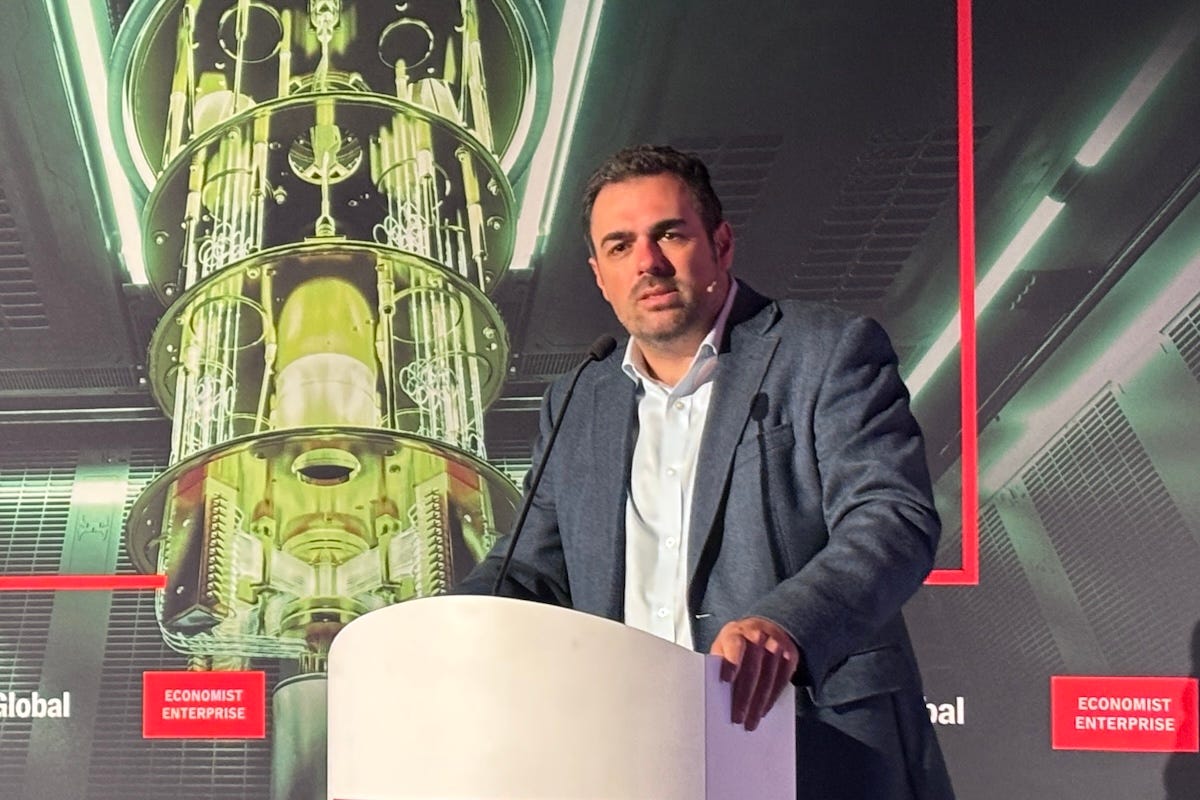
The odds of quantum computers cracking one of the internet’s most trusted encryption standards within a decade have jumped sharply in just a single year.
New estimates suggest it would take roughly 26,000 qubits to break RSA-2048, the encryption standard protecting much of the world’s financial data, down from earlier projections that ran into the tens of millions. The shift signals that a “cryptographically relevant” quantum computer may arrive well before many institutions are ready.
“PQC (post-quantum cryptography) and quantum-safe security is a very significant threat that quantum poses to all sectors, particularly financial services, which are top targets for cyber criminals,” said Philip Intallura, global head of quantum technologies at HSBC.
“There’s now a 38% chance of a quantum computer breaking RSA in the next 10 years, and that’s based on a survey of deep experts that runs every year,” he said. “That probability has increased 12 percentage points over the last year alone.”
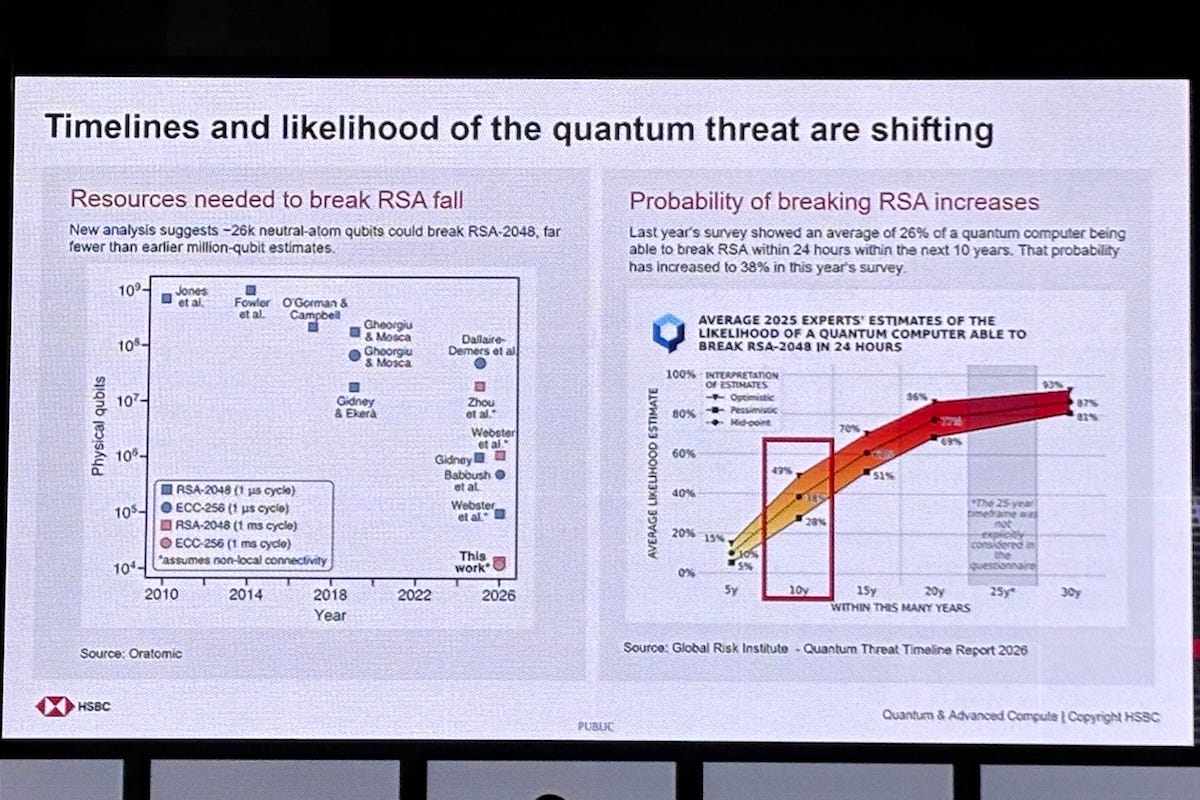
He said the qubits needed to break RSA-2048 have fallen from an estimated 20 million five years ago to the tens of thousands today, a shift he called non-linear progress in algorithmic efficiency.
The chart he presented used a logarithmic scale, meaning the real shift is steeper than the numbers first suggest.
“When you think about the consequence of not being able to keep customers’ data and payments secure, that is not a comfortable probability,” Intallura said. “A breach of security at our bank would result in a catastrophic loss of confidence from our clients.”
He said he was glad HSBC started work on the cost of quantum-safe security four years ago, rather than only beginning now. He focuses on a 10-year horizon, roughly how long a bank HSBC’s size takes to modernize its cryptography.
He added that some qubit architectures remain far harder to build than others, so falling counts alone do not fix an exact date, and noted the same warning had been raised earlier at the conference by Lord Holmes.
HSBC has run a dedicated quantum technology group for nearly five years, spanning work in trading, security and tokenization. Intallura said the case for taking quantum seriously is far easier to make today than when he started, given how quickly the numbers have moved.
Proof already paying off
His remarks came during the Commercialising Quantum Global 2026, organized by Economist Enterprise, in London. The session explored how industries can capture near-term value from quantum without waiting for fault-tolerant machines.
One example: a pilot HSBC ran with IBM last year on algorithmic trading to price corporate bonds.
“If you price too aggressively, you’re likely to win the trade, but it costs you margin,” Intallura said. “If you price too conservatively, you won’t be competitive, so you won’t win the trade.”
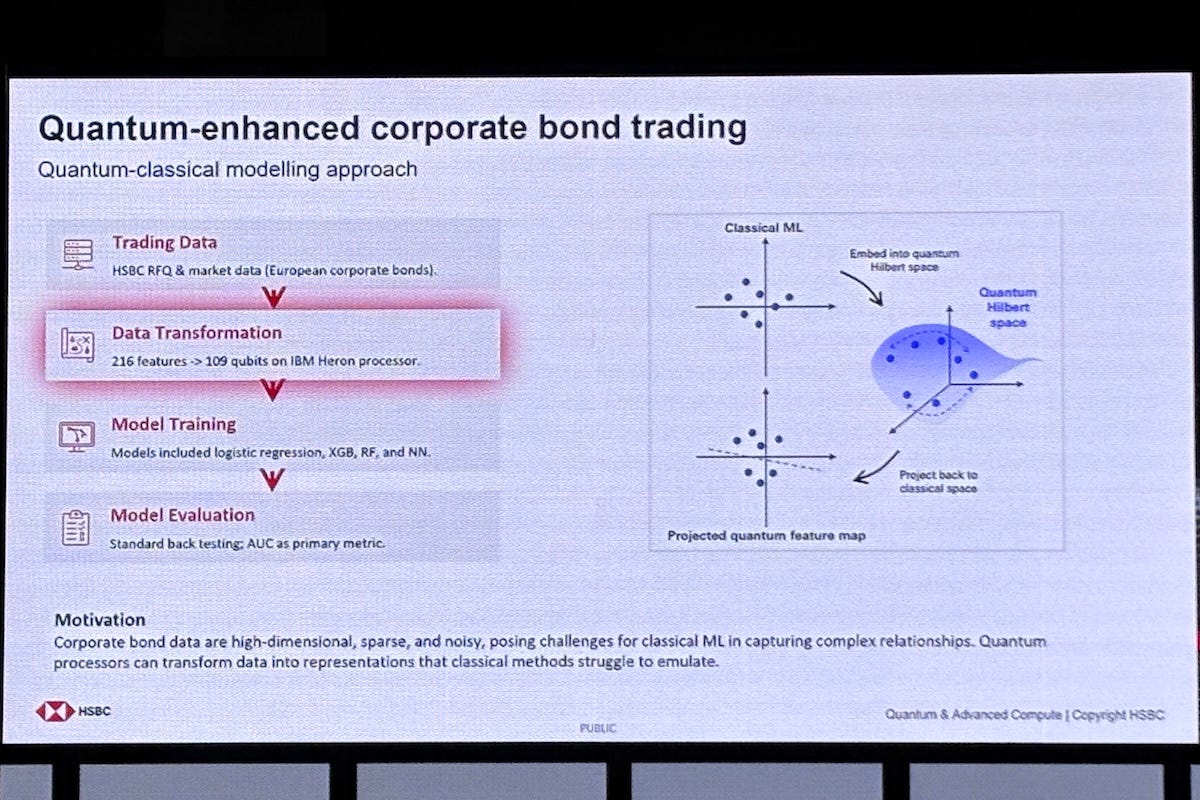
The pilot applied quantum machine learning to the feature-generation stage of the pricing model. It condensed 216 classical features into 109 qubits run on an IBM Heron processor, before feeding the results into classical models including logistic regression, XGBoost (eXtreme Gradient Boosting), random forest and neural networks.
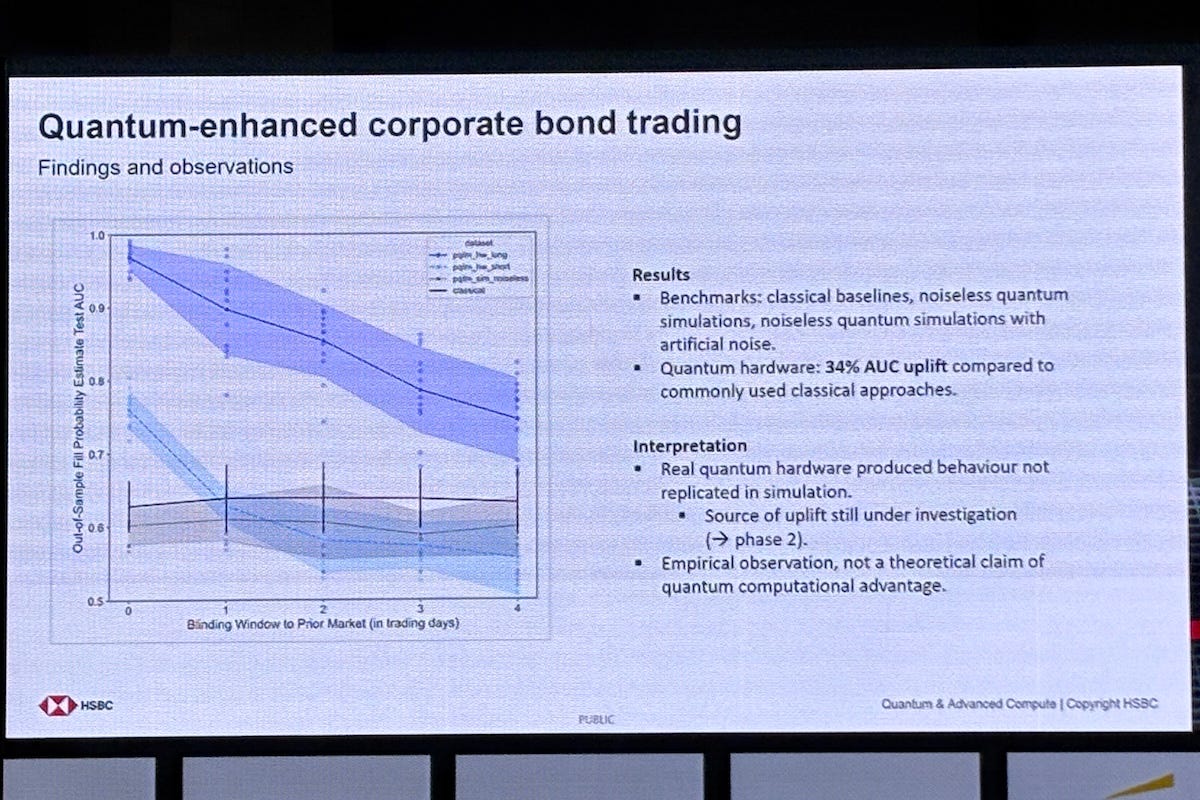
The approach delivered a 34% uplift in accuracy on real quantum hardware compared with classical methods.
“This is not a claim of quantum advantage; it’s a claim of beating models that we’ve already got,” Intallura said. “What was interesting is we used a real quantum computer with a real data set at production scale.”
HSBC called it an empirical finding, not a theoretical claim of quantum advantage.
The result decays over time and needs retraining, though it continued to beat HSBC’s classical baseline for a few days even without fresh data. Intallura said the bank is now in an early phase of building a pilot that touches its live trading systems, extending the work beyond the initial proof of concept.
“Quantum is becoming a useful tool in the toolbox as we develop these types of models within the bank,” he said.
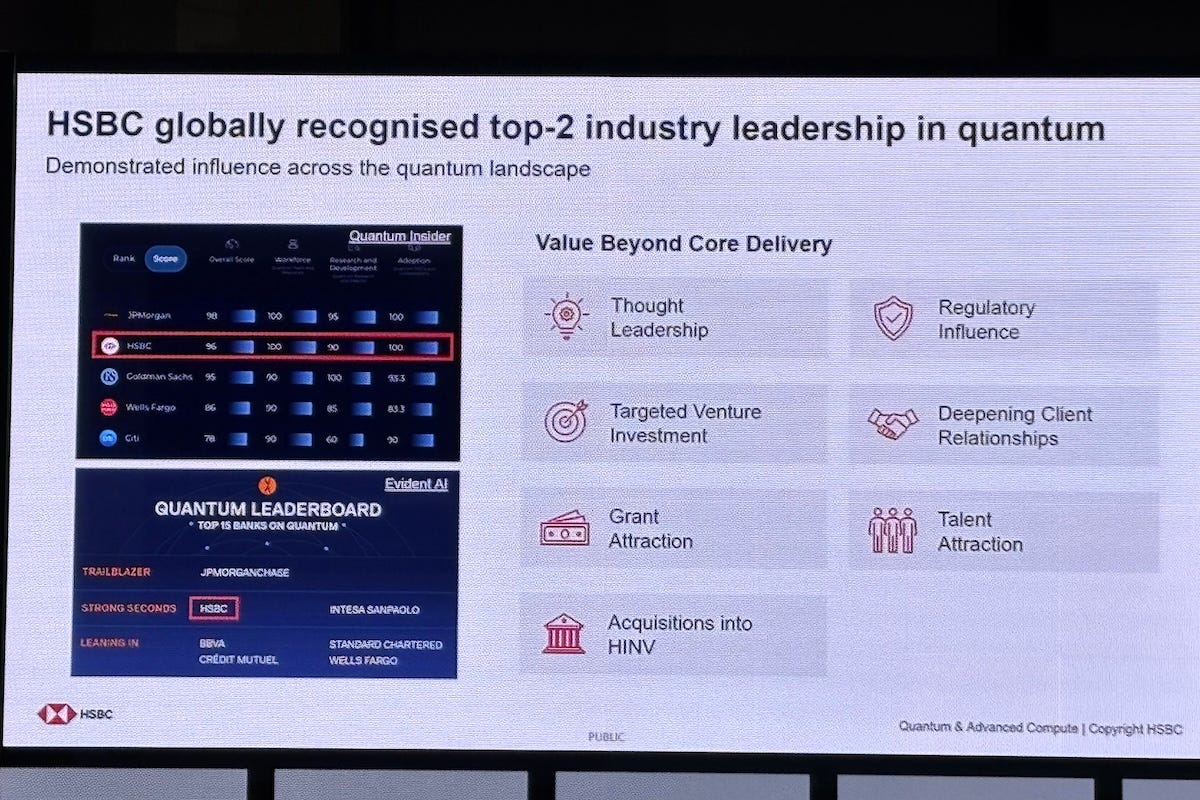
HSBC’s quantum credentials extend beyond a single pilot, ranking second among banks on the Quantum Insider’s index.
Behind only JPMorgan Chase, it ranked ahead of Goldman Sachs, Wells Fargo and Citi. On Evident AI’s Quantum Leaderboard, HSBC sits among the “strong seconds,” behind trailblazer JPMorgan Chase.
“HSBC is positioned very well in those rankings, and it’s not because we’ve ever demonstrated quantum advantage,” Intallura said. “That generates a lot of brand value for us. And it is absolutely not true to say that there is no return on investment, near-term return on investment, from quantum.”
He pointed to grant access as an end user in startup-led experiments, and to requests from relationship managers serving HSBC’s largest corporate clients who want to learn from the bank’s quantum program as they build their own.
“The most tangible benefit is acquisitions into HSBC Innovation Banking,” he said. “We attract hundreds of millions of dollars into our innovation bank through quantum and innovation startups that have raised Series A, B or C funding and have global banking needs.”
Betting on early movers
The scale of the wider opportunity adds to the urgency. McKinsey estimates quantum adopters could unlock $1.2 trillion to $2.7 trillion in value over the next decade, with financial services capturing $400 billion to $600 billion of that.
“There is value to be captured,” Intallura said. “Financial services is one of the top beneficiaries of that value.”
“Our bias has been over the last four years to what can we do with quantum technologies of different flavors, like annealing, simulation or tensor network elements,” he said. “What we’re trying to do is not achieve quantum advantage, but achieve marginal commercial advantage by beating models we’ve already got.”
He said that approach builds organizational readiness, demonstrates real progress rather than a research paper about the future, and keeps investment flowing toward eventual fault-tolerant systems.
“Quantum doesn’t solve everything,” he said. “It’s a very narrow sliver of problems that it can help accelerate and improve.”
He said building a quantum capability inside a bank starts with assembling a team, a strategy and funding, before any project begins. From there, a project moves through:
Business engagement, to understand the computational challenge
Problem identification and scoping, including whether quantum can help at all
Data identification, sourcing the right data to use
Vendor selection and procurement
A pilot touching production systems, if the business case holds up
“It’s materially easier to make the argument for quantum investment now than it was five years ago, when I got a lot of strange stares given the state of the technology at that time,” he said.
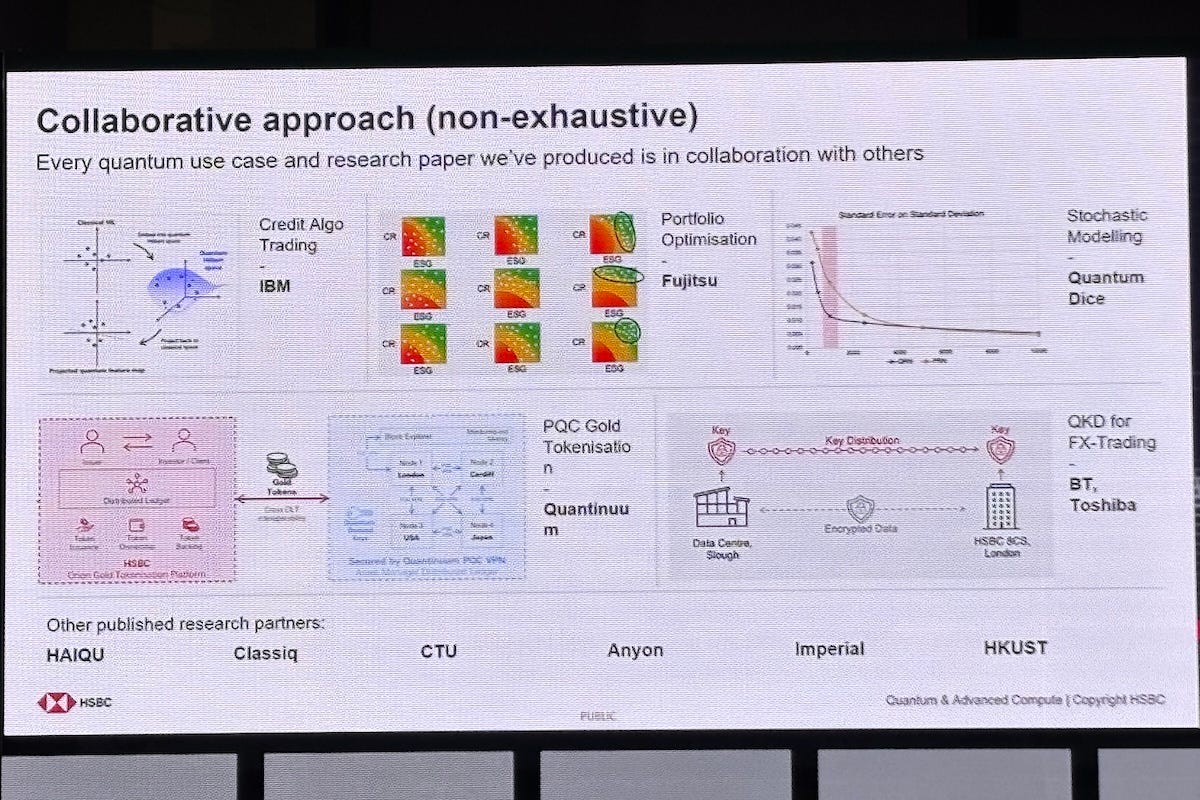
Every quantum use case and research paper HSBC has produced has involved a different partner: IBM on algorithmic trading, Fujitsu on portfolio optimization, Quantum Dice on stochastic modeling, Quantinuum on gold tokenization, and BT and Toshiba on quantum key distribution for foreign exchange.
Research partners also include HAIQU, Classiq, CTU, Anyon, Imperial College London and the Hong Kong University of Science and Technology.
“No one can do this alone; it’s an ecosystem of collaboration,” Intallura said. “We’ve even done work with regulators and government, so we’re in this together.”
That scale of investment comes wrapped in some of the tightest export controls of any emerging technology.
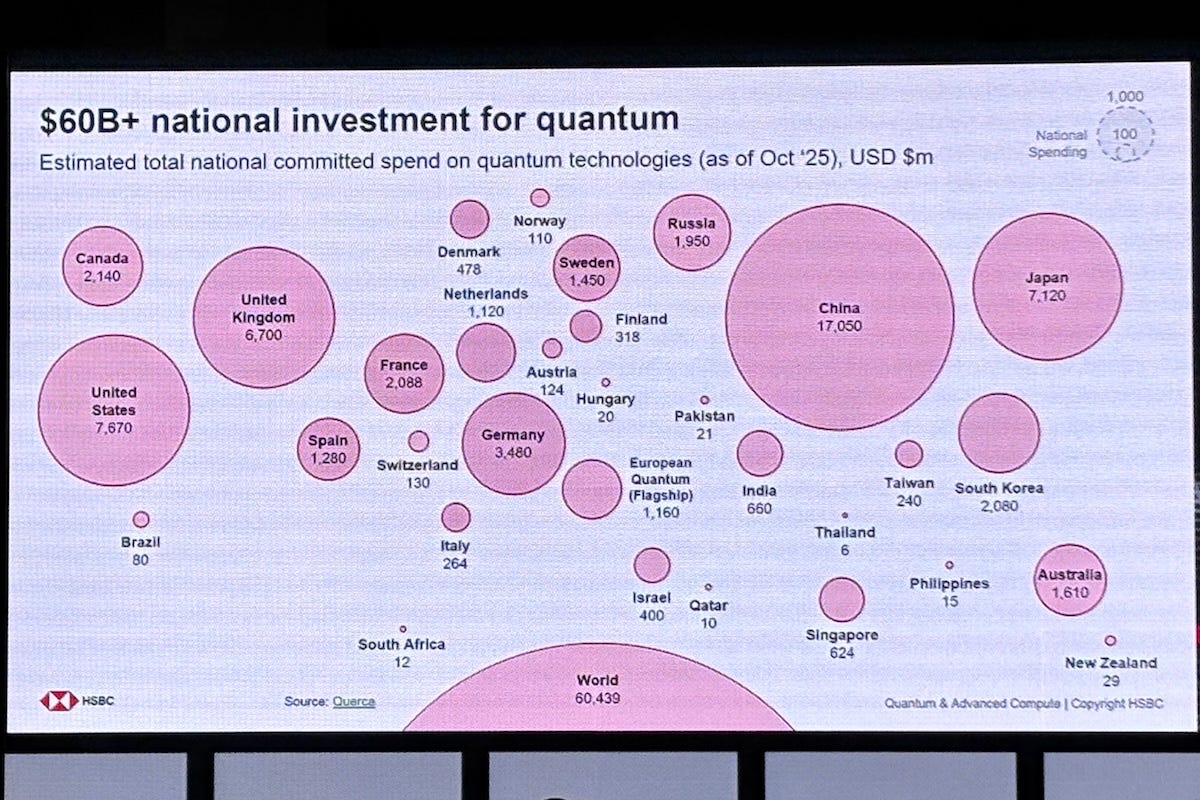
Global committed spending on quantum technologies topped $60 billion as of October 2025, led by China at $17 billion, the United States at $7.7 billion, Japan at $7.1 billion and the UK at $6.7 billion, underscoring how much government money is now chasing the technology.
He pointed to the Quantum Growth Alliance, announced the week before his talk by UK Science Minister Lord Vallance, as one of the clearest signals yet that end users are organizing around the technology.
Founding members include HSBC, Barclays, Standard Chartered, GSK, BP, Rolls-Royce, BAE Systems, BT, Vodafone and QinetiQ.
“This is one of the strongest signals we’ve seen to date in trying to build up the end users, large UK, globally recognized leading institutions, getting together and working out how we, as a group, are going to have a pathway to use the technology,” Intallura said. “In quantum, the winners will be the organizations that move before they have to.”
HSBC’s own pilots remain in an early phase. Intallura said the next milestone is pushing the bond-trading model into systems that touch live trading, while the bank continues preparing its cryptography for a decade-long migration to quantum-safe standards.