


The UK's quantum sector has moved from scientific promise to commercial delivery. After more than a decade of research investment, the government is now focused on a harder challenge: getting quantum technologies out of the laboratory and into real-world use.
The practical applications are concrete. Lord Vallance, Minister for Science, Innovation, Research and Nuclear, cited drug discovery, sensing minute changes in the body, energy optimization and supply chain transformation as problems that quantum could solve and that are genuinely beyond the reach of today's technologies.
“We’ll be launching a £33 million call to directly support the development of quantum computing supply chains here in the UK, and a £13 million call on software. This isn’t just about hardware. It’s about software solutions, error correction, industrial readiness of the entire system and, often forgotten, data readiness,” said Vallance.
"I am pleased to announce the launch of the UK Quantum Standards Network (QSN), led by the National Physical Laboratory, and supported by £10 million of government funding. This will be the UK central hub for quantum standards," he said at the June 16 event.
The QSN is described by the government as the world’s first national framework of its kind. Partners include the British Standards Institution (BSI), UKQuantum, the National Quantum Computing Centre (NQCC) and the National Cyber Security Centre (NCSC). Its purpose is to ensure quantum systems can be tested, benchmarked and integrated so they work together and can be deployed reliably.
“Standards must be shaped by the sector itself. Whether you are in industry or academia, this is your opportunity to help define the frameworks that will underpin global quantum markets,” Vallance said.
On the sensing side, a £32.8 million competition to support quantum sensing and position, navigation and timing (PNT) supply chains opened the previous week. Vallance also announced a further £14.3 million research and development call focused on quantum sensing missions, due to go live in July.
UK Research and Innovation (UKRI) has issued an additional £238 million in funding calls for quantum research this year, alongside long-term commitments to the National Quantum Computing Centre through a 10-year program designed to support initiatives requiring an extended outlook.
Procurement drives demand
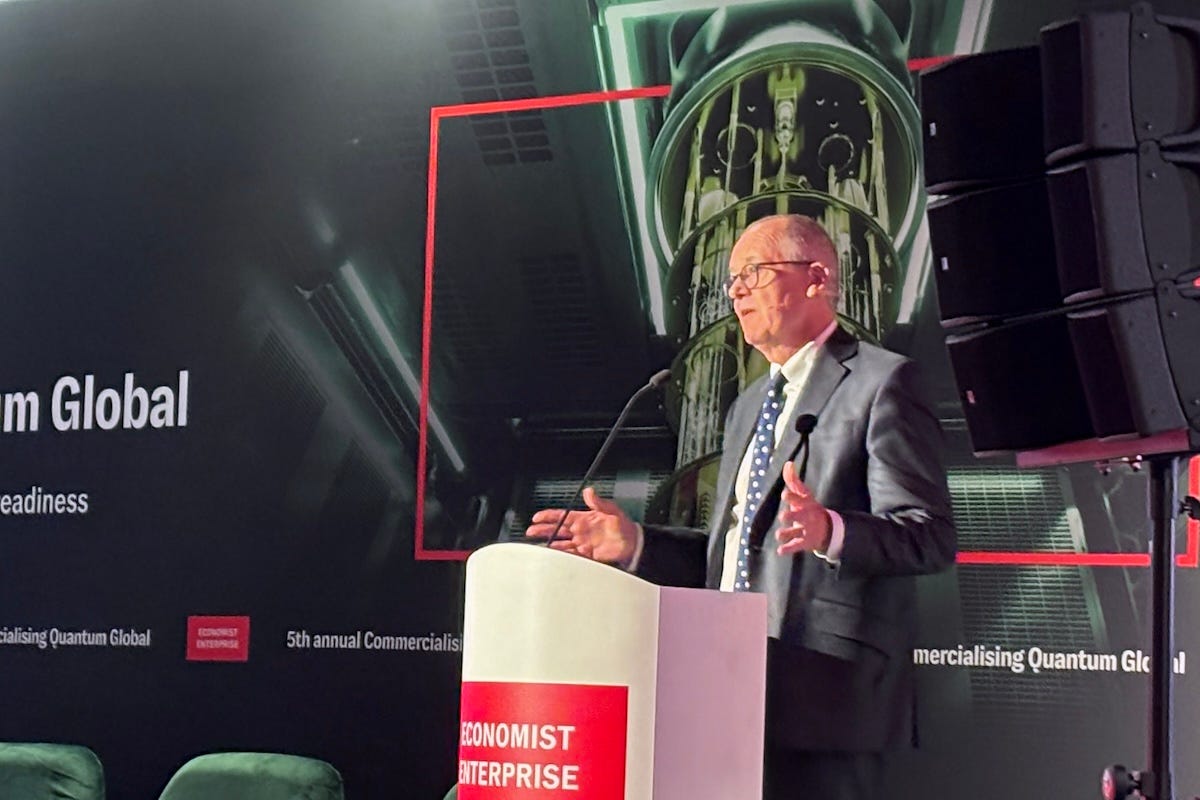
Vallance was speaking at Commercialising Quantum Global 2026, organised by Economist Enterprise and held in London on June 16. His address covered the full breadth of the UK’s quantum strategy, from infrastructure investment and procurement to demand creation and international standards.
As Minister for Science, Innovation, Research and Nuclear, he oversees the government’s quantum and fusion programs and has been central to shaping the UK’s national quantum strategy.
“We launched this year Procure, our flagship quantum computing program, culminating in a procurement commitment of up to a billion pounds to target large-scale quantum computers by the early 2030s. If we can do it sooner, so much the better,” Vallance said.
The programme was already generating tangible market impact, with companies announcing major funding rounds and investment decisions in the UK on the basis that the government would be an early customer. Not every organisation would buy a quantum computer on day one, but access to one would be essential.
At London Tech Week on June 9, the government launched a £12 million fund focused on hybrid quantum computing algorithms that combine conventional and quantum computing approaches. It also announced the Quantum Growth Alliance, bringing together 10 major industry players from financial services, life sciences, energy, defense and telecoms to define real use cases and accelerate the pathway from innovation to adoption.
Vallance said the Alliance brought together companies like HSBC, Barclays, GSK, BP, Rolls-Royce, BAE Systems, BT and Vodafone not as observers of quantum but as its future users: the organizations that would deploy these technologies at scale across the economy.
By engaging future users now, the government hopes to define real use cases and accelerate the pathway from innovation to adoption. Supply alone is not sufficient for the sector to scale, Vallance said. Clear, credible demand signals from potential customers are equally critical.
Investment follows ambition
The QSN’s technical scope is broad. It will oversee specifications ranging from the linewidths of ultra-narrow lasers used to control qubits inside quantum computers to the size, weight and energy-efficiency requirements that ensure one quantum sensor’s readings can be trusted against another’s.
“Its purpose is simple: to ensure that quantum systems can be tested, benchmarked and integrated, so that they work together and can be deployed at scale. That matters for confidence, it matters for interoperability and it matters for enabling UK companies to compete globally,” he said.
International confidence in the UK’s quantum infrastructure is already visible. American quantum component manufacturer Vescent recently selected the National Physical Laboratory (NPL) as the location for its first office outside the United States, citing the UK’s emerging standards ecosystem.
The UK ranks second globally for the number of quantum companies and levels of private investment and is home to three of the top five quantum clusters worldwide. More than 12 years of sustained public investment through the National Quantum Technologies Programme (NQTP) has built capability across computing, networking, timing, imaging and sensing.
Vallance said scaling quantum deployment was a challenge relevant to many sectors, with the private sector now expected to take the lead in ensuring quantum companies not only start in the UK but scale and remain here.
“The task now is very clear: it’s to translate that strength into real economic and societal impact, and to do that quickly,” he said.
Private investment is following the government’s lead. Oxford Quantum Circuits (OQC) closed a £260 million Series C in June 2026, Europe’s largest ever private funding round for a quantum computing company, with participation from the British Business Bank. Quantum Motion raised $150 million and US firm Rigetti committed $100 million to expand its UK presence.
Vallance declined to put a precise timeline on when quantum would become mainstream but said the direction of travel was no longer in doubt. His ambition is to make the UK the place where quantum moves fastest from ideas to impact, delivering long-term growth, resilience and benefits across the economy.