


Companies deploying humanoid robots in warehouses and factories still haven't decided who owns the data those machines generate or the smarter robots they produce.
As pilots turn into full deployments, data captured when robots stumble has become the most valued training material.
“I don’t believe the entire industry has figured out who owns the data. Is it the customer, the operators or the robotic company?” said Nizar Trigui, chief technology officer of GXO.
“Right now we are willing to share data because we have an interest that the model is working well for us. But at some point in time, we want to be in a place that we can use our data to improve the model further for us,” said Patrick Lanners, innovation and AI lead at BMW Group. “Otherwise, we are just training the model for all our competitors as well.”
Trigui said GXO has deployed humanoids at seven sites for more than two years, working mainly with startups. Under current contracts, customers own their data. He said the best training material comes when the model is uncertain and a person teaches it.
“You teach one robot, but the entire family is learning at the same time. So it’s highly valuable,” he said. “As we move from proof of value into full deployment, we need to figure this part out and understand who owns the data.”
GXO plans to announce that move to full deployment by the end of November.
Lanners said he often hears debate over how much data BMW should share with frontier model providers. The more manufacturing data these models contain, the easier it is for BMW to adapt them, but the point at which it stops sharing has yet to be defined.
“If we are not able to use our data for our own purposes and we’re just training for everyone else as well, the question is really where’s our competitive advantage? Where can we be better in building cars than everyone else?” he said.
Christina Yan Zhang, chief executive of The Metaverse Institute, said nobody yet knows whether model providers will later use shared robot data for other commercial purposes. She said some enterprises are responding by building their own specialized small language models.
Open-source world models offer another route, such as Meta’s 8-billion-parameter RoboJEPA, released on October 8.
“Maybe the future is all about how we can use open-source models to provide support on the very specialized industrial robotic data we are training to serve our industry better. So we don’t need to worry too much about the data’s final ownership,” she said.
“The software and the model without the experience and the data are useless. The combination of both gives you only then the real power,” said Radosław Nowak, managing director for fast-moving consumer goods and supply chain at Greenyard.
Outcomes nobody recorded
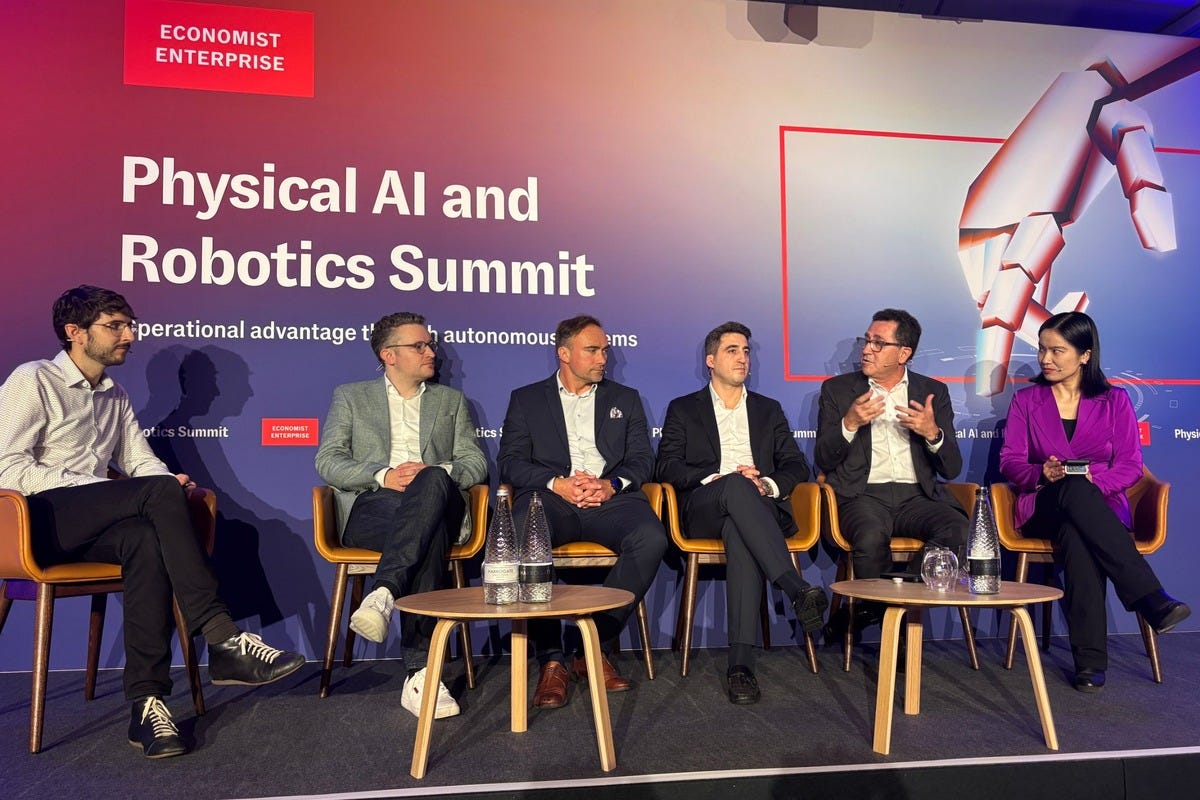
The comments came at the Economist Enterprise Physical AI and Robotics Summit, organized by Economist Enterprise in London on October 13. Alex Hern, AI writer at The Economist, moderated a panel on how to gather data good enough to train robots.
Lanners said BMW began work in 2025 on vision-language-action models, but the data its factory robots already produce is of little use for training them.
Trigui said crushing a box, or packing an item so the lid won’t fit, counts as a failure.
“Robots are not going to learn from visual; they need to experience it. So you need the context, and more importantly, you need the outcome. The outcome is the part that’s very difficult that we’ve never collected before,” he said.
Nowak said companies spent years collecting information-flow data, such as forecasts, demand and point-of-sale figures, which is already well automated. Robots instead need to know how much force to press a box, and no company system stores that.
Sertac Güzel, head of robotics, digital and specialty at Johnson & Johnson MedTech, said surgeons still learn by seeing one, doing one and teaching one, and AI can shorten those learning curves by identifying anatomy and tasks.
“There is still a lot of transferable know-how. When you think of surgery, you can think of it as a very underdeveloped space from a technological adoption standpoint,” he said.
Trigui said the best results come from combining data types, an approach borrowed from autonomous-vehicle programs:
Real-world data comes first
Teleoperation then lets humans handle exceptions
Synthetic data fills in permutations nobody has observed
“You can build those synthetically, but the basis has to be the on-the-floor learning and understanding the perception and the outcome,” he said.
Güzel said surgical teams can study the operating room, patient anatomy and different approaches long before choosing any hardware.
“You could create the digital twin of the OR (operating room) and the procedure that’s going to be able to optimize the interventional approach for the robotics. So all of this you can do without a robot in the room,” he said.
Lanners said robot-collected data, from teleoperation and offline or online reinforcement learning, gives models the clearest signals, while egocentric and simulation data may help close the gap.
“We all learn right now what is the right amount of data and what are the different types of data. We haven’t figured it out fully, because if so, we would have these already in production,” he said.
Zhang said the largest open robot dataset, built by Google DeepMind with dozens of institutions, holds about 1 million episodes, while text models train on tens of trillions of tokens.
She said training costs for robot data have fallen from about $300 an hour to about $100 in two years.
But she said off-the-shelf generated data does little for regulated sectors such as healthcare, automotive and defense, which need physics-based data that complies with their rules.
Sorting avocados by algorithm
Greenyard buys and trades fruit and vegetables worldwide from growers with different standards.
Nowak said its sorting machines photograph each fruit 80 to 100 times and compare it with a reference image for mold, rot and color. Retailers demand different avocado shades, and the images settle disputes with quality-control staff.
“Imagine that you have a new employee, or you do this manually. It’s very subjective,” he said. “The learning is happening already after a few hours. I think the software can beat very experienced people who are doing this for many years.”
Car making sits at the other extreme. Lanners said BMW’s paint and body shops are already highly automated, but assembly and logistics are not, because the tasks are too complex.
“Where your part is not always in the same position, typically old classic automation fails. There we see still a lot of potential,” he said.
Güzel said sharing should rise in levels:
Common standards and language at the bottom
Data shared with customers and developers
Data shared across industry players
Shared models
“If you truly want to make a difference, then you need to be bold about this sharing idea,” he said. “We are sitting down with other industry players to at least align on the standards, which will leapfrog innovation.”
Trigui said sharing will start with common ground such as taxonomy and safety.
“The operational specifics for manufacturing and logistics, that’s the IP (intellectual property) that each company has, and that’s our comparative advantage. So I doubt that there will be a marketplace for that,” he said.
Nowak compared future robot standards to the EuroPallet, whose fixed dimensions make logistics easier for everyone, and said robots will need common standards to communicate with each other.
Zhang said the robotics industry needs a minimal interoperable mechanism, similar to the standards set by the International Telecommunication Union, that defines the minimum data automotive, healthcare, logistics and defense firms can share. She said that would move the industry forward and lower training costs.
The panel also weighed whether the firm with the most data will simply build the best model.
“Why is Reddit the most important data that helped the LLMs (large language models)? It’s that little thumbs up or down, because that gives you the feedback mechanism and gives you an outcome of people accepting those results or not,” Trigui said.
He said task-specific models fitted to each operation will scale first, before the industry eventually relies on generic models with broad perception and execution skills.