


Demand from artificial intelligence (AI), chip and defense companies is turning smelter by-products such as germanium and indium into strategic metals in short supply.
These metals go into fiber optics, silicon photonics, infrared and targeting systems.
“It began originally with people that were just consuming finished metal, but now it is fiber optics manufacturers, AI and semiconductor users, large defense primes, all of which are far more interested in this industry than they have been,” said Ian Anderson, executive vice president and chief commercial officer of Teck Resources.
“We’re having semiconductor manufacturers come to us, particularly interested in indium and silicon photonics. That landscape has changed. It’s wider and more nodes down the chain than it has been traditionally, and the awareness is very high,” he said.
Teck is the largest germanium producer in the West, and its Trail smelter in British Columbia, North America’s largest integrated lead-zinc smelter, also produces indium, antimony and cadmium. Anderson said the fiber-optics industry faces a severe shortage of germanium tetrachloride.
He cited Nvidia’s investment in Corning as an effort to lock up fiber-optic supply over the long term. The US chip giant put $500 million into the glassmaker in May to expand fiber production for AI data centers.
He said buyers face shortages now and expect them to last.
“What they’re looking for is a trusted, high-quality producer who behaves the right way, who’s deeply engaged in transparency and producing sustainably, but also someone they can trust for the long term,” Anderson said. “That’s the space the game is played in, as opposed to just a commodity market.”
Matt Hadfield, head of metals and minerals assets at commodities trader Trafigura, said its zinc smelting arm Nyrstar is putting such metals at the center of its plans in Europe and Australia.
“Those critical metals come in today in the raw material that the smelters process. Some of those smelters don’t recover those, so they end up in waste,” he said. “If you want to have these critical minerals processed and available in your country, you need to invest and support the processing capacity you have today.”
He said Nyrstar’s French smelter has produced indium since 2009, and its European plants could also recover germanium, antimony and bismuth. In Australia, antimony and germanium projects are under development as part of a possible rebuild.
In July, Teck signed an agreement with the Canada Growth Fund for an investment of up to C$400 million at Trail. Anderson said the money would mainly expand germanium output, and that customers are keen to back such capacity through long-term purchase agreements.
A national security question
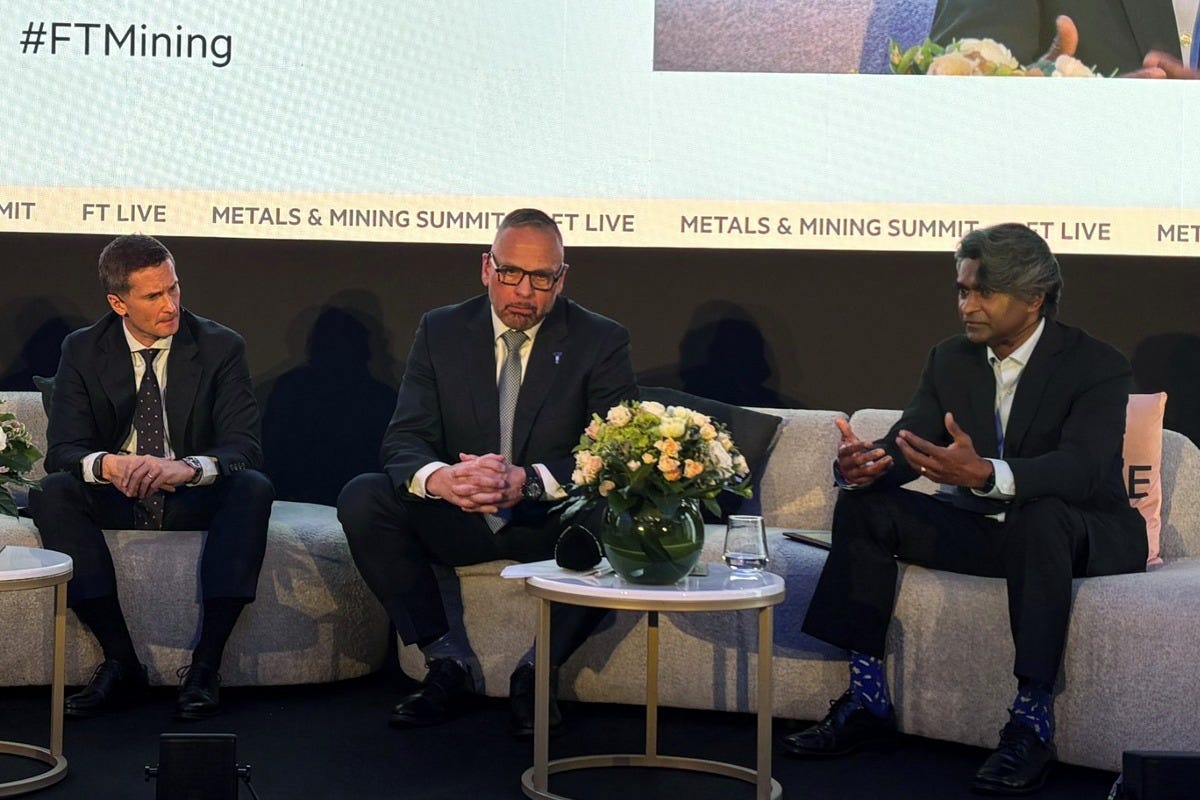
The comments came at the FT Metals & Mining Summit, organized by FT Live in London on October 15, during a panel on smelting and energy costs. Camilla Hodgson, commodities correspondent at the Financial Times, moderated the panel.
The panelists offered different cases for why governments should support smelters.
“It’s an aspect of national security. If countries want to retain the processing capacity within their countries, there needs to be the support structure in order to create a level playing field,” Hadfield said.
He said governments must provide the policy and funding to make smelters globally cost-competitive.
“I would challenge both governments and capital markets to think about investment in processing capacity in a way that doesn’t focus just on individual returns for that specific asset,” Anderson said.
He said that approach is fundamentally wrong if Western smelters are to compete globally. Governments should first support the mines that feed smelters, through faster permitting and investment in rail and terminals. He said China builds smelters close to supply, refineries and grid infrastructure in a hub-and-spoke model.
When judging whether state support is sustainable, governments should weigh what is lost by not acting rather than whether a single smelter can stand on its own, he said.
South Africa once lacked the power to run its smelters but now has a surplus.
Agit Singh, executive head of processing operations at South African platinum group metals (PGMs) producer Valterra Platinum, said cost is the next challenge, and the government is working with industry on renewables.
“That partnership between government and the private sector is what makes the difference,” he said. “Once we understand each other, what our concerns are and what it means for the country, there is a collective understanding that this is going to benefit all of us.”
He said producing green metal is costly because green energy must run through the whole value chain.
“If we want to compete on the playing field on the basis of equality, then every metal needs to be faced with the same stringent requirements,” he said.
Hadfield said Europe is the region hit hardest by energy costs. Power prices in the Netherlands and Belgium are approaching €200 per megawatt hour (MWh), up to four times what other regions pay, as the Middle East crisis drives up gas prices.
“Historical European power prices were something in the range of around €50 per MWh. We’re now looking at €200 per MWh in the forthcoming months,” he said.
He said grid connections in the Netherlands cost four times as much as in Belgium. Nyrstar is reviewing the future of its Budel zinc smelter in the Netherlands, which can produce 315,000 tonnes a year. Hadfield said he met Dutch ministers in The Hague two days before the summit.
“They’re taking the issue very seriously and doing everything that they can within their power to be able to alleviate some of the cost issues,” he said.
Protect what exists
Panelists agreed the West should protect existing smelters before building new ones.
“From a Western perspective, the first priority needs to be protecting what already exists today. Building a new smelter and refinery is an extremely costly and time-consuming exercise,” Hadfield said.
He said no new zinc smelter has been built in the West since 1999, while China has added nearly 2 million tonnes of capacity. He said adding units to recover critical metals at existing smelters is the most efficient way to bring them to market.
Anderson agreed, saying national interests will inevitably focus on supply security and little can be done about global overcapacity. Existing smelters are the natural place to lift output and upgrade technology.
“We have to be focused on brownfields [existing sites]. What we have has got to be full,” Singh said. “The best way to run a smelter is full. If we get half-full smelters around the world, it is going to be a nightmare with regard to costs.”
He said PGM smelting capacity is already sufficient on paper, so consolidation is needed.
“If you directly take everything you’ve got coming out of a mining operation, concentrate it and bring it to the smelter, your efficiencies will be extremely low and your energy costs will be astronomical,” he said.
Valterra consolidated its own smelting about three years ago and cut waste by about 10% by rejecting it before smelting. About 30% of its power now comes from renewables.
Singh said energy costs were not going away, so the company had to work from that basis.
“It’s not just about moving commodities around. These are supply chains that function together, and that is fundamentally how the market is changing,” Anderson said.
He said a small mine ramping up can strengthen its investment case with a 10-year agreement to sell its output to a nearby smelter, and customer prepayments are becoming longer-term. Recycled feed will also grow, with suppliers offering slags and residues smelters can use quickly.
Singh said buyers are not yet paying premiums for greener metal, but he expects them to.
Hadfield said EU policy on critical metals is moving in the right direction but now needs funding, and member states can currently move faster than Brussels.