


Western governments can cut their reliance on Chinese rare earths for artificial intelligence (AI), cars and defense, but only if they fast-track new processing plants.
China mines about 60% of the world’s magnet rare earths, refines more than 90% of them and makes almost 95% of permanent magnets, according to the International Energy Agency (IEA). Breaking that grip has become a priority for Washington since Beijing began restricting rare earth exports.
“It can be done, but the thing you have to realize is the situation we are in today developed incrementally over a period of years. You just cannot create a new ecosystem around rare earths by way of magic wand,” said Jim Rutherford, non-executive director of Ionic Rare Earths.
“When you’re staring at the possibility of your car industry and your defense industry being shut down within six months, it does tend to focus the mind.”
He said the US government had woken up to the problem. At the BMO mining conference in February, he lost count of how many US government departments were present, all seriously seeking investment. He said the Trump administration had brought heavyweight business experience into government to drive the effort.
Rutherford said Western miners had made a rational choice to put their capital upstream. Further down the chain, the capital employed rises while the economic rent shrinks, and winning environmental approval for a smelting and refining operation can take years.
Asked whether breaking the dependency could take 20 years, he said the answer hinges on downstream processing.
“Unless something is done to shift and enable fast-tracking of a lot of downstream processing operations, it will take 20 years,” he said.
He said a conventional banker would hesitate to finance a rare earth project with opaque pricing, one dominant player and high volatility. That is where three tools come in:
Government underwriting
Strategic stockpiles
Minimum floor prices
Europe and the UK, including the UK National Wealth Fund, are catching up but need joined-up thinking, he said.
Rutherford separated such structural problems from war-related shocks. The Middle East conflict has squeezed fertilizer makers out of the sulfur market because copper producers need sulfuric acid, a dislocation he hoped would be temporary.
Asked by an audience member whether the Trump administration’s recent measures to build rare earth supply chains could deliver results within three to five years, Laura Konkel, senior counsel at law firm Akin Gump, said success would come down to the sheer number of deals.
“It’s a volume game. Not everything is going to work. But when you are investing in a significant number of companies in an industry, the statistical likelihood of success obviously increases,” she said.
She said it was now up to the industry to deliver on due diligence, project timelines and milestones.
Governments as anchor investors
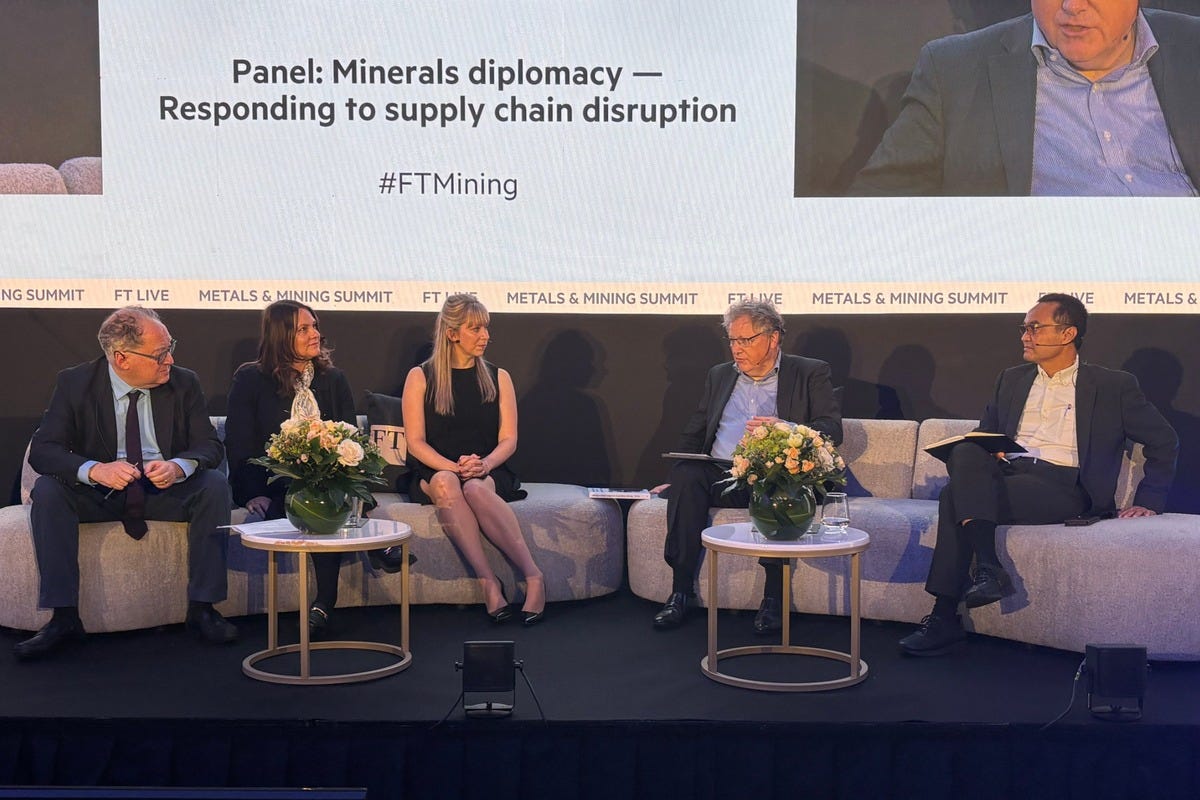
The panel discussion, titled “Minerals diplomacy: responding to the impact of war on trade and supply chains,” took place at the FT Metals & Mining Summit, organized by the Financial Times in London on October 15. Gideon Rachman, the newspaper’s chief foreign affairs commentator, moderated it.
Konkel said she does significant work for US government agencies active in the sector.
The Department of War’s Office of Strategic Capital alone can provide up to $100 billion in loans and guarantees for critical minerals, backed by a $500 million credit subsidy. The Export-Import Bank of the United States (EXIM) and the US International Development Finance Corporation (DFC) are also investing.
She said state money is now pulling in private investors, with $500 million of government debt sometimes matched by the same sum in private capital.
“No longer are governments just regulators. They are one of the anchor investors in the space,” she said. “The US government may ask for $500 million in private capital to be raised, and the crazy part about it is that they’re able to raise it. That’s how frothy the markets are right now.”
She said governments are also creating trading blocs through restricted-entity rules and offtake limits. Companies can raise money only from specific investors in specific countries, which can slow broader mergers and acquisitions.
Many of the people now driving these deals come from private equity and hedge fund backgrounds. The deals are publicly filed, and the government takes warrants and equity stakes to secure both upside and downside protection for taxpayers, something Konkel said had not happened before.
“They’re not just coming in saying let’s talk about a project. They’re saying let’s talk about a project, and what’s your ROI (return on investment)? There are no free handouts,” she said.
Rutherford said agencies such as the DFC had hired people who understand capital allocation and carry out serious due diligence. He added that the IEA’s estimate of $60 billion for rare earths alone shows why such large sums are needed once other commodities are added.
Kuswantoro Pranabudi, director of corporate strategy, business development and portfolio at Indonesia’s state-owned mining holding company MIND ID, said the shift is visible from the other side of the negotiating table.
“Five years ago, when we discussed with partners, normally they were asking about possible costs, what the grades are, and what the price is. Now it’s totally changing,” he said. “When we discuss with the potential partner, even before we talk about commercial terms, they ask about where the product is going to go.”
He said minerals have almost become a security issue over the past 18 months.
“We would like to be diversifying. We’d like to have our partners as long as this is mutually beneficial,” he said.
About a decade ago, Indonesia launched a policy to move beyond extraction into processing, and MIND ID, whose group includes Antam’s bauxite operations, has since expanded into refining.
Recycling as a shortcut
Rutherford said the panel had so far focused on primary supply, but a very substantial pool of rare earth material will come from end-of-life wind turbines and electric cars.
“Where the West does have an inbuilt comparative advantage, and has yet to be fully exploited, is on the recycling side,” he said. “With proper economic incentives and infrastructure put in place, the West could catch up more quickly in certain areas.”
Ionic Rare Earths plans to roll out its magnet recycling technology in Northern Ireland first, before scaling it to other countries.
Rebecca Tomkinson, agent general for Western Australia in the UK and Europe, said critical minerals do not follow traditional market mechanisms and must be approached differently as an economic concept. She said an F-35 fighter jet needs about 417 kg of rare earths and critical minerals, while a submarine needs four tonnes.
She said Western Australia is reindustrializing former industrial hubs, where communities already accept heavy industry and want jobs back.
“When we used to have a gallstone, we used to go in to extract that gallstone with open abdominal surgery. Today, you go in with a keyhole, and it’s a day procedure. Mining is the same,” she said.
In the Pilbara region, people living in the city remotely run mines 2,000 km away.
Tomkinson said the US has approached the state about projects, including Alcoa’s plan to produce gallium with US backing. Asked whether Washington wants Western Australia to do less with China, she said the new partnerships add to, rather than replace, existing trade.
“I don’t think any of us would be sitting in this room five years ago talking about the importance of gallium, yet that is how significantly those commodity mixes have changed,” she said.
Konkel said the minerals boom is drawing young people into sophisticated manufacturing jobs that they see as protected from AI because they are building the AI revolution. She pointed to North Carolina, where Vulcan Elements is building a magnet production facility with the help of tax incentives.
“You either grow it or you mine it, and so the first stop is mining and critical materials for the AI revolution,” she said.
She said private equity and hedge fund figures, such as the founders of MP Materials, are helping to kickstart the industry, while strong environmental and social protections in countries such as Canada and Australia mean people will not allow past harms to be repeated.
Tomkinson said aging smelters and other infrastructure need reinvestment, and the required capital will mean governments and companies work in partnership so new supply comes online as quickly as possible.