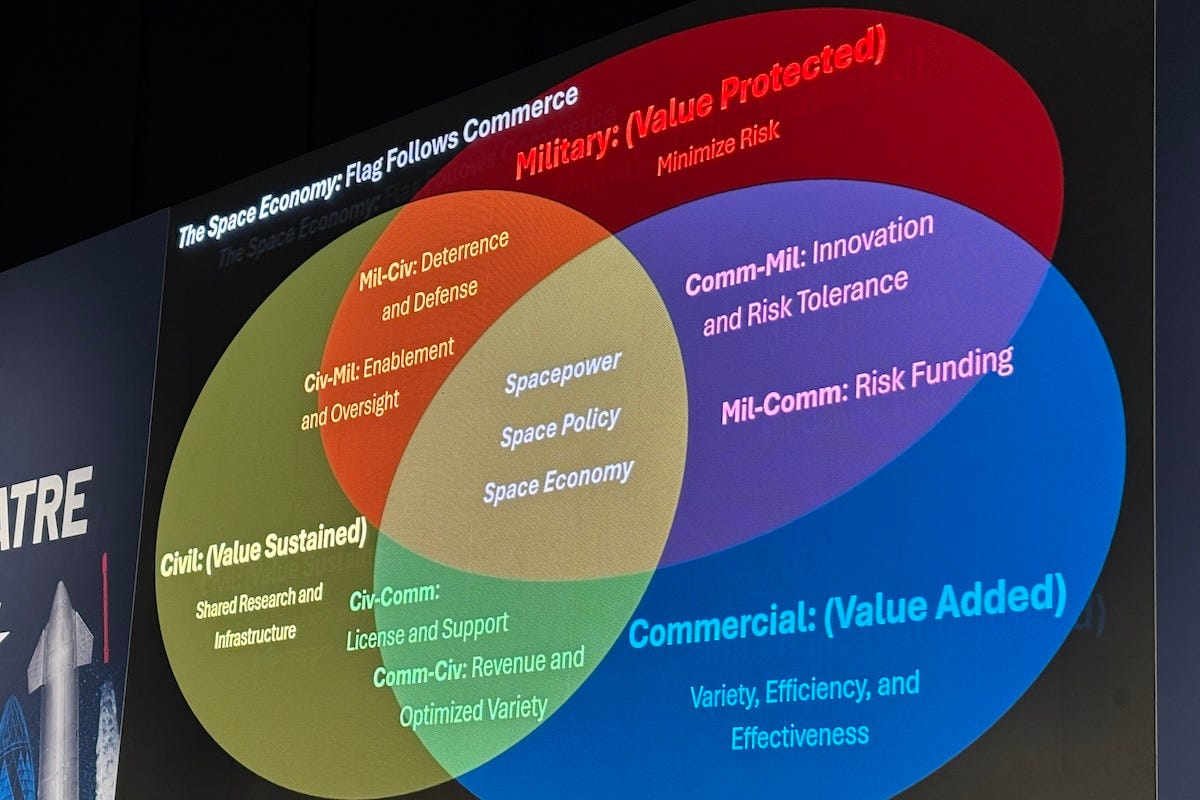
Orbital waste disposal could become one of the space industry’s most profitable new businesses.
The problem it would solve is already large. The world stores nuclear and toxic waste in containers known to leak, with new orbital and lunar disposal methods now under discussion.
“The world spends about $50 billion a year just storing nuclear and toxic waste, and we’re doing it in containers that we know are going to leak, and many are leaking already,” said Everett Dolman, professor of space strategy at Johns Hopkins University’s School of Advanced International Studies.
“We can put these in 55-gallon drums and push them into the sun to be disposed of forever,” Dolman said.
One engineer he knows has proposed an alternative, storing the waste on the moon instead, in case a use for it is found later.
Progress on this front depends on breakthroughs still working their way through the space industry. Spacecraft remain constrained by what’s sometimes called “the tyranny of delta v” (or the rocket equation) in the industry: the energy required to change velocity or orbit, since a satellite’s lifespan is largely determined by how much fuel it carries.
“If we could come up with a different type of propulsion system, perhaps an electric engine, we might be able to start looking at constant propulsion,” he said.
Beyond propulsion, Dolman pointed to an unnamed development he called “technology X.”
What the breakthrough will be is impossible to predict, only that something transformative is likely within two years, he added. He named a space traffic management system as the most achievable near-term goal, given rising satellite numbers and growing orbital debris, and space-based solar power as already within reach.
“Can you imagine having free electricity that is green, not producing any pollutants and available free for the whole world?” he said.
Engineers have told him that capturing an hour of solar energy hitting Earth could power the planet for a year. Initiatives are already under way to put data processing centers in orbit, powered by solar energy, technology that could eventually beam power directly into existing electrical grids on Earth.
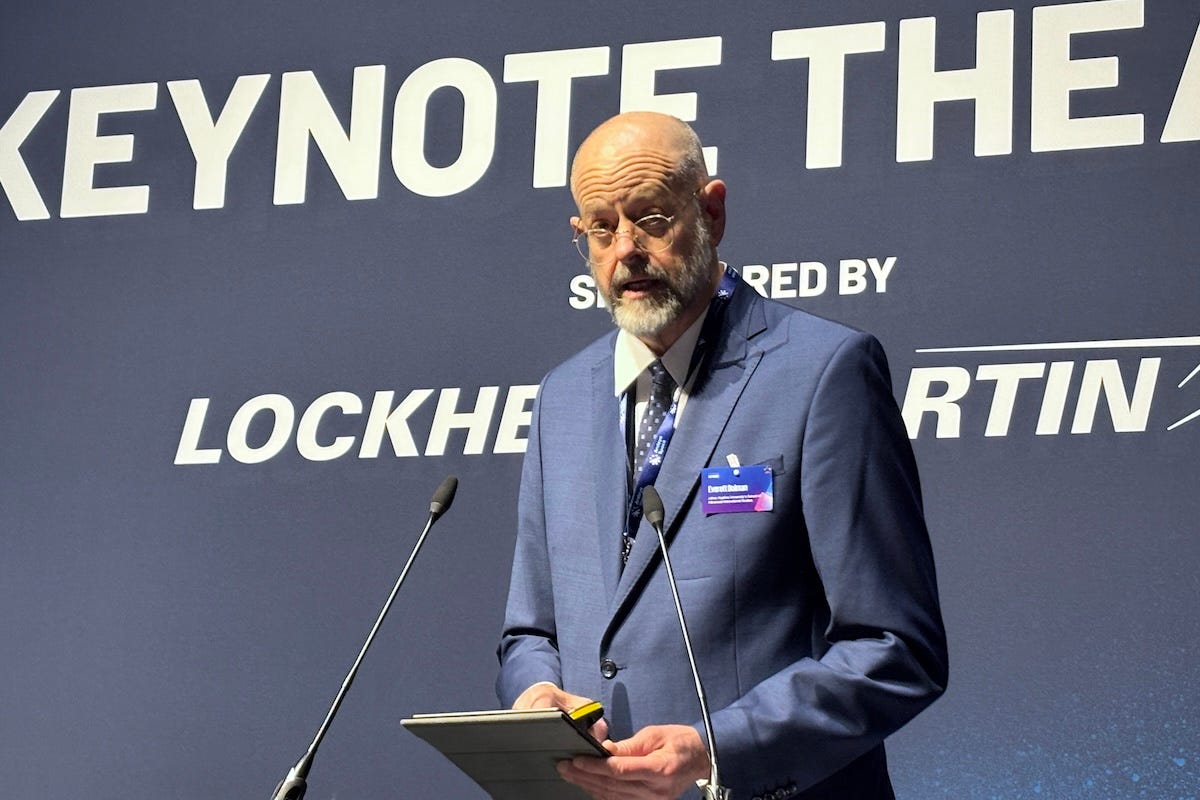
Dolman, who began his career as a National Security Agency intelligence analyst before moving into space strategy for the US Air Force and, more recently, Johns Hopkins University, is in London for the Space-Comm Expo Europe conference, where he delivered the keynote titled “Why Space Matters: Power, Security and Prosperity.”
The importance of vision
The Space-Comm Expo Europe is organized by Space-Comm Limited in partnership with the ADS Group, the UK trade body for the aerospace, defense, security and space sectors.
Dolman illustrated the risk of ignoring disruptive ideas with a story from a 1988 Motorola pitch. As a young army officer at the original US Space Command in Colorado, he sat in on the pitch for Iridium.
Iridium was a satellite phone network then in early development by Motorola, with a planned constellation of 77 satellites in polar orbit that presenters said could give anyone with one of their handsets global coverage, connecting a call directly to a person rather than a fixed telephone line.
The command chose not to endorse the initiative.
Dolman recalled a member of Motorola’s team responding, “Imagine this. Imagine, in the future, you won’t call somebody’s house. You won’t call their office. You will call them.”
The room went quiet.
“We sat around stone-faced,” Dolman said. “We just could not see the vision, the future that this young woman had presented to us.”
Iridium’s handsets cost about $8,000 each in today’s money and required an unobstructed view of the sky, working poorly indoors, in cars or in bad weather. The company filed for bankruptcy in 1999, which was then the largest bankruptcy in history.
Iridium survived under new ownership and went public in 2009. In June 2026, rival space company Rocket Lab agreed to acquire it for about $8 billion, one of the largest deals in the industry’s history.
“What held space back was the mere absence of a compelling vision,” Dolman said.
He linked the episode to a broader stall in public enthusiasm after the 1969 Apollo moon landing, noting the space shuttle was originally projected to fly 1,000 times by 2000 but managed only 135 missions, including the fatal 1986 Challenger and 2003 Columbia losses, before its retirement in 2011.
Around 1997, Dolman formalized his own framework for understanding this pattern, developing a model he called “astropolitiks,” extending classical geopolitics into orbit.
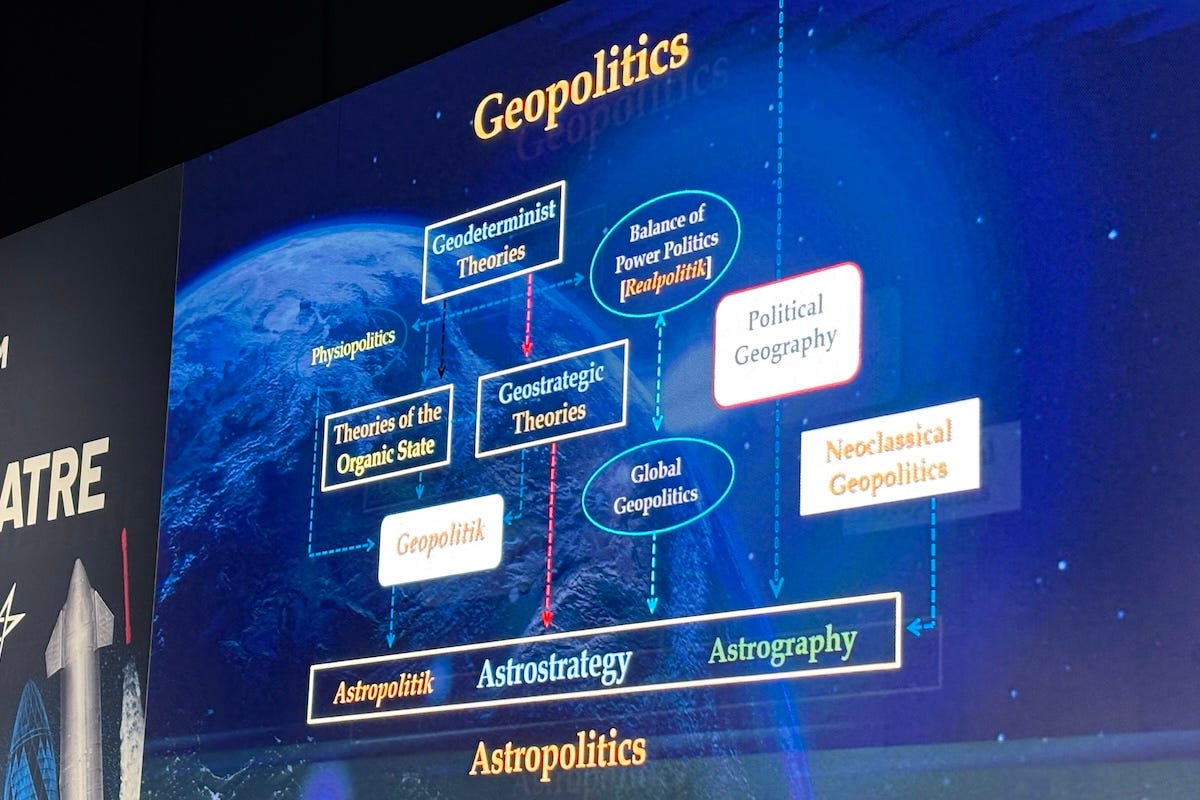
“Reasoning by analogy, the Earth sitting at the bottom of this well appears to be a single spaceport,” he said.
He replaced distance-based space maps with maps measuring energy expenditure, using gravitational lines rather than elevation to chart the terrain. Low Earth orbit, roughly 150 to 1,000 kilometers above Earth, accounts for about 90% of the energy required to reach the moon and back.
“The importance of the space blockade is that it is unflankable. You simply can’t get around it. We don’t have alternate ports,” he said.
He likened the concept to naval chokepoints, comparing low Earth orbit to the way trade bound for London must pass the Thames, or trade bound for New York must pass the Verrazzano Narrows, both of which a sufficiently powerful nation could shut down entirely, leaving no alternative ports to reroute through.
Dolman named his book Astropolitik as a deliberate warning, aware that the term echoed a corrupted school of early-20th-century German geopolitics rather than endorsing it.
He later co-founded the journal Astropolitics with Dr. John Sheldon.
War risk in orbit
Dolman’s broader warning is blunter. He believes the next major conflict between the United States and China will begin in space.
“The coming war with China will begin in outer space,” he said.
He first raised the claim in an article he wrote several years ago, comparing the logic to modern air campaigns in which radar and air-defense systems are struck first. Recent operations against Iran targeted its space capabilities first and foremost, primarily through jamming.
“Neither side can realistically think about attacking, occupying and pacifying the other,” he added.
Dolman described the United States as the world’s greatest maneuver power and China as its greatest land power, bound together by deep trade ties even as each views the other as its primary adversary.
“If nothing changes, war is inevitable between the United States and China and will start in outer space,” he warned.
The US Space Force frames the situation as a genuine prisoner’s dilemma, a framing increasingly shared across the Pentagon as officials weigh the extent to which American military operations have become reliant on satellite links spanning the Middle East and the wider Indo-Pacific.
“Is it reasonable to think a war could happen in space? Probably. I don’t see that kind of great power conflict as imminent,” he continued.
Whichever side retains reliable access to space while the other does not gains a decisive strategic advantage over its rival, a dynamic that officials increasingly cite when arguing for greater investment in resilience and redundancy across the entire satellite network today.
Dolman warned that dependence cuts both ways, calling satellite reliance a strategic weakness as much as a military asset.
“Space is our literal and collective Achilles’ heel,” he warned. “We are vulnerable, and we know it, and yet we have failed to adequately defend that infrastructure.”
Dolman considers current defenses reliant on deterrent threats that lack credibility, with no real answer to natural hazards such as a comet, an asteroid or a solar flare, nor to accidents, miscalculations or an unstable authoritarian leader choosing to strike first.
“When deterrence fails, it fails completely and utterly,” he said.
Catastrophic scenarios include a Carrington-level solar flare, a Kessler cascade of orbital debris and a nuclear detonation in orbit, any of which could collapse financial markets and cut off electrical grids and food production, Dolman warned.
The risks prompted a question from the floor about whether NATO and the European Space Agency needed to do more to protect the space domain.
“All of our rules and laws come from the 1960s and some from the 1970s. These are Cold War rules and laws,” Dolman replied.
Current international law leaves basic commercial questions unresolved, including whether a company can legally keep the profits from resources it extracts from asteroids, the moon or other celestial bodies, an ambiguity Dolman called one of the industry’s biggest obstacles to long-term investment.
“I’d rather have a liberal democratic state that’s responsible to the people to be that space cop, rather than an authoritarian state that could do it but would not necessarily be responsible to anyone,” he added.
He expects a dominant spacefaring nation, rather than a coalition of allies, to take on that role first.