


Virgin Galactic is preparing to revive commercial space tourism later this year with a new generation of spacecraft, positioning itself to capture demand as rivals redirect attention toward deeper missions.
The decision came after Blue Origin founder Jeff Bezos said on January 30 that his space company, which has carried 98 people on 38 missions above the edge of space since 2021, would pause its New Shepard tourism program for at least two years to focus on lunar initiatives.
“Blue Origin seems to have bowed out of putting people into space. We need to fill that gap. There are an awful lot of people who want to go to space and we just need to hurry up with that now,” said Richard Branson, founder of Virgin Galactic.
“At the end of this year, we hope the first Delta ships will be flying people into space. Next year, we hope to be very busy flying people into space. Through a new series of Delta spaceships, we’ll be able to offer more and more people the chance to go to space,” he said.
Virgin Galactic began commercial spaceflights in June 2023. A year later, it halted operations after completing 12 suborbital missions that carried 61 people into space, shifting its focus to building the new Delta spacecraft designed for more frequent, lower-cost flights.
The company’s space tourism model centers on suborbital flights that typically reach altitudes between 80 and 90 kilometers (50–55 miles) above Earth. At that height, travelers briefly experience microgravity and see the curvature of the planet before returning to a runway landing.
Branson, who began planning a space tourism venture in 2004 and later flew to space aboard VSS Unity on July 11, 2021, described the experience as transformative.
“There’s just nothing like being in space. To unbuckle and float away from your seat and look back at our beautiful Earth. Nothing beats it,” he said. “It took me nearly 20 years to get there, with a lot of tears, a lot of hard work, and a lot of money, but it has been one hell of a journey.”
New Delta-class spaceships
Virgin Galactic tickets are expected to cost about $600,000 per seat on its Delta spacecraft. Each vehicle can carry six people and is designed for high-frequency suborbital flights, roughly twice per week, using a hybrid rocket system.
With Blue Origin stepping back from space tourism, Virgin Galactic is set to become the only major provider of commercial human suborbital flights in the near term.
“We have about 700 tickets sold, and we capped it for the time being because of the waiting list,” Branson said.
He said that if everything goes according to plan, the company should be able to send those 700 people into space much faster than before, noting that only about 750 people have ever been to space in human history.
“One of the big advantages of the new Delta class spaceships is that we won’t have to have them on the ground for two or three months between flights,” Branson said. “We’re building them more like airplanes, so we should be able to do a second flight every 48 hours or even less.”
“That’s going to make the economics better, which means in time we’ll be able to get the price down,” he said. “When the price comes down, more and more people will have the chance to go to space.”
He added that research missions would remain an important part of the program, noting that the company has already conducted several research flights and expects many more in the future.
Branson has built several businesses around transportation. He launched Virgin Atlantic in 1984, when the airline’s first flight — using a leased Boeing 747 — departed London Gatwick for New York.
Rival visions
While Virgin Galactic focuses on tourism flights, other major space companies are prioritizing deeper-space exploration.
On February 8, SpaceX founder Elon Musk said in a social media post that the company aims to build a permanent settlement on the Moon within the next decade, prioritizing that effort ahead of its longer-term goal of sending humans to Mars. Such a lunar base could support satellite launches and serve as a staging point for deeper space missions.
The contrasting strategies highlight the increasingly diverse goals emerging within the private space industry, ranging from tourism to satellite networks and lunar infrastructure.
“Fair competition is essential,” he said. “Governments have got to encourage competition because that’s their principal role.”
He also welcomed the emergence of rival systems challenging Musk’s dominant satellite network.
“Jeff has got deeper pockets, and he’s coming in to give Elon a run for his money. I think that’s a really good thing because people will have a choice,” he said.
He noted that Virgin once attempted to compete in the satellite launch market through Virgin Orbit.
“We were hoping with Virgin Orbit to be competing with Starlink, but we just didn’t have the deep enough pockets,” he said. “It was costing us 25 or 30 million dollars a month, and we had to call it a day.”
Europe’s space economy
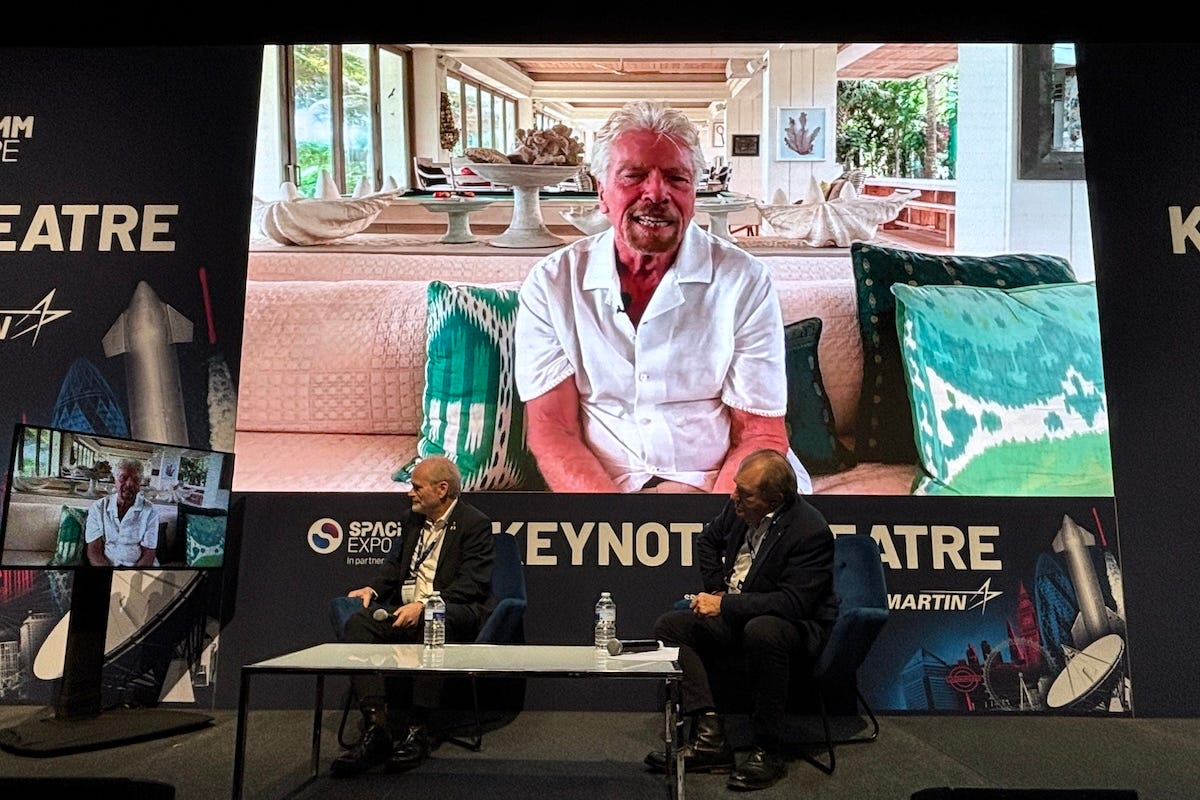
The discussion took place on Wednesday at the Space-Comm Expo in London, where Branson joined the audience via live video link from Necker Island.
The conversation was moderated by Space-Comm Chair Will Whitehorn and included Virgin Galactic Chief Pilot David Mackay.
Whitehorn said early forecasts in the mid‑2000s had predicted the emerging commercial space sector might generate about 20,000 new jobs in the United States by 2020. Instead, the industry has expanded far faster, now employing roughly 200,000 people in the U.S. alone and attracting more than a trillion dollars of investment in the past five years.
He added that Europe is rapidly emerging as a hub for private space ventures, with startups developing satellite constellations, space-based solar power projects, and new orbital infrastructure.
Branson warned, however, that European governments must provide stronger support for domestic space companies if the region is to compete with the United States.
“Elon has got billions from the U.S. government, which has enabled him to become very dominant in the space world,” he said. “European companies do not get a lot of financial support from their governments, and that makes the playing field tip toward American companies.”
“If European companies come up with projects that are worth supporting, some kind of financial help from governments should be forthcoming,” he added. “If Europe is going to compete with America, it needs to back its industries.”
Branson also praised the idea of technology prizes such as the Ansari X Prize, saying relatively small incentives can accelerate breakthroughs.
“Prizes are a wonderful way of encouraging people to push forward,” he said. “The X Prize was a relatively small amount of money, but it resulted in a spaceship going into space and pushed technology forward.”
The Ansari X Prize, launched in 1996 and later renamed after a donation from entrepreneurs Anousheh Ansari and Amir Ansari, offered $10 million to the first private team to launch a reusable crewed spacecraft into space twice within two weeks, helping spur early commercial spaceflight development.
Space and security
The discussion also touched on the growing geopolitical importance of space systems, particularly amid conflicts in Ukraine and Iran.
Branson said the war in Ukraine highlights the strategic value of satellites and space-based infrastructure.
“Ukraine needs Europe’s help, 100% commitment,” he said. “It’s extraordinary how well Ukrainians are managing on their own, but the rest of Europe has got to give every single bit of help to Ukraine.”
He said Europe must strengthen its independent capabilities in space technology and defense.
“Europe has got to be ready to stand on its own two feet,” Branson said. “We should obviously work with the Americans, but Europe needs the capability to defend its own interests as well.”
Mackay said Europe must expand its own launch capabilities and space infrastructure, arguing that the region needs to do more in space to develop the capacity to look after itself.