


The US is treating everything from mines to semiconductors as a single artificial intelligence (AI) supply chain, with mineral processing as its weakest link.
Washington is also funding new smelters, mines and steel plants that feed power grids and data centers.
“We put this all together in one office because we view it as one big value chain. We haven’t built the infrastructure historically that’s needed to drive superintelligence, AI and data centers,” said Audrey Robertson, Assistant Secretary of Energy for Critical Minerals and Energy Innovation at the US Department of Energy (DOE).
“Midstream is a huge issue. Our friends have a lot of resources, but we do have a single choke point in the system.”
DOE set up the Office of Critical Minerals and Energy Innovation (CMEI) this year, combining research on mining, processing, metallurgy and recycling with work on magnets, motors, electronic components and semiconductors. It is tackling the gap through research at its 17 national labs and by helping to speed up new mines.
Robertson said US grid growth has been no more than 1% to 2% a year for decades, leaving the materials behind AI as a single point of failure.
“Without copper, there are a lot of problems, and it’s not just building out new power connectivity across the United States. It’s within distribution transformers. It’s within data centers themselves, where copper is such an integral part of all of the switchgear,” she said.
Recent federal moves on steel, aluminum and niobium include:
a large investment by her office in Century Aluminum’s planned smelter in Oklahoma, the first new US aluminum smelter in more than 40 years;
DOE support for Cleveland-Cliffs to expand output of grain-oriented electrical steel, used in transformer cores, by up to 25% at its Pennsylvania plant; and
a visit by officials to NioCorp’s Elk Creek niobium project in Nebraska, still under construction, a day before the panel.
She said the government has also strengthened its financing tools, from the Project Vault stockpile to financing through the Export-Import Bank (EXIM) and the US International Development Finance Corporation (DFC), while cutting permitting barriers.
Loic Jonchery, Senior Metals Trader at commodity trader Centalion, formerly Gunvor, said the boom is about more than volume.
“We often speak about commodity supercycles, and it’s a bit misguided. It’s more an infrastructure supercycle, because it’s not like you just need more copper. You need many metals in different shapes or forms, and you need to make sure you have them reliably in the place you want them to be, when you want them to be,” he said.
China holds the midstream
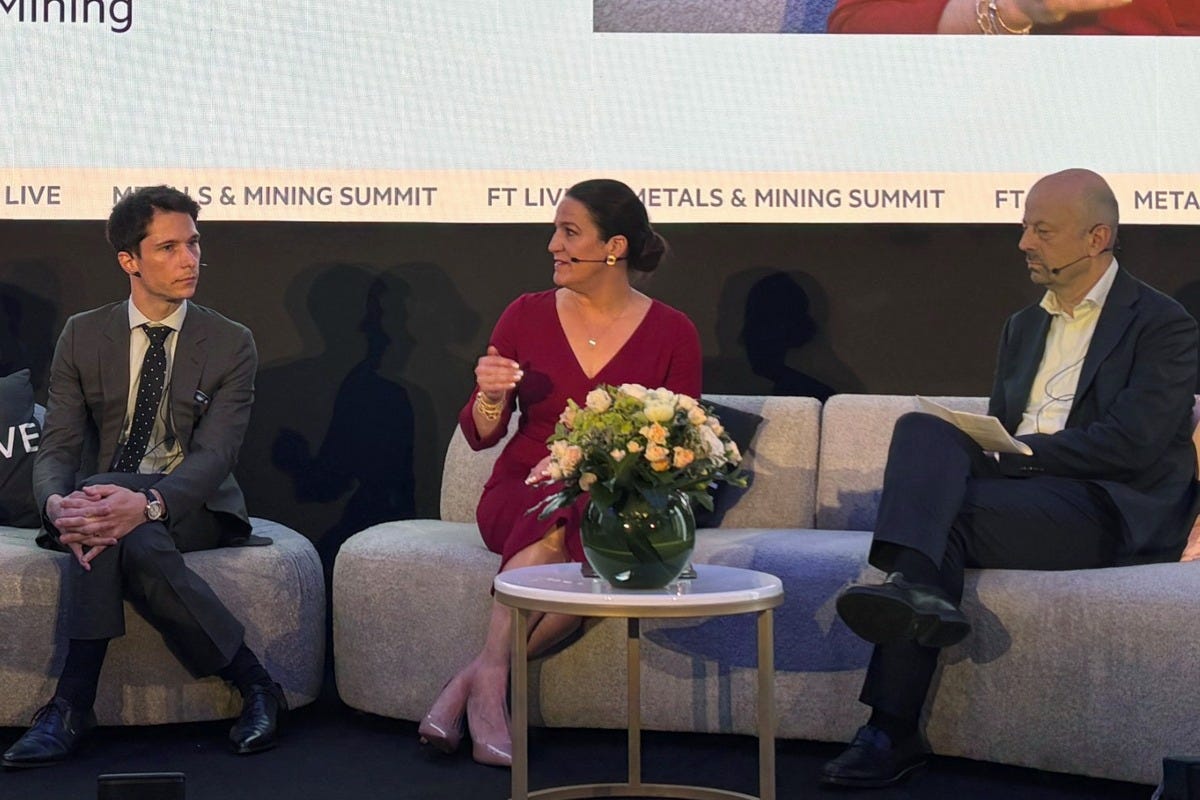
Dan Thomas, Natural Resources Editor at the Financial Times, moderated the panel at the FT Metals & Mining Summit in London on October 15.
Robertson said most of the world’s smelting, especially for copper, is in China, which has an oversupply of smelters. The US needs not only to catch up but to exceed it. She said smelting and the other midstream steps in minerals and metals processing are now a major focus.
“The smelting story is a power story. Smelting is power hungry, and so when there is a finite amount of power, where do those resources go, how much do they cost, and what’s the impact of that?” she said.
Michel Van Hoey, Senior Partner at McKinsey, said supply is becoming more concentrated despite the push to diversify.
“Everybody’s talking about diversification of supply and diversifying supply chains. When we look at the facts, concentration of supply has increased by three percentage points across commodities,” he said, citing McKinsey’s newly published global materials perspective.
He said metals and mining are far more concentrated than oil and gas. The Organization of the Petroleum Exporting Countries (OPEC) oversees roughly 40% of oil supply, while a single country can control 70% of one metal's supply. That means supply risk must be weighed alongside demand.
An audience member asked whether the US has enough technicians to process critical minerals, noting that China has barred its own technicians from leaving the country.
Robertson said the US developed innovations such as batteries over 20 years but not the manufacturing know-how.
“We might develop the IP (intellectual property), but we don’t execute on building the big factory. We don’t feel like we’re going to close the gap on what we see as a supply chain issue by trying to do what we’ve been doing for 20 years,” she said.
DOE has launched PROSPECT, its largest-ever workforce initiative, to double mining degree graduates within two years. Robertson said the US became the largest exporter of oil and gas, after being the largest importer 20 years ago, by innovating.
Van Hoey said the gap is wider in some areas than others.
“In the rare earth and magnet value chain, this is a piece of process capability that the West has just transferred to China and doesn’t have anymore. There’s a real catch-up that we will have to make in order to close the gap, if you want to be independent as a region from China,” he said.
Power decides metal demand
Jonchery said the way data centers are powered, not just how fast AI is adopted, will largely decide how much metal they need. He sees three models emerging:
Europe, where everything must connect to the grid, which uses a lot of metal for transmission but is slow to build;
the US, where many data centers now have power on site, which uses less metal but is much faster; and
a smart grid, which Centalion is working on in Australia, where operators can cut data centers off when the grid is under stress and backup power takes over.
“It’s about trying to leverage the current infrastructure we have, to not just build a new grid or a bigger grid based on peak loads, but also trying to have a smarter way of looking at workloads,” he said.
He said the path matters, as the US model may use less metal than Europe’s but arrives faster.
Robertson said hyperscalers have signed dozens of deals with power producers, from small modular nuclear reactors to gas and solar with batteries, but rarely buy into mines. Amazon Web Services’ copper deal with Rio Tinto in Arizona is an exception, while Meta’s deal with Corning targets specific components.
Van Hoey expects hyperscalers to sign partnerships, offtakes and selective investments rather than own mines, a very different business.
Jonchery said long-term offtakes from tech firms could make new mines financeable, as power purchase agreements do for power plants. He said low capital spending by miners and a lack of long-term demand commitments are among the reasons supply has lagged demand.
“Can you have a world where Google doesn’t own a mine but makes that mine financeable for the supplier? It’s in my view definitely possible, because they both need it,” he said.
Van Hoey said data centers and AI accounted for only 0.4% of metals demand revenue in 2025. Even with data center demand growing 20% to 30% a year, he expects them to account for 4% of copper demand and 6% of gallium demand by 2030.
“There might be a bit of a correction coming. It’s important that we’re not extrapolating GPU (graphics processing unit) power demand to metal demand,” he said.
Silver use per solar panel fell 90% in 20 years, and he expects data centers to become less metal-intensive too.
Jonchery said the hype may still serve a purpose. New copper supply takes 10 to 20 years to bring online, so high prices today may be needed to bring on the supply required in the future.