



Blockchain earned its reputation as an unbreakable ledger, immune to tampering. Quantum computing is quietly turning that guarantee into a liability.
The technology that makes blockchain trustworthy relies on cryptographic keys that are extremely hard to crack with today’s computers. Quantum computing, once a distant academic pursuit, is now advancing at a striking pace, and a sufficiently powerful machine could eventually break those keys in a fraction of the time.
That would unravel the very immutability the technology was built to guarantee.
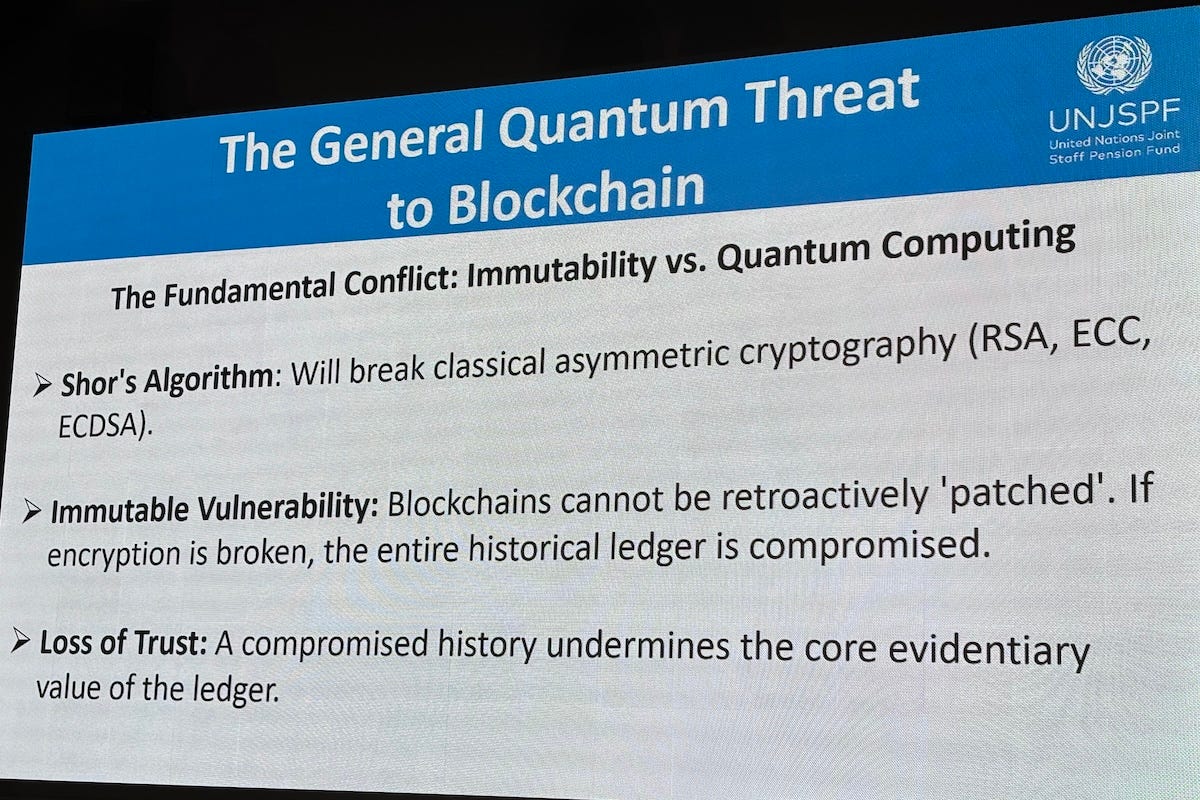
“What was considered to be the best value proposition, I recognized, was at the same time its biggest vulnerability,” said Dino Cataldo Dell’Accio, deputy chief executive of the United Nations Joint Staff Pension Fund (UNJSPF). “That could expose us to a loss of trust and undermine the construction of the model we had put in place.”
Dell’Accio, who has spent most of his 25 years at the UN in information-systems and technology auditing, said he arrived at that conclusion gradually, drilling down from a general unease about emerging technology to the specific mechanics of how quantum algorithms undermine cryptography.
He said he reports the risk every year to the fund’s governing body, made up of representatives from 193 countries, as part of its budgeting process.
The urgency is not unique to the pension fund. The US National Institute of Standards and Technology (NIST) finalized its first quantum-resistant encryption standards in August 2024, known as FIPS 203, 204 and 205, intended to replace RSA and elliptic-curve cryptography across government and industry systems.
The US National Security Agency has set 2030 as its deadline for national security systems to complete the migration.
The UNJSPF was established in 1949 by the UN General Assembly. It manages more than $114 billion in assets for beneficiaries across 192 countries, making it the world’s largest international pension fund.
A threat already here
Dell’Accio discussed the fund’s quantum strategy at the Commercialising Quantum Global 2026 in London. The event, organized by Economist Enterprise, featured a fireside chat moderated by Christina Yan Zhang, chief executive of The Metaverse Institute, centered on transitioning a live, mission-critical identity system to post-quantum security.
Dell’Accio said most public attention on emerging technology has gone to artificial intelligence (AI) rather than quantum computing, which remains largely confined to laboratories. He said working quantum decryption is not purely theoretical, pointing to early laboratory-scale demonstrations that have not yet reached mass adoption. He said that gap is exactly the problem.
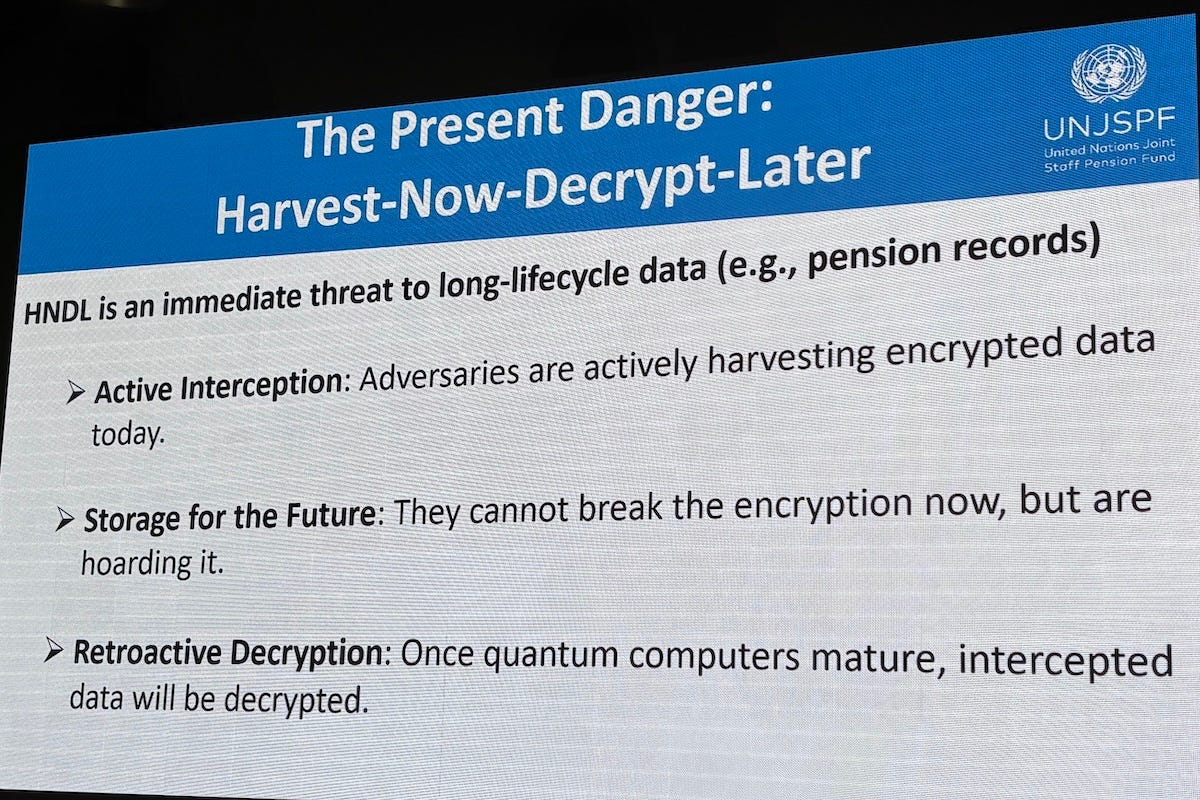
The tactic he described is known in the security industry as “harvest now, decrypt later,” a pattern documented by government cybersecurity agencies including the US Department of Homeland Security and the UK’s National Cyber Security Centre.
The European Union Agency for Cybersecurity has issued similar warnings, noting that adversaries are already collecting encrypted data today. Expert surveys put the odds of a capable quantum machine existing by 2035 as high as 50%.
“Adversaries need only patience, not a working machine today,” he said. “I had to convince, persuade and demonstrate: the threat is today.”
“There is a real possibility that ill-intentioned actors are storing offline the transactions we have on our blockchain, waiting for the day quantum computing will enable them to break that encryption.”
Retroactively decrypting that harvested data would undermine a system built specifically to support decentralized digital identity, he added.
The fund’s digital identity platform runs on Hyperledger Indy, an open-source blockchain built for decentralized identity by the Linux Foundation. It also underpins the Sovrin Foundation’s public identity network, letting individuals hold and control their own credentials.
Dell’Accio said his team cataloged every element recorded on the ledger: the root hash, transaction type, timestamp, and sender’s public signature. He said a compromised timestamp is a smaller risk on its own, but it could still quietly undermine the chronological record of transactions.
Grover’s algorithm poses a significant threat to the hashing mechanism, he said.
“The public signature is the element most vulnerable to post-quantum computing, allowing someone to derive the private key and potentially start altering the integrity, availability and trustworthiness of the ledger itself,” he said.
Turning threat into readiness
Dell’Accio outlined the steps now underway at the pension fund to prepare for the shift:
Identify what data is written to the blockchain and how long it must remain valid
Take inventory of the cryptographic primitives and mechanisms in use
Prioritize critical systems and evaluate technical debt
Assess exposure through third parties
Migrate toward a post-quantum resistant blockchain platform
“No one system or application lives in isolation,” he said.
The likely destination is a platform built on lattice-based algorithms such as ML-KEM, used for key exchange, and ML-DSA, used for digital signatures. Both are NIST-approved standards now emerging as leading candidates for this kind of migration across the industry.
The fund is also building flexibility to run classical and quantum-resistant computing side by side, he added.
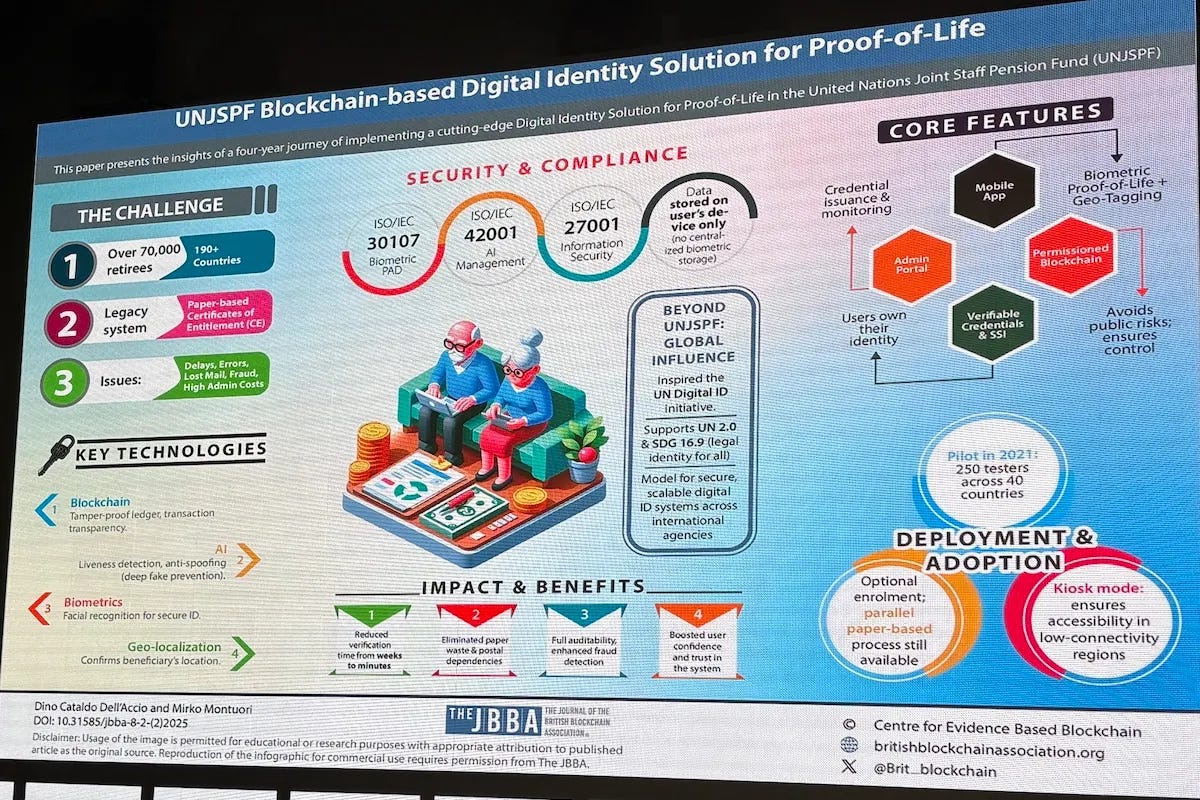
The urgency is rooted in what is already at stake. Dell’Accio said UNJSPF’s blockchain-based proof-of-life system has been running in live production since 2021, verifying roughly 89,000 beneficiaries across more than 192 countries and replacing a paper process that dated back 70 years.
“We are the first and only, as of today, UN entity to achieve ISO [International Organization for Standardization] certification on the responsible use of artificial intelligence (AI),” he said.
The certification, ISO/IEC 42001:2023, covers the fund’s proof-of-life digital identity solution, known internally as the Digital Certificate of Entitlement.
The system also uses biometrics, facial recognition and geolocation to detect deepfakes, and is independently audited every year against international standards.
The British Blockchain Association recognized the solution in 2025 at its international scientific conference.
Zhang, who has collaborated with Dell’Accio through the UN Global Initiative on AI and Virtual Worlds, known as Discovering the Citiverse, recalled that he once replied to one of her proposals within 24 hours with a complete framework spanning 10 areas and 50 indicators.
The initiative is developing global standards on AI readiness for cities worldwide, and Dell’Accio has contributed executive briefings and a pre-implementation checklist to its work. The UN Secretary-General recognized that record with an Innovation Award in 2022.
Other public and private pension funds are now lining up to adopt the same approach, she said.
For Dell’Accio, the next test is migrating a live, high-stakes ledger to post-quantum security without breaking the trust it took years to build.