


Artificial intelligence (AI) use inside companies has tripled in under two years. Turning that activity into real business results is proving far harder.
According to Accenture’s own research, nearly 90% of companies have yet to see that surge in individual activity show up in company performance or gross domestic product (GDP). Only around one in ten organizations have managed to convert it into measurable profit and loss impact.
“We’ve got a dichotomy between individual productivity and that translating into company performance,” said Matt Prebble, chief executive of Accenture UK & Ireland. “It’s only when you redesign the work, look at the processes and engage the people in that exercise, that unlocks the productivity step change.”
“When we look at the one in ten we call ‘stayers’ that really start to get P&L (profit and loss) impact, they’re looking at the work itself. They’re redesigning the work, and they’ve got a different engagement model with their employees.”
“A narrow view of productivity, doing the same things I did yesterday but at a lower cost, isn’t a winning strategy. We don’t see people winning with that strategy.”
He said that mindset needs to work at three levels at once, reinventing the industry, the role and the individual’s own next chapter.
“If you don’t give people the tools, they’re going to find workarounds,” said Kerry Dryburgh, executive vice president for people, culture and communications at BP.
She said UK research shows only one in six UK companies are deploying agentic AI tools across their organization, even though more than 70% of the population already uses AI day to day.
The gap between individual enthusiasm and organizational results is proving to be the industry’s central challenge.
Closing the trust gap
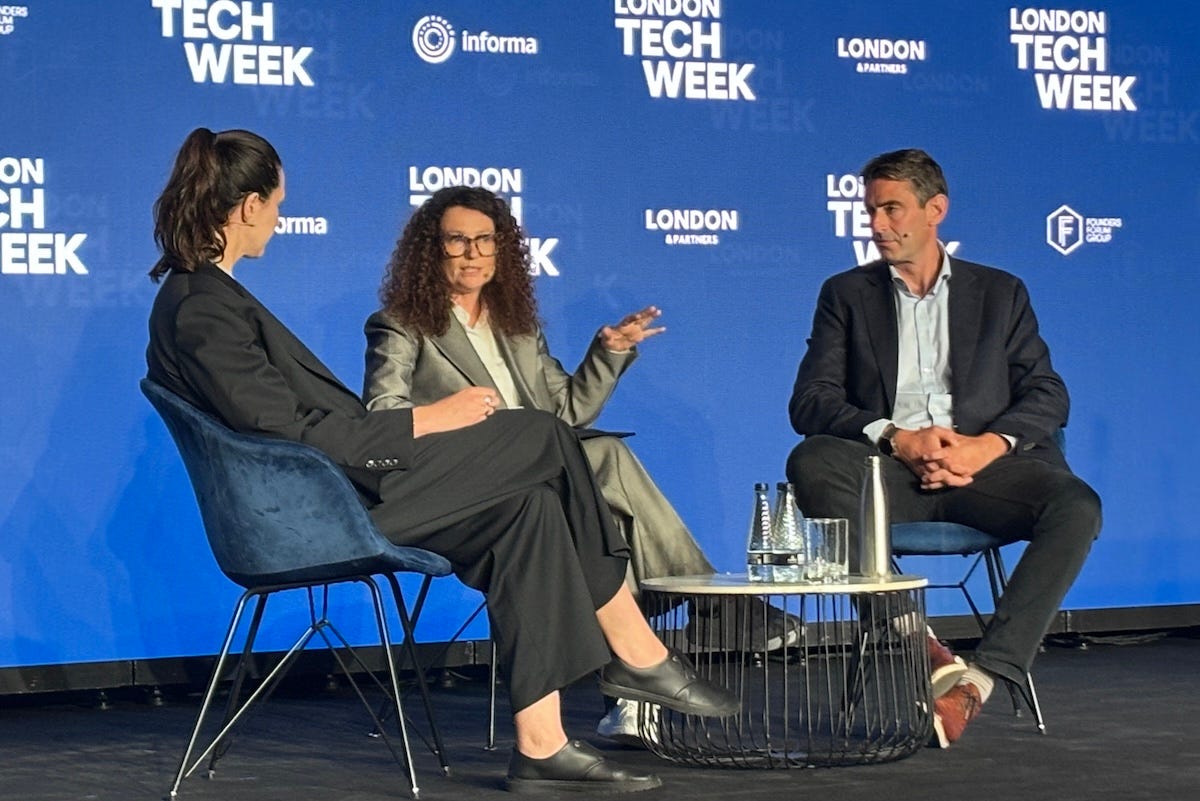
The exchange took place on a panel at London Tech Week in June. Patricia Clarke, technology reporter at The Observer, moderated the discussion on bridging the gap between boardroom ambition for agentic AI and workforce readiness.
Founders Forum Group and Informa, alongside London & Partners and Tech London Advocates, organized the event.
Prebble said only 20% of the workforce feel engaged in the AI journey, based on an Accenture survey of thousands of employees, even though about 85% of C-suite leaders plan to keep increasing AI investment and scale.
“That lack of engagement translates into distrust,” he said. “The real innovation happens on the edge, with our clients and project teams. It’s those people on the edge who really create the innovation, not the people in the center deciding what to scale next.”
He said closing that gap starts with mapping out talent pathways for the roles agentic AI is creating.
“About 18 months ago, I had an Accenture reverse mentor who helped me,” Dryburgh said. “We’re at this point in time where you can rethink how you do your job on a day-to-day basis, and how many opportunities do you get like that in a lifetime? Not many.”
“People can’t trust what they don’t know. That’s why it’s important to think about a whole enterprise deployment overall.”
BP has deployed AI agents in its recruitment process to sift through thousands of CVs, but a human still checks for bias and makes the final hiring decision.
“You have to ensure that you’re deploying AI in a way that designs for a human-first approach, and that you’re always taking human accountability and judgment into account,” she said.
BP’s own deployment centers on three areas:
safety, including maintenance at its facilities;
production, such as drilling wells more effectively;
and inventory management across its retail network.
It is working with MIT (Massachusetts Institute of Technology) in Boston on a customized program for its top 120 leaders, alongside broader training across the whole company so employees can identify where AI can remove friction from their work.
“You’ve got to have not just the tools, but a strong data foundation,” she said. “ You’re an expert in your field, and if you can understand enough, you can become a ‘super user.’”
BP calls these employees “citizen developers,” who apply AI to solve problems day-to-day without formal technical training.
“We’ve deployed something called ‘AI Edge,’ which is learning over a 12-month period, whether that’s online learning or masterclasses, across the whole company,” she said.
Doubling down on graduates
When Prebble took over leading Accenture’s UK and Ireland business, one of his first questions was how many graduates to hire this year. He said Accenture redesigned its whole graduate intake program in response, including a 12-week onboarding course built around tools from Microsoft, Anthropic and Amazon Web Services (AWS).
“There’s an easy mindset that says we need fewer graduates because the work they did previously is going to be done by AI,” he said. “That is entirely the wrong mindset to have.”
“We found there’s a whole new set of tasks those people can do that could have real client impact, and clients really want to engage with AI-native people who can drive their growth forward.”
He said Accenture is increasing its graduate intake this year as a result, rather than cutting it.
“The uncomfortable truth is that the US and China have led the way [on infrastructure],” he said. “There is a super exciting opportunity for the UK, which is how you apply the new technologies in industries like financial services, life sciences and the legal sector.”
New Accenture research puts the UK’s agentic AI opportunity at roughly £736 billion by 2038, the largest of any European country outside North America.
Prebble pointed to Amazon’s retail arm as an example of a low-cost leader that got there through reinvention, not by doing what traditional retailers already did more cheaply.
He said the only way the UK gets there is with a broader view of productivity and a real mindset to reinvent, rather than the narrow view of doing as little as possible and just trying to reduce cost.
“There’s opportunity to create new businesses and new versions of those industries, whether that’s professional services, energy or consumer goods,” he said. “That is a huge opportunity for the UK.”
“About 8 million people in the UK don’t have digital connections. They can’t open a bank account or shop online,” he said. “If you give them the tools to get started, if they cross the bridge and start using a chatbot, you suddenly see the confidence flourish.”
He cited outreach work using generative AI that had just reached a million people, as evidence of what a first successful interaction can lead to. He said closing that gap for the UK’s 8 million digitally excluded citizens, like closing the gap between individual AI use and company-wide results, will depend on whether more organizations choose to redesign the work rather than simply digitize it.