


Military satellite terminals must switch between orbits and frequency bands, as the war in Ukraine shows jamming and attacks can cripple any single network.
Ukrainian forces use low Earth orbit (LEO) satellites to keep mission command and control alive, but those links can be jammed and GPS signals spoofed. When traffic shifted to geostationary (GEO) satellites, those services were also jammed or disrupted as their ground infrastructure was destroyed.
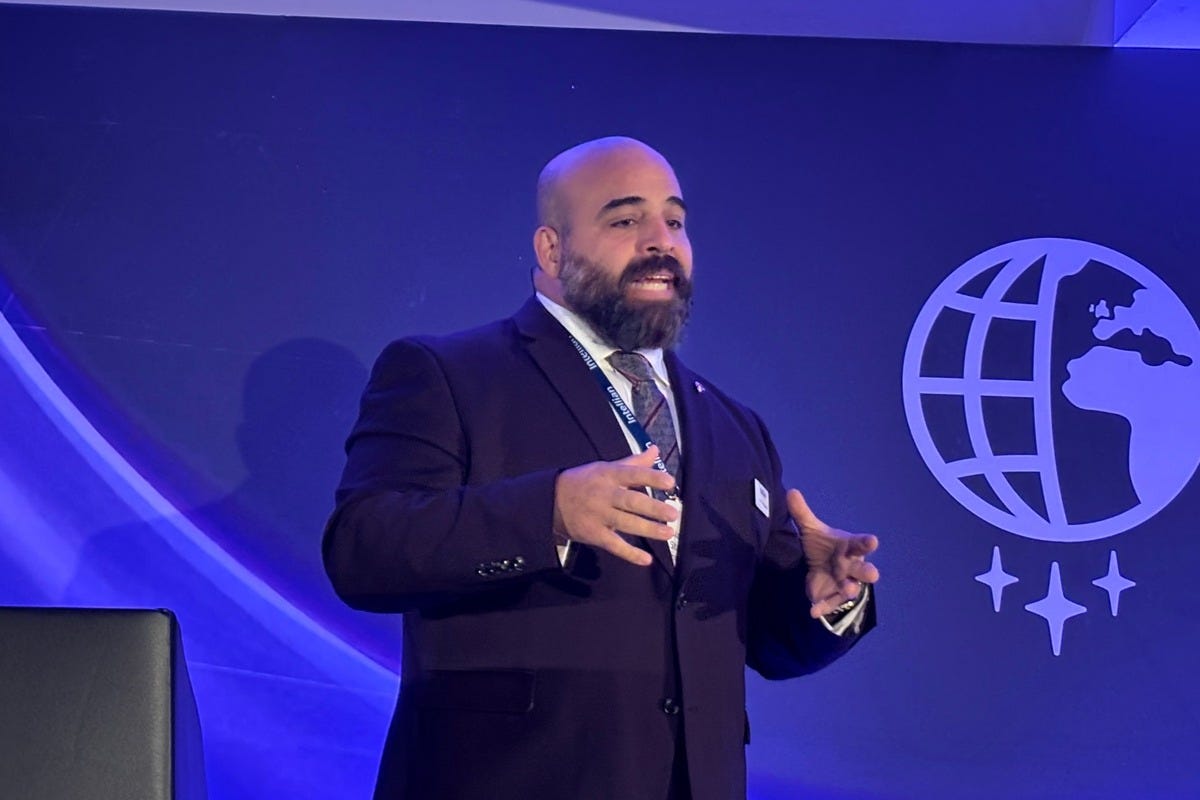
“The main learning curve we’re having these days is, unfortunately, something that we’re getting taught by force in Ukraine,” said Bladimiros Stavropoulos, senior director of solutions and sales engineering at Intellian Technologies. “When we look at this and we start unifying the pieces or blocks, history is telling us a story that is not ideal, but it’s pretty compelling.”
He said forces now need equipment that lets them diversify and move across orbits. That job falls to the terminal, the hardware sitting on a pole, on the ground or at a post that delivers communications wherever troops operate.
He said companies must partner, because no one can operate in contested environments without collaborating.
“One piece of hardware doesn’t fit and resolve all the problems, but hardware that is able to open the door to multiple constellations, orbits and bandwidth demands is serving what your contract is today. It’s also serving where your ally is bringing you tomorrow,” he added.
Intellian, a South Korea-based maker of satellite antennas and ground gateways, supplies terminals for military and commercial networks. It works with armed forces, defense ministries and satellite constellation owners.
Its terminal range now spans every major orbit:
LEO: Eutelsat OneWeb in Ku-band and Iridium Certus in L-band
Medium Earth orbit (MEO): SES’s O3b mPOWER in Ka-band
GEO: Inmarsat Global Xpress and other Ku-, Ka- and C-band networks
Highly elliptical orbit (HEO): the military ARC-M4 series
Requirements age fast
Stavropoulos delivered the keynote “The Hardware of Resilience: Engineering Multi-Orbit Terminals for Sovereign Agility” on October 27 at the Defence in Space Conference (DiSC) 2026 in London, an industry-run event for the space and defense sectors. He spoke straight after a panel on assured positioning, navigation and timing (PNT).
“My goal here is to be sure that when you’re writing your requirements, you’re not writing requirements for something that needs to be developed in 24 or 36 months. By the time you’re delivering that terminal, it’s already aged,” he said. “What you wrote is not the world that we are living in by the time of delivery.”
He said that after Intellian showed one of its land terminals, someone asked whether the same unit could fly on an unmanned aerial vehicle (UAV). He added that adapting a proven design is quicker than building a new terminal from scratch, and that Intellian’s current terminals draw on five years of development.
“We don’t try to resolve all the problems at once. If you can tackle three problems, resolve them quickly, iterate and go over to the next one right away, you may be able to solve that issue quicker, in a couple of months rather than three years,” Stavropoulos said.
“I cannot predict the future because the world will be different. But we can read what is happening on the field,” he said.
This year, NATO and the NATO Communications and Information Agency (NCIA) issued requests for proposals for flyaway terminals, which let troops stay mobile and spread across locations so they are harder to target. Requests for compatibility with GEO, LEO, MEO and HEO satellites followed.
He said France, Germany and the Netherlands are seeking the same type of terminal. Reusing a terminal already proven at sea removes risk from these programs. Buyers no longer need to ask whether it will connect to the constellation or meet military standards, only how quickly they can get it and move their teams over.
In September, Intellian agreed with systems integrator Network Innovations to develop and distribute multi-band flyaway terminals for Wideband Global SATCOM (WGS), the US military satellite network. The terminals are being engineered for full WGS certification and key military specifications.
One of its flyaway designs, the ARC-M4 TF13, is built for speed in the field:
network-ready in under 20 minutes
lightweight carbon composite segments that twist-lock together without tools
a single power and Ethernet connection
X- and Ka-band modems that can be swapped in the field
Big dishes draw fire
Large fixed ground stations have also become targets. Stavropoulos said 4- and 6-meter land-based antennas serving GEO satellites in the Middle East, which supported large operator systems, were attacked right away by Iranian forces.
He said a 2.4-meter terminal scaled up from a 1.3-meter naval design offers stronger reception and transmission than the original. It can work as a user terminal or as a portable gateway station for LEO constellations, including the US proliferated LEO (pLEO) program and new constellations being built in Europe.
He said such terminals give armed forces and large command posts sovereign, high-capacity MEO or LEO service.
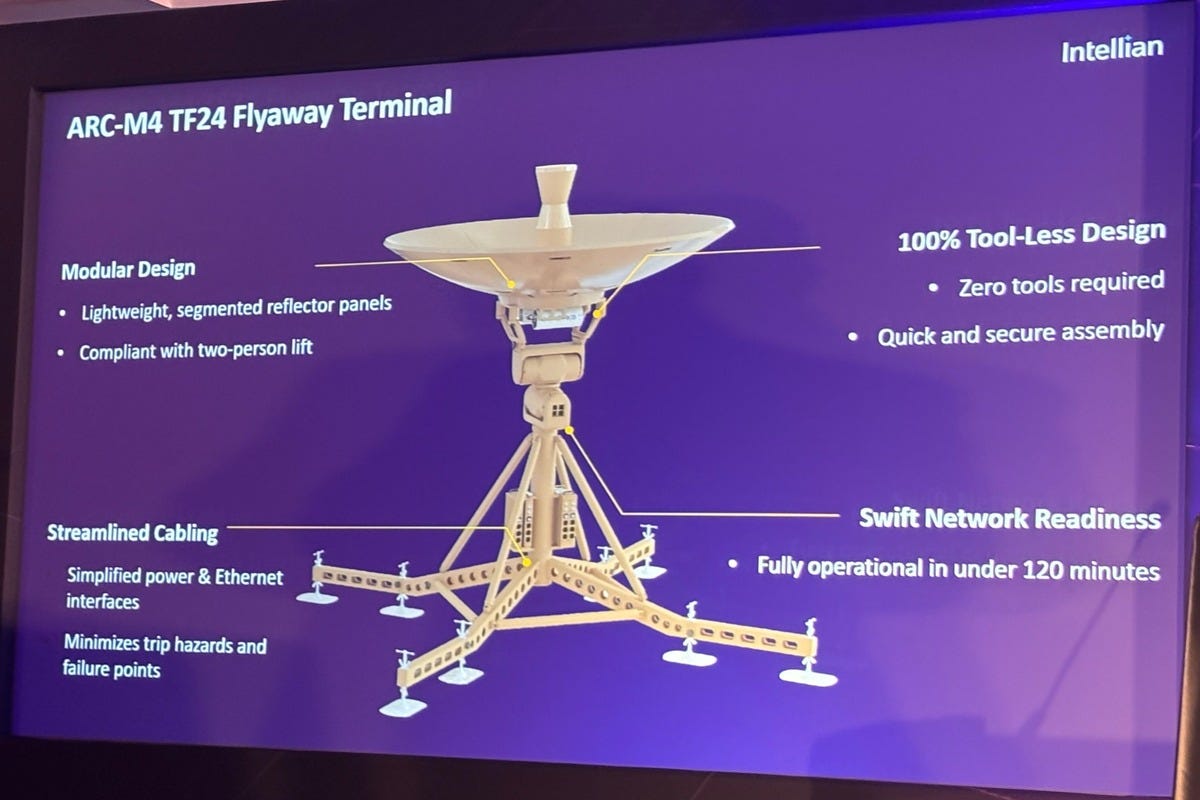
The 2.4-meter ARC-M4 TF24 flyaway breaks down into lightweight segmented reflector panels that two people can lift. It needs no tools to assemble and is fully operational in under 120 minutes.
At sea, the US Navy-sponsored ARC-M4 Block 1 terminal runs X-band and military Ka-band simultaneously on WGS satellites and can switch to MEO if both are jammed. He said it offered something new, and Intellian had to help the US Space Force rewrite some of its rules.
The 1.3-meter terminal won WGS certification with no caveats in 2024. It tracks GEO, MEO, LEO and HEO satellites and can switch quickly between commercial and military satellite communications.
“If your X-band gets jammed, you already have a Ka link running on a separate band, spread enough that the jamming of one will not affect the other one,” he added.
He said the naval terminal’s radio frequency (RF) specifications and control software carry over to land, which has no ship motion, pitch or roll to deal with. For the naval terminal, Intellian is discussing a use case with Telesat on its upcoming Lightspeed constellation, and Amazon has also shown interest.
Drones are the next step. Intellian's OW7MP manpack, a LEO user terminal for Eutelsat OneWeb, can be unpacked, placed on the ground and in service in under five minutes, keeping forces in contact with their teams.
“UAV is the next frontier that we’re seeing across everybody, and it’s not the next; it’s the frontier of today. We’re not dreaming of systems here,” he said.
He said such terminals are already deployed with armed forces on the battlefield, and a UAV terminal can carry video as well as command and control to the aircraft.
Intellian’s OW7UA, a lightweight LEO flat panel for UAVs, weighs under 7 kg integrated.
It is rated for speeds of up to 250 km/h, a limit that may rise after further validation and testing. The panel is designed for low latency, high throughput and resilience when global navigation satellite system (GNSS) signals are disrupted.
Stavropoulos said the industry must deliver systems that meet today’s demands while staying ready for what forces will need tomorrow.