Space has moved from the margins of economic life to its foundation. Timing signals underpin every financial transaction, positioning data drives global logistics, and weather forecasting depends on sensors in orbit.
As the sector’s strategic weight grows, the UK government is reshaping how it backs the industry, shifting from broad, diffuse support to a concentrated bet on the areas it believes will determine the country’s long-term security and prosperity.
Baroness Lloyd of Effra CBE, who oversees space policy as Minister for the Digital Economy at the UK Department for Science, Innovation and Technology (DSIT), has signaled a fundamental change in approach, one built around commercial ambition, focused funding, and a single, unified government voice.
“The UK is entering a new era in space, one defined not by fragmentation but by focus, not by good intentions but by capability, and not by isolated effort, but by a unified, one-government approach,” she said at a London event.
“We are backing the areas where the UK can thrive. We are investing in the technologies and companies that will shape our security and prosperity, and we are reforming the way government works so that ambition is matched by our delivery,” she said.
It was announced in August 2025 that the UK Space Agency (UKSA) would merge into DSIT from April 1, forming a single government civil space unit intended to streamline strategy, policy and delivery. Rebecca Evernden, director of the UKSA, has led the merged function.
The agency published its annual report on July 14, the first since the merger was announced and also its last as an independent body, closing out 16 years since its creation in 2010.
The agency disbursed a record £775 million in 2025-26 and catalyzed at least £2.4 billion in investment and revenue for the UK space sector, beating its £2.1 billion target.
The report noted that more than 60 new industry-led recommendations on smarter regulation were published alongside the transition, covering issues from tackling space debris to building and repairing satellites in orbit.
The wider UK space sector now comprises more than 1,900 organizations, employing over 55,000 people directly and generating nearly £19 billion in annual income, according to the agency’s own figures.
The UKSA estimates that 18% of UK gross domestic product, more than £450 billion, now depends on satellite services.
Lloyd said revenue was once concentrated in a handful of firms, noting that three companies generated 80% of sector revenue in 2006, compared with 12 companies accounting for nearly 70% by 2022-23.
A sharper funding focus
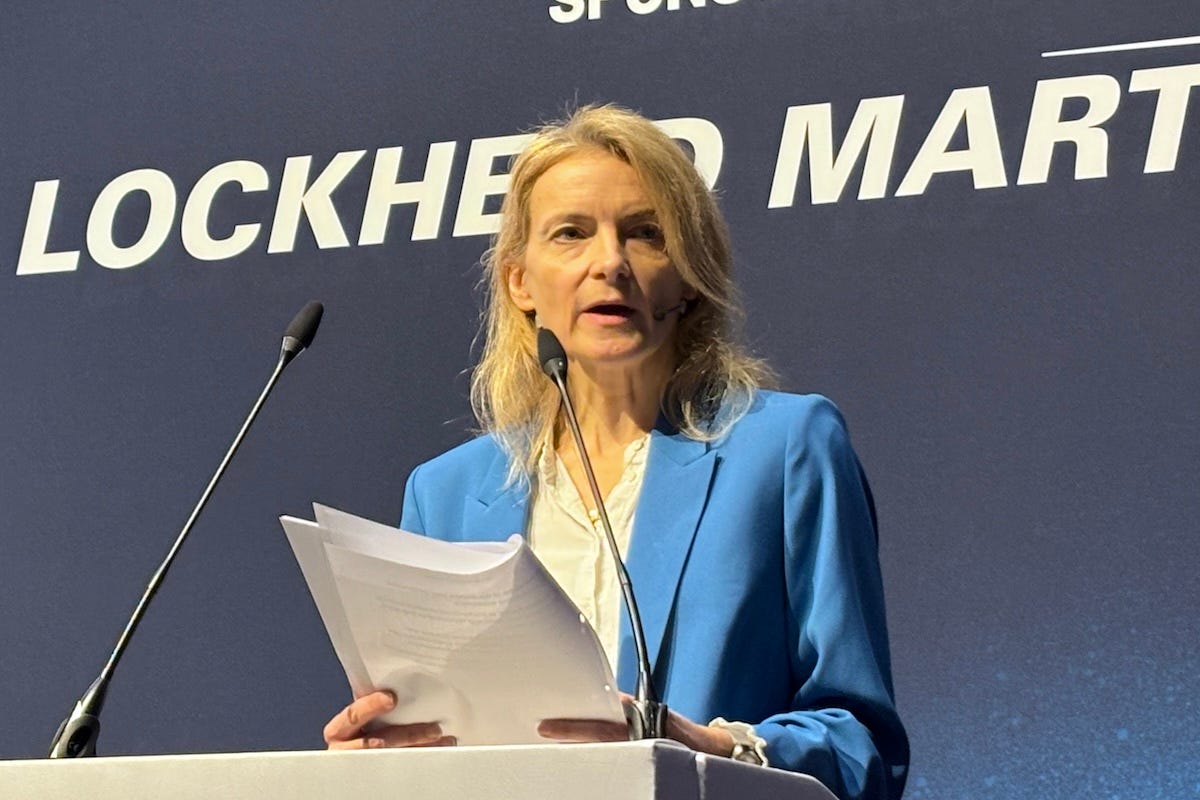
Lloyd delivered her address, titled “Space for Growth and National Security, Responding to a Changing World,” at Space-Comm Expo Europe in London, an event organized by Space-Comm Limited in partnership with the ADS Group.
Her brief at DSIT also covers telecoms, cyber, economic security and space.
The government could no longer fund all seven subsectors of the UK space economy equally, she told delegates, and would go further and faster in four areas it judged critical to economic growth and national security:
Satellite communications
Assured access to space
In-orbit servicing, assembly and manufacturing
Space domain awareness
In March, Lloyd announced a package of over £500 million as part of an overarching £2.8 billion that the government is funding from now to 2030.
The £500 million adds to £1.7 billion Lloyd committed to European Space Agency (ESA) programs in November 2025, which the annual report said secured funding for the Vigil space weather mission, the Rosalind Franklin Mars rover and the European Launcher Challenge.
“This is just the start,” Lloyd said in her speech, adding that the government would publish its full Plan for Space later this year.
She said the UK needed to become more commercialized, specialized and capable as a space power, focusing government support where it would do the most good while staying agile enough to adapt as the world changes.
That drive to prioritize is now being tested nowhere more visibly than in the agency’s most delayed program.
“In addition to completing the national active debris removal mission to safely deorbit two UK-licensed satellites, I am announcing a further £40 million to develop our civil capabilities in ISAM (In-Orbit Servicing, Assembly and Manufacturing). This brings funding for ISAM to over £105 million,” Lloyd said.
That mission, a £75.6 million tender to capture and remove two defunct UK satellites, had its contract award pushed back from a March 31 deadline to summer 2026, the annual report said.
Early concept work was led by the UK arms of Astroscale and ClearSpace, while the agency separately awarded contracts in February to three UK companies, BioOrbit, OrbiSky and Space Forge, to explore developing medicines and advanced materials in orbit.
A 10-year ISAM strategy running to 2035 was developed with the Ministry of Defense, the UK Atomic Energy Authority, and the Science and Technology Facilities Council, according to the report.
Launch setbacks and progress
The UK’s launch sector took a setback in February when Orbex, which was developing a launch site in Sutherland, Scotland, entered administration after failing to secure private investment under the European Launcher Challenge.
“We are disappointed that Orbex has gone into administration and will provide what support we can to help them manage this process. But that does not end our ambitions for launch,” Lloyd said.
“I want to make funding available for the capabilities, skills and infrastructure that enable the launch sector to thrive, and so I can announce £20 million to accelerate spaceport infrastructure development in Scotland,” she said.
SaxaVord Spaceport, the UK’s first licensed vertical launch site, completed mission control, telemetry and tracking infrastructure during the year, with Rocket Factory Augsburg conducting fresh engine testing after a 2024 anomaly, according to the annual report.
Both rocket stages are now in the UK, with a first launch planned for later this year. The agency also led the development of a memorandum of understanding for Starlift, a high-priority access to space program run by the North Atlantic Treaty Organization (NATO).
“We already have cutting-edge capabilities in satellite communications. I want to position UK companies to capture a greater share of the global satellite communications market,” Lloyd said.
She said she would add £80 million to the Connectivity in Low Earth Orbit (C-LEO) program, bringing total satellite communications funding to more than £600 million.
The C-LEO program’s second funding call, worth £30 million and opened on March 4, supported three national projects focused on technology development, market analysis, and commercial readiness, the annual report said.
The agency also advanced direct-to-device satellite capabilities through a €50 million commitment with ESA and Viasat and continued to lead the communications segment of a European lunar connectivity program called Moonlight.
“Space domain awareness is key to understanding and managing an increasingly congested space environment,” she said, announcing £85 million for the National Space Operations Centre, including £40 million for new ground-based sensors.
The investment adds to a £149 million ESA commitment for the Vigil space weather mission. She said it would support hazard alerts for UK-licensed operators, government and international partners.
The center monitored an average of 56 uncontrolled satellite re-entries and issued 1,913 collision warnings to UK operators each month during the year, the annual report said. Daily satellite observations more than tripled after a UK company brought new sensors online in February.
The UKSA reached initial operating capability for Borealis, a civil-military space domain awareness analytical system, alongside upgrades to its public Monitor Space Hazards portal, according to its annual report. Overall, the agency met 67% of its performance targets, with 22% rated close to target and 11% missed outright.
Passing the baton
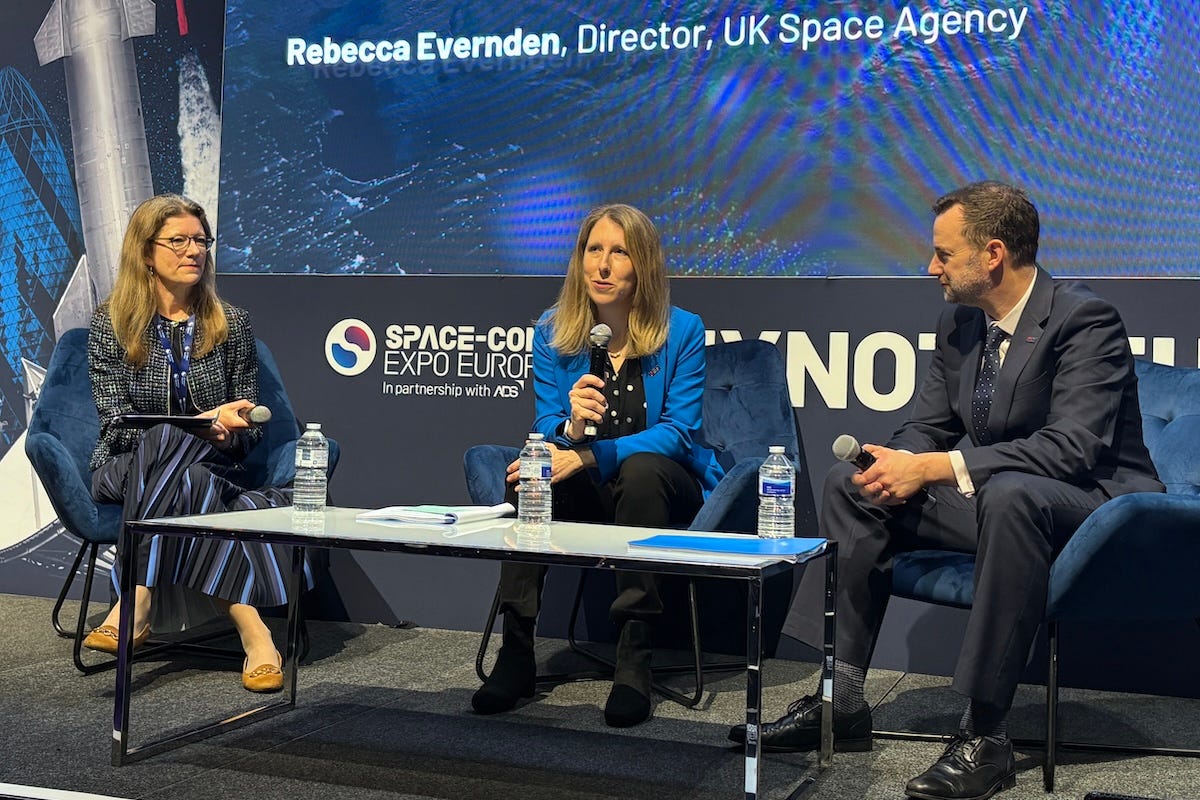
The merger’s human dimension played out later that day in a fireside chat moderated by Dr Joanna Hart, Director of Space Partnership, as Dr Paul Bate, the outgoing chief executive of the UKSA, introduced Evernden to delegates. The two have worked together for at least five years, he said.
“It’s important that you’re passing the baton on to someone who is professional and smart and has integrity and kindness, and that is what you have in your new leader,” Bate said.
Evernden said she and Bate had spent recent weeks working closely together to ensure a smooth handover as the merged organization took shape.
Asked about her priorities, she pointed to the same twin focus Lloyd had set out earlier that morning.
“Economic growth and national security are the things that we must focus on and the things that we must coordinate our activity around,” Evernden said. “So as the new director of the space agency, I will make those the twin pillars.”
Concentrating government support on fewer areas comes with tradeoffs, echoing Lloyd’s shift away from broad, diffuse funding.
“It’s not always easy to make these choices, and I know that the choices that are made are not always the ones that please everybody,” Evernden said. “But for the sake of spending our resources wisely, for really maximizing the impact that we can have, having that focus is extremely helpful.”
For her, the newly merged agency is a chance to speak with one voice on behalf of the sector.
“I’m very proud and excited to have the opportunity now to go on and lead our newly merged UK Space Agency, which will bring together the government’s thinking on strategy, policy and delivery into one organization,” she added.
Looking beyond Britain’s borders, Evernden wants the UK recognized as a reliable partner as international competition in space intensifies.