


Britain’s space sector keeps finding the right idea, then losing momentum just as it needs to scale.
Decades of strength in satellite manufacturing, small satellites, telecommunications and space science have earned the country a reputation as one of the world’s leading scientific nations, built in close partnership with counterparts across Europe.
Converting that early promise into companies that survive their first major funding rounds has proven far harder.
“The UK is fantastic at identifying opportunities and spinning up activity, but then we seem to struggle to scale,” said Malcolm Macdonald, president-elect of the Royal Aeronautical Society and chair of applied space technology at the University of Strathclyde. “We have to be a little bit honest with ourselves. We’ve come through quite a dynamic period, and the perception of the UK has changed through that.”
He pointed to the Met Office’s use of satellite data and the City of London’s strength in regulation, insurance and finance as areas where Britain is world-leading. Data from Seraphim Space, a UK space investment firm, shows local companies raise funding through early rounds only to stall once they reach Series B and beyond.
He said the country remains a trusted partner for space science and major European Space Agency (ESA) missions. He added that investors need a clearer account of why they should back British ventures when far larger sums are available elsewhere in Europe and North America.
“We’ve got some fantastic capability, but we need some more stability in what we’re doing and a little bit better focus on delivering on the track record that we’ve got,” he said.
Macdonald has spent his career working across academia, industry and government, and now leads Project Prism, a Glasgow-based initiative at Strathclyde. He also holds a visiting professorship at the Centre for Space Research at University College Dublin and is a director of Weather Stream, a US-based company providing satellite weather instrumentation and analytics.
An open goal
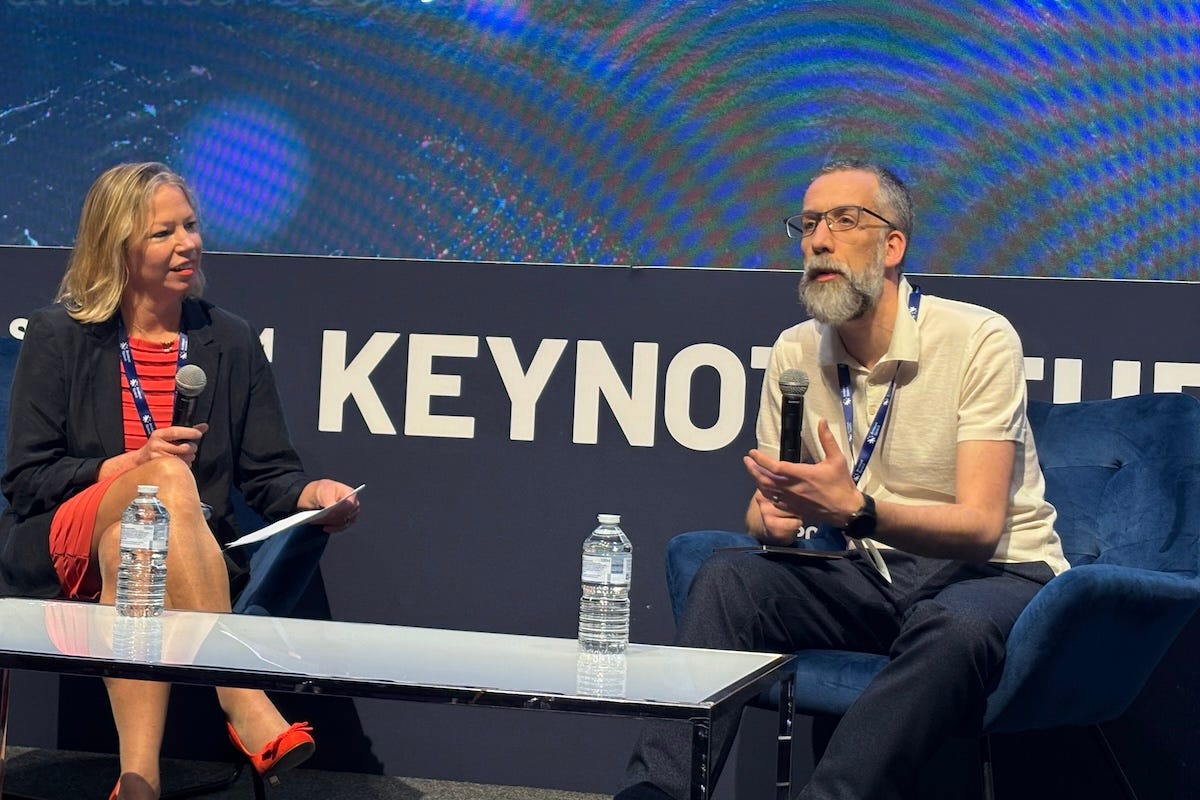
The comments came during a fireside chat at the 2026 Space-Comm Expo Europe in London, organized by Space-Comm Limited in official partnership with ADS Group, the UK trade body for the aerospace, defense, security and space sectors.
Dr. Alice Bunn, president of UKspace, moderated the session on the UK’s ambitions and long-term direction in the space sector.
Bunn recalled how UK space policy has cycled through different structures, from the British National Space Centre, a coalition of government departments with no centralized budget, to a stand-alone UK Space Agency she called productive but limited in its ability to carry weight across government.
“It’s very striking that we’re doing the opposite of a lot of our European peers,” Macdonald said, adding that the Dutch launched the Netherlands Space Agency on March 3.
He said European peer nations are significantly increasing their space budgets as the UK restructures.
He said the UK had decided to try to become a launching nation, but PLD Space announced a 150 million euro investment on March 4, a striking comparison with the investment made into the UK's own launch sector. The Spanish launch company has raised 350 million euros in total, with a further 160 million euros awaiting approval through ESA from the Spanish government.
He added that committing to a priority only matters if it is backed with matching investment.
“Committing to a bad strategy is better than continually changing your strategy,” he said. “Let’s not make perfect the enemy of good.”
He said that same commitment has driven Project Prism in Glasgow.
Project Prism reflects a conscious choice to recognize what’s happening around the world today and better integrate the space and defense sectors to address national security and critical national infrastructure.
Glasgow’s space sector has grown over the past 10 to 15 years as something distinct from the rest of the UK, built around new space rather than displacing activity elsewhere, in a city where Strathclyde already has a strong track record working with defense partners.
“The quantum sector in Glasgow is recognized globally as a leading capability, along with photonics and advanced manufacturing, and interesting innovation happens in the boundaries between them,” he said, adding that these are nationally important initiatives that are locally rooted.
“It’s too easy for a UK government to just spend money in the Southeast of England, when Leicester, Glasgow or Belfast need investment too.”
He said Britain isn’t making the best of capabilities spread across the whole country.
Choosing where to invest
Asked to name three priorities for the UK, Macdonald pointed first to defense.
“No matter what happens in the world, we always seem to end up at war with somebody, so investing in defense and investing in resilience does seem to pay off,” he said.
He said a “no regrets” approach pays off regardless of how global conditions shift.
“Too often in Europe we invest in things because we see that activity happening in the US, but the US customer is the Department of Defense (DOD). We don’t have that same customer in Europe,” he said. “The UK has been recognized for satellite applications and Earth observation opportunities for so long, but it’s never really come through in terms of the scale that we thought it would.”
He said pulling early academic research through the technology readiness level (TRL) pipeline and validating it in orbit would give Britain unique capabilities other countries lack, creating new commercial opportunities, and hoped the incoming agency would focus on the whole pipeline rather than just its end.
Not every priority is about hardware or funding.
“We need to shout a little bit about how space can be a little bit boring at times, and do some of the really dull things that are really valuable to life,” he said. “It’s not always about exploration.”
He said his team is working with a rescue crew on using satellite data to support safe navigation and save lives, and pointed to an announcement from the UK Space Agency about producing medicines in orbit to improve health outcomes.
“There’s a lot of value that space can offer, and the innovation will lead to a lot of these great outcomes,” he said.
Bunn recalled that the Shetland Islands had been cut off from communications that morning after undersea cables were damaged. She said the incident showed the kind of local, practical demand for satellite connectivity that often gets overlooked when strategy is set purely at a national level.
“Places like Shetland are strategically important for a whole range of different reasons for us now today,” he said.
An audience member later asked about the UK’s newly outlined strategy, which the science minister had described as prioritizing sectors including orbital manufacturing, satellite communications and defense.
“It’s a really positive first step that we are making strategic choices,” Bunn said. “We need to now see those funded, costed delivery plans.”
She said space domain awareness still means different things to different people, pointing to the UK’s existing strength in space weather forecasting with the United States as one example, while for others it might mean surveillance, debris analysis or a collision-prediction service.
“There needs to be more of a focus on what the leave-behind capability is when we invest in things,” Macdonald said. “I don’t hear that level of detail coming through yet, but the space agency isn’t yet in place, so we need to give them the chance to communicate.”
The real test lies ahead, whether the strategic choices outlined in recent months are matched by funding, delivery plans and patience for a still-forming agency to prove itself.