


The UK must become an early buyer of quantum technology and fund its adoption, not just its invention, to keep its lead, experts say.
That lead is real. A UK Research and Innovation (UKRI) evaluation published on November 6 credits the national quantum program with 74 spinouts, more than 2,000 skilled jobs and about £482 million of private investment. But prototypes still need help to become products that customers will buy.
“It’s about government buying early and being the early customer. They need to fund adoption and not only innovation,” said Tony Lowe, chief executive of Delta.g.
“A secret ingredient to all the things you need to meet for a good product is urgency, and the role of government is to increase urgency,” said Carmen Palacios-Berraquero, founder and chief executive of Nu Quantum. “Programs like ProQure remind quantum computing companies that they need to aim for utility and beyond.”
She said many firms used to focus on small machines that might be sold as research and development (R&D) tools.
“Over the past couple of years, there’s been a huge shift toward commercial utility, and that’s what has given the industry a common timeline. This race doesn’t end at utility; it begins at utility,” she said.
Lowe said government support has already helped Delta.g. The National Security Strategic Investment Fund (NSSIF) invested £750,000 in its seed round in September 2025, taking 11 weeks from first contact to clearing most of its investment committees. Within 10 days, it offered an R&D contract worth more than twice that amount.
“It’s great that you’re enabling early-stage companies to develop this technology, but there’s a manufacturing loop that you have to go through, and people need support for this,” he said.
He also urged the UK to own a critical component of the quantum supply chain.
Chander Velu, professor of innovation and economics at the University of Cambridge, said many UK photonics firms supply parts to manufacturers in China and elsewhere. Making components for quantum computers may not yet make economic sense for them.
“If we think about the keystone players in that chain of activities and get their business model aligned, then the rest of the community’s business models would slowly get aligned. Otherwise, the whole system, however good the technology is, can get stuck and never get adopted,” he said.
He said the risk is that nobody wants to move first.
“It’s a classical economics problem where there’s a public good where everyone benefits, but nobody will pay for it. This is where government can play a role, where we formulate a program where the firms come together to tackle a big societal problem,” he said.
Productivity may dip first
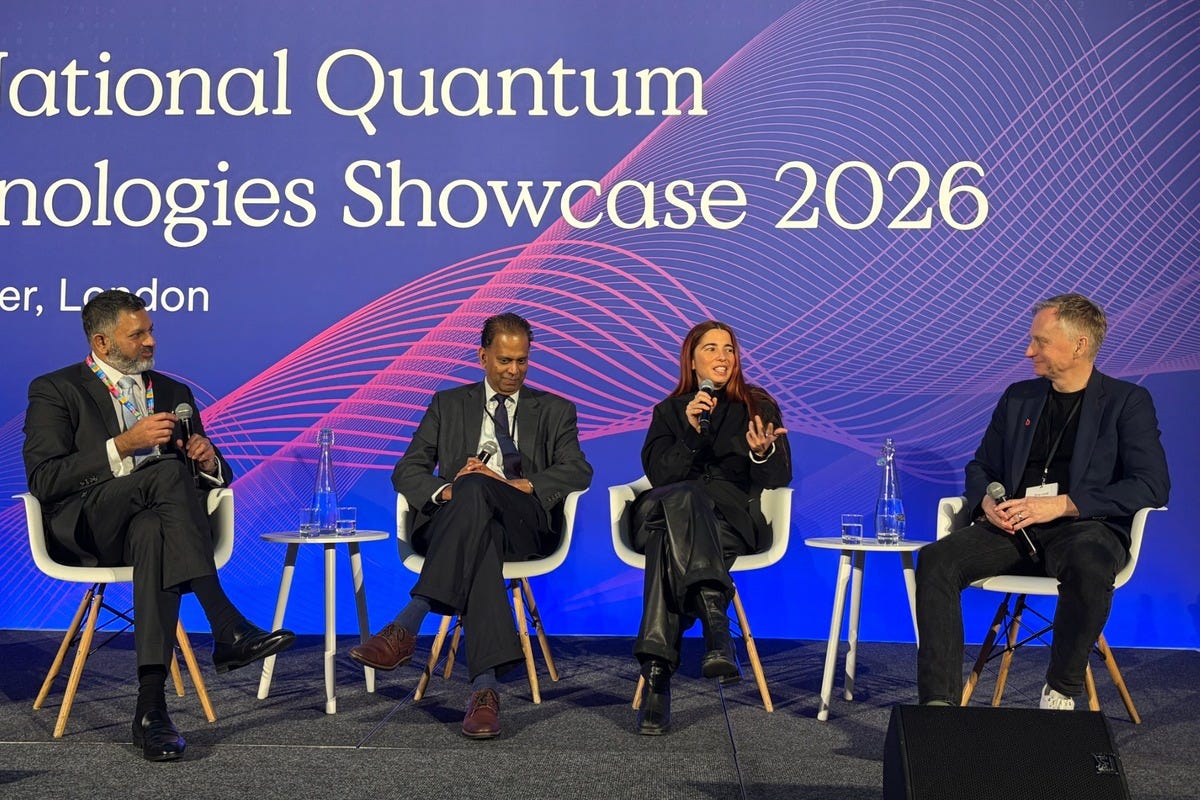
The panelists were speaking at the UK National Quantum Technologies Showcase 2026, organized by Innovate UK for the UK National Quantum Technologies Programme in London on November 6. Leon Lobo, director of quantum at Innovate UK, moderated the session, titled “From lab to market: The road to commercialising quantum tech.”
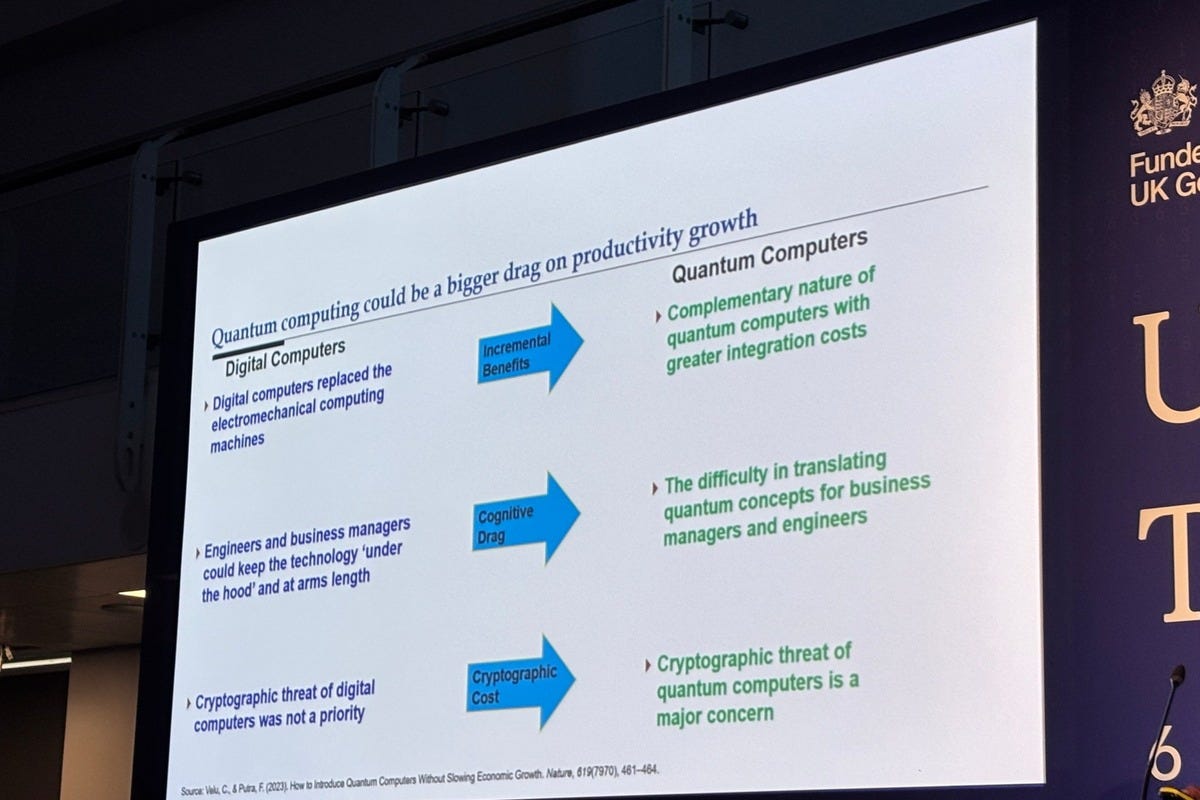
Velu warned that quantum computing could slow productivity growth before it lifts it.
Every general-purpose technology, from electric motors to digital computers, has caused such a dip. In the US, labor productivity growth fell to 1.28% a year between 1976 and 1990, from 2.04% in the previous 15 years.
“Our proposition is that the same thing is likely to happen. There’s going to be a dip in terms of productivity growth before it takes off. In fact, it’s likely that that dip might be even more severe than it used to be during the time of digital computing,” he said.
He said the dip could be deeper this time for three reasons:
Quantum computers will work alongside classical high-performance computers rather than replace them, adding integration costs while early gains may be small.
Quantum concepts are hard for business managers to translate.
Companies will focus on protecting their data from quantum attacks before weighing the technology’s value.
“When it comes to quantum computing, there’s always the challenge of translation between engineers, scientists and business managers, and therefore there’s a cognitive drag. The cognitive drag will add cost, and therefore it could slow down productivity,” he said.
Lowe said Delta.g faced similar integration hurdles while turning a lab instrument into a field product. The company was spun out of the University of Birmingham in 2023 after a decade of research at a national quantum hub. Its quantum gravity sensor finds things underground without digging a hole.
“We’ve got an amazing frontier technology. It’s our founders’ life’s work. Turns out customers don't care about quantum or gravity. They’ve got a problem, and they need an answer,” he said.
The UK spends £2.4 billion a year fixing accidental strikes on gas mains, power cables and communications lines.
He said startups often mistake a big company’s new-technology team for a buyer. The real decision-makers are front-line operations teams who must fit a tool into their workflow, senior managers and purchasing teams that judge everything by the numbers. Delta.g brings them all into workshops to map their daily pain points.
“Nobody is going to change their processes for a company that’s just brought this interesting new tech. You’ve got to fit in. The integration cost alone can outweigh the value of the technology,” he said.
Delta.g named its sensor the Rhino and painted it bright orange to make the technology feel familiar.
Building quantum data centers
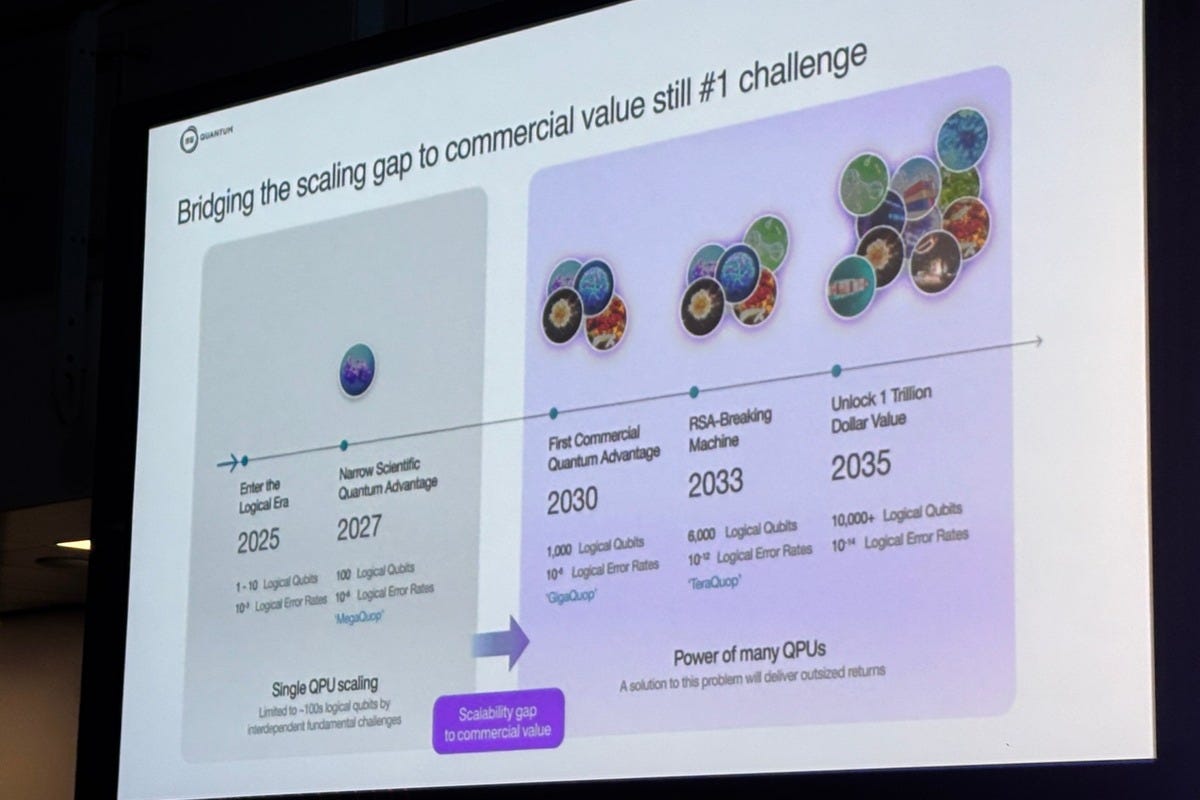
Palacios-Berraquero said scale remains the biggest barrier. Ever-larger single processors run into limits on chip yield, temperature, power and cooling, so Nu Quantum links many processors into one machine, much as artificial intelligence (AI) data centers connect hundreds of thousands of graphics processing units (GPUs).
“Commercial quantum computing systems won’t look like single chandeliers. They will look like small data centers or high-performance compute systems made of many modular quantum processors interconnected by a quantum network,” she said.
Nu Quantum plans to network trapped-ion machines first, then neutral-atom systems from 2027, followed by superconducting and silicon-spin qubits.
She said a well-connected modular system can also survive the failure of a single module, treating it as an error the network corrects. The company published that result in May 2026.
Innovate UK announced £35 million on November 6 for two quantum networking testbed calls, opening in February 2027.
An audience member from outside the sector asked whether industry is calling for quantum computing yet. Palacios-Berraquero said pharma, energy, finance and defense companies that rely on computational chemistry are building internal skills so they are ready once machines reach scale, though no one has reached commercial quantum advantage.
“Today it is still government that’s the biggest customer of quantum, but that shift will happen in the next few years,” she said.
She said much of the industry now accepts that no single company will build a whole quantum computer. Nu Quantum set up the Quantum Datacenter Alliance (QDA) in 2025, and its October event in London drew people from more than 70 companies, including Cohere and Nvidia, to discuss benchmarks, interfaces and standards.
“These systems will need to be an ecosystem that flourishes, where there’s competition between layers, where companies specialize in their core IP (intellectual property) and collaborate on other parts,” she said.
Lowe said quantum sensing could cut costs for infrastructure owners. He said Delta.g speaks with telecom operators such as BT and Vodafone, which often dig up high streets to find faults, while a precise map would let crews dig a two-meter square hole and leave within half a day.
Delta.g’s next-generation sensor, due within weeks, should detect tunnels 10 to 15 meters below ground.
Velu said some markets still have to be created. Blind quantum computing, where a provider runs a calculation without seeing it, could change how banks, which now build their own systems to keep calculations private, think about the technology.
He said the next generation of National Quantum Computing Centre (NQCC) testbeds, including an IonQ computer to be donated to Cambridge, will link application development more closely to the technology itself. He said the UK will also need leaders who understand both quantum science and business.