


The UK government will give strategic artificial intelligence (AI) data centers priority access to the grid as it seeks to triple Britain’s AI compute by 2030.
The country has about 2 gigawatts (GW) of AI-optimized compute and wants at least 6GW for sovereign use.
“Unlike many other countries, where people are going from door to door to try and figure out whether they can get an incremental bit of grid, we will prioritize the most strategic projects,” said Kanishka Narayan, minister of state for AI in the UK government. “There are hundreds of projects in the pipeline, but a lot of those are speculative.”
He said communities want the benefits of AI infrastructure now and close to home, not promises of future gains.
Narayan said the government faces two challenges. British communities are asking what they gain from hosting AI infrastructure, while investors worldwide say time to power matters most as transmission systems become jammed. He will run a ministerial control center to tackle both.
In return for priority, developers must build for sovereign capacity, give local communities a voice and support the British AI hardware sector.
A new data center covenant also favors projects that support communities on energy, water and environmental standards.
“There’s a lot of public narrative that somehow this stuff isn’t working. I’d encourage everyone just to build your own tracker as well and go see the projects,” he said.
Construction has started in Lanarkshire and the North East, where people are being hired, and some compute in South Wales is already live. North Wales, which pairs small modular reactors (SMRs) with a data center, was always a longer-term project. Culham is a bet on nuclear fusion with its own timeline.
“Alongside pressing the accelerator, we want to turn the steering wheel towards the things that matter strategically,” Narayan said.
He said each AI Growth Zone serves a strategic purpose, from fusion at Culham and SMRs in North Wales to solar plus batteries in Lanarkshire, financial services in the North East and the semiconductor cluster in South Wales.
Asked whether the grid gets enough investment, he said the political answer is always no. He wants more transmission investment, including through the Energy Secretary’s GB Grid. He has seen startups looking at AI for grid flexibility, which could let compute clusters smooth demand and spread the network’s fixed costs over a bigger base.
Narayan, a former venture capitalist, became the UK’s first Cabinet-attending AI minister on July 20.
Chips as a hedge
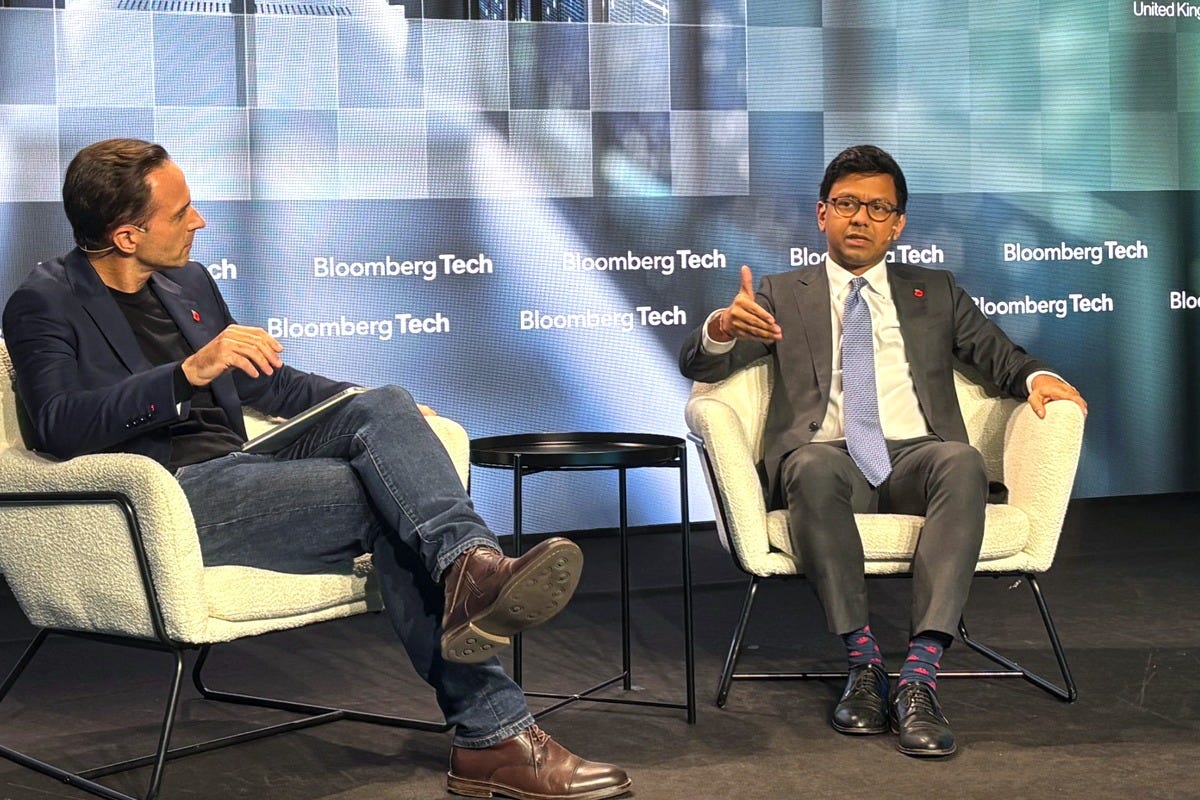
He spoke at Bloomberg Tech London, a conference organized by Bloomberg in London on November 3. Tom Mackenzie, an anchor at Bloomberg Television, interviewed him in a session on whether Britain can compete in the AI race.
He defines sovereignty by outcomes, such as keeping people safe online, staying prosperous and keeping defenses secure.
“The outcome for me is for Britain to be able to shape its destiny on questions that are most critical to the public good. I very importantly used the word discretion rather than total ownership,” he said.
He said Britain will not build graphics processing units (GPUs) overnight, so his first move in the job last year was to secure as many as possible from Nvidia. He then persuaded Groq, SambaNova and Cerebras to open UK offices to support British work on inference chips.
“In some cases you build full-fat British and own the part of the stack that is critical,” Narayan said.
The government unveiled a £1.1 billion AI Hardware Plan in June. He said next-generation chip companies raised $1.6 billion in the past year, more than in the previous 10 years combined, partly due to that focus.
Asked about Anthropic’s planned initial public offering (IPO), he said Britain must ask who supplies capital for its AI projects.
“You have some very unusual stuff going on, with the hyperscalers being shareholders, customers and ultimately credit guarantee providers in some cases as well,” he said.
He said untangling that web of circular financing, especially in private credit, is a critical question. He was positively surprised by Anthropic’s cash and balance sheet, and its latest quarterly operating margin on a compute-purchase basis looked much better than he had expected.
“Are we too anchored on the downside, thinking about the crunch, rather than thinking about what happens if these guys continue on this self-improvement track and are able to finance it?” he said.
He also flagged a duration mismatch between labs’ customer contracts and compute commitments, with revenue concentrated in the latest model.
Britain is placing its bets on three areas:
Next-generation inference compute
Non-language frontier models for materials discovery, drug discovery, computer vision and world models
AI adoption across services, life sciences, cyber, and trust and safety
“It doesn’t matter whether you get Claude being the winner, or whether you get Nemotron or Cohere or Mistral being the winner. If you’ve got the chips, you’ve got a diversified hedged bet,” he said.
Cyber breach extremely likely
Asked whether cybersecurity risks keep him up at night, Narayan said yes, naming them alongside biochemical threats and loss of control as the three AI risks he watches. He has said a cyber breach is extremely likely in the UK, in both the public and private sectors.
“I worry about the cybersecurity stuff because it’s here now. It exposes where we’ve been as a country and a world, which is [that] we’ve got a backlog of vulnerabilities,” he said.
He said AI probably widens the attack surface even further. Board-level ambition has historically fallen short of the scale of vulnerabilities across UK organizations, and he wants that to change. The Budget included £60 million for a National Cyber Shield that will use AI agents to improve defenses.
The AI Security Institute (AISI) still gets access to the latest generation of models, and the last one it tested came from DeepMind. The Budget gave it an extra £120 million.
Narayan said the UK is the only government with this kind of testing capability. Its pitch to the US government and the labs is that, if they engage with Britain, it will lead on safeguards for safe testing, a very new science that others would find hard to match.
“Nothing is particularly a permanent guarantee in the world of AI,” he said. “So long as we keep building the argument on the basis of both capability and trust, I feel very hopeful.”
He said factory laws had no bite until factory inspectors arrived, so the government is doubling down on state capacity.
He said what AI companies may not be able to do in future is a philosophical question more than a regulatory one. Companies that see major risks in their own models need better safeguards to win a large, trusted market for AI agents, built on identities, gateways and permissions.
Narayan would not say whether the UK might ban Chinese models such as DeepSeek.
He said Office for National Statistics (ONS) data suggests open-weight models, mostly Chinese, hold 20% to 30% of the UK enterprise market. He added that shaping Britain’s destiny is different from owning every part of the AI stack.
“You’ve got to be very honest about where you are, but also make sure that you’re building the right level of assurance and security, which is both a question of the model and a question of the deployment environment in which you’re using the model,” he said.
Narayan aims to get the first new AI data center project running within 18 months and reach 6GW of compute by 2030.