


Britain has named digital assets as the engine of a financial services revival — and it is now putting legislation behind that ambition.
The UK government used the King’s Speech on May 13 to introduce the Enhancing Financial Services Bill, a sweeping package designed to modernize regulation and restore growth to a sector that has stagnated in real terms since 2010. Digital assets and payments reform sit at its core.
“This financial services bill contains major reforms that are going to drive growth in our financial services sector, and therefore for the whole of our economy,” said Lucy Rigby, Economic Secretary to the Treasury. “I could not be more focused on getting on with the major reforms that this country needs.”
“We are providing firms with the certainty that they need,” Rigby said. “They have been calling for some time to get that legislation down. They were very pleased when we got there. It gives us that certainty of landscape that we know people need to be able to invest in this country and grow.”
The bill, one of around 35 pieces of legislation in the King’s Speech, delivers key parts of the Leeds Reforms announced by Chancellor Rachel Reeves in July 2025. It will consolidate the Payment Systems Regulator within the Financial Conduct Authority (FCA) and cut the burden of the Senior Managers and Certification Regime by 50%.
Despite being the world’s largest net exporter of financial services — with exports totaling £102.2 billion in 2025 — the sector has not grown in real terms since 2010, lagging behind several international financial centers that recovered more strongly after the global financial crisis (GFC) in 2008.
Rigby outlined three policy pillars underpinning the digital assets push:
Payments: modernizing and streamlining payments regulation, with a consultation announced during FinTech week due imminently. It will cover stablecoins and AI agents within the payments space.
Wholesale markets: digitalization of capital markets through an active sandbox, an upgrade of the Bank of England’s Real-Time Gross Settlement (RTGS) system to enable near 24/7 settlement, and the ambition to become the first G7 country to issue a digital gilt.
Crypto assets legislation: new rules, laid earlier in 2026, to bring crypto assets under the Financial Services and Markets Act (FISMA) framework, with the FCA authorization portal set to open later this year.
Transatlantic race
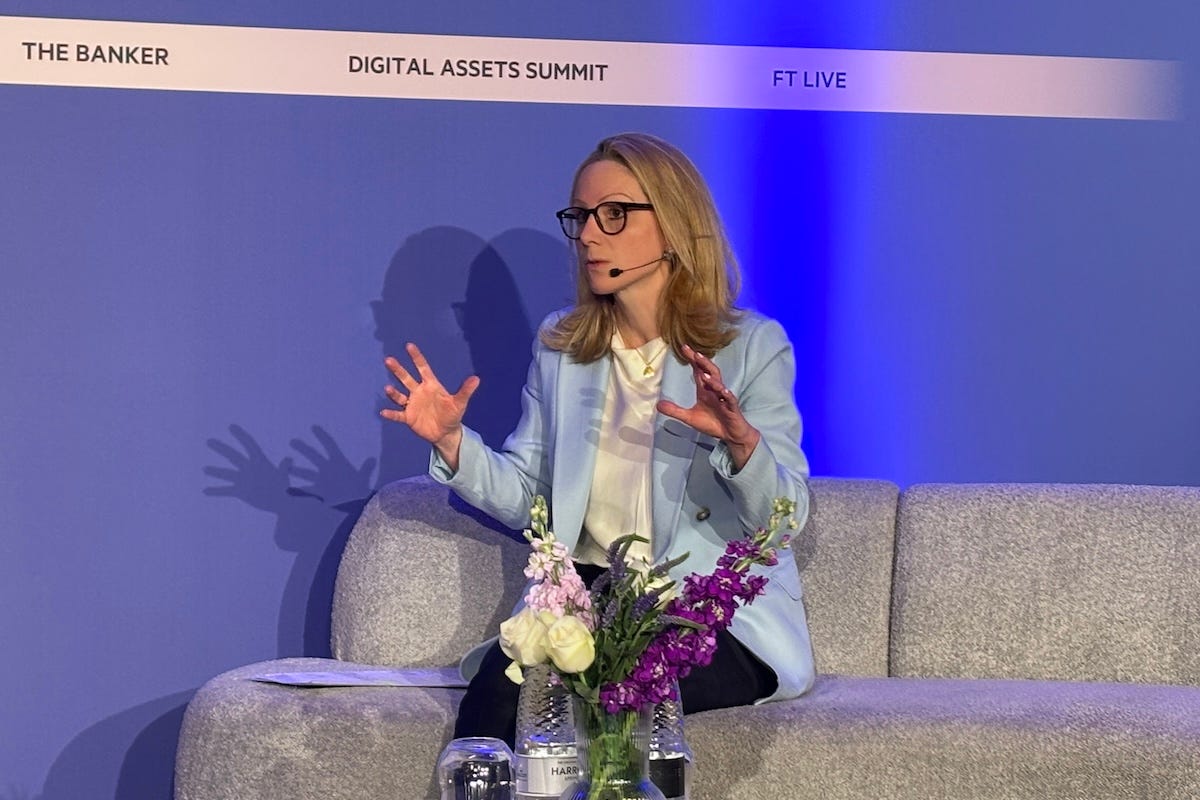
The keynote interview took place at the Financial Times Digital Assets Summit in London on May 13. Martin Arnold, the Financial Times' financial regulation editor, interviewed Rigby on the UK’s digital assets agenda.
Rigby came to her ministerial role after a long career as a City solicitor, and she frames the digital assets moment in the broadest historical terms.
She traced Britain's financial prowess back to its seventeenth-century roots, framing the current era as the latest chapter in a long history of market evolution. This legacy of constant adaptation serves as the foundation for the next great shift in global trade.
“Right from the coffee houses on the banks of the Thames in the 1650s, we have continually embraced innovation,” she said. “Digital assets are the next wave of innovation, and I am very ambitious for this country in this area.”
The interview came against a backdrop of growing pressure on the UK to demonstrate it can compete with the United States and Europe.
Arnold cited criticism from former Chancellor George Osborne, now working for a large crypto group, who has warned the UK risks being left behind. He also referenced Dante Disparte, Chief Strategy Officer of Circle, one of the leading US stablecoin issuers, who wrote in the Financial Times that stablecoins are becoming too important for the UK to lag behind.
Rigby pushed back on Europe first. The UK had deliberately chosen not to replicate certain elements of the EU’s Markets in Crypto-Assets Regulation (MiCA), which came into force in 2024.
“When you look at what’s going on in Europe, you have MiCA in 2024, but there are elements of that which we didn’t emulate in our legislation,” she said. “Our approach is the better one.”
On the United States, she acknowledged a spirit of optimism but noted that American rules around market structure have not yet cleared the legislative process.
“In the States, there is a spirit of real optimism around this area, and that is a real positive,” Rigby said. “But when you look at the need for rules around market structure to come forward, those rules haven’t yet made it through the legislative process. I think we are in a very good place relative to other jurisdictions.”
That confidence is also shaping the UK’s international posture. A transatlantic task force covering digital assets and capital markets has been established between the UK and the US. Rigby said the Treasury regards the digital assets strand as particularly important.
She declined to pre-empt announcements expected later in 2026 but indicated outcomes could include regulatory recognition or alignment.
“It is right to acknowledge where we are in terms of development of regulation regimes and this technology more broadly, and be looking to minimize frictions,” she said. “That may well take the form of some forms of recognition or alignment. It is not just the States — we are looking at where we can ensure maximal cooperation.”
Sterling stablecoin push
One of the most commercially watched elements of the agenda is the development of a GBP stablecoin. Four firms are currently in the stablecoin cohort of the UK’s financial market infrastructure sandbox, each expressing a clear intention to launch.
“We have four firms at the moment within the stablecoin cohort of the sandbox, and they have each said they are keen to get a GBP stablecoin out there,” Rigby said.
The Digital Gilt Instrument (DIGIT) remains a centerpiece of the wholesale markets pillar. Rigby said it is intended to do more than demonstrate technical capability — it is meant to catalyze broad adoption of distributed ledger technology (DLT) across UK markets.
“We believe that the digital gilt has the ability to catalyze wide use of DLT,” she said. “The interoperability piece is really important — collateral, secondary trading. There are all sorts of stuff this can catalyze.”
The interview also touched on the political turbulence surrounding the agenda. The Labour Party had suffered a poor set of local elections on May 7, and the fallout intensified in the days that followed, with an internal party crisis that brought Prime Minister Keir Starmer close to stepping down, raising fresh questions about the government’s stability.
Arnold pressed her on whether that instability could derail momentum on financial services reform. She acknowledged the pressure directly.
“It has been a tough 48 hours,” Rigby said. “My party had a pretty abysmal set of local elections, and people have rightly questioned why and questioned the leadership. But we have a process for triggering a challenge to the leader, and that process has not been triggered.”
She acknowledged the instability had market consequences but said her focus remains entirely on the legislative agenda.
To those in the industry sending pointed messages about the pace of reform, Rigby said she welcomes every one of them. The pressure, she said, comes from the right place — a shared desire to see the UK move quickly and attain a global leadership position in digital assets.
Her message to skeptics weighing whether to back the UK was equally direct: continued engagement and shared ambition have already brought the country to a strong position, and that is how it intends to press forward.