Britain wants to turn its strengths in chip research and design into products it can sell, as the next phase of artificial intelligence (AI) relies on hardware as well as software. Chips now underpin AI, communications, clean energy, defense and digital infrastructure.
Value lies not only in the chip itself but in how it is designed, integrated and used within wider systems.
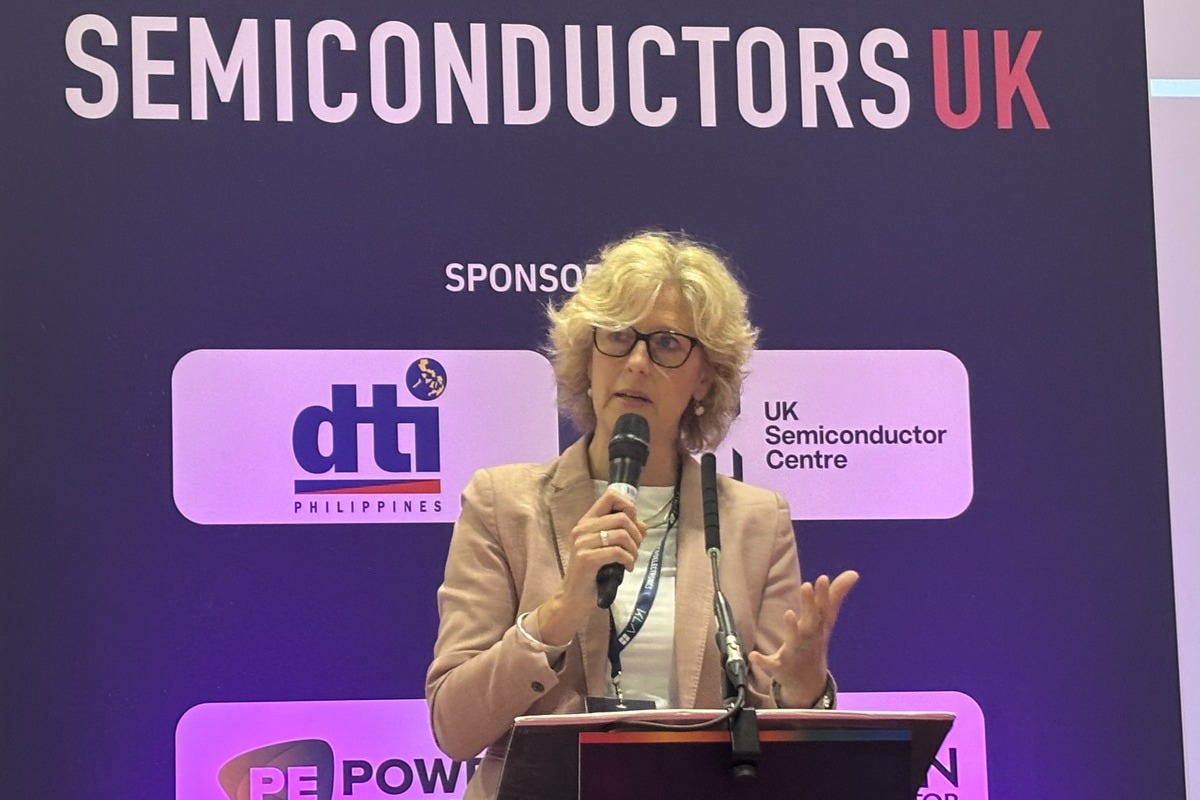
“AI will define the economic and security landscape in the coming months and years ahead, but the next phase of technology development is not going to be driven by software alone,” said Julia Sutcliffe, chief scientific adviser at the Department for Business, Innovation, Science and Trade (DBIST). “The quality of the hardware solution is going to shape what the wider systems can do.”
“Semiconductors are an absolute enabling layer behind all of those systems. They sit between scientific discovery and practical application,” she said. “They shape performance, energy efficiency, security, connectivity and scale.”
“A good idea has to transition from research through to design, into prototyping, testing, packaging and validation before it can become a product or a system that customers can rely on, and that we can trade in a globally competitive environment,” Sutcliffe said.
She said the government’s role is to make that journey easier, so brilliant ideas grow into British businesses. That means backing research, improving access to infrastructure and helping companies move from prototype to product.
“It’s also going to mean being super clear about priorities, so that public support is focused where it can have the greatest impact,” she said.
The UK’s Modern Industrial Strategy, published in June 2025, names eight priority sectors, with AI and semiconductors prominent within digital and technologies. The AI Hardware Plan, published in June, sets out £1.1 billion of investment to secure Britain’s capability and strategic advantage in chips.
The plan’s main elements include:
£750 million for a national AI supercomputer, including £400 million to buy next-generation AI chips
£120 million for an AI Hardware Innovation Programme
£45 million for skills, backing doctoral training and undergraduate bursaries
£18 million for a Hardware Security Research and Development Programme
“Finance is essential. We need to match the realities of what is achievable with the hardware products that we need, and so government has a role to play in connecting those finance pathways,” Sutcliffe said.
She said the government’s support includes:
Early-stage grants
The British Business Bank and the National Wealth Fund
Advance market commitments that signal demand
ChipStart UK, which helps promising semiconductor startups access commercial expertise
“The UK Semiconductor Centre is an important part of turning that plan into a clearer, more joined-up offer for the sector. It will provide an obvious front door for the UK ecosystem, for companies, for investors and international partners,” she said.
AI Minister Kanishka Narayan, who made last year’s conference one of his first ministerial engagements, sent his support. Sutcliffe said his new role in the Cabinet Office underlines the agenda's importance across government.
Growth in every postcode
Sutcliffe gave the opening address on the Semiconductors UK stage at Microelectronics UK 2026 in London on September 29. Martin McHugh, board chair of Novomorphic, chaired the conference.
Sutcliffe said Britain’s base includes chip design, compound semiconductors, photonics, power electronics and advanced materials, as well as four of the world’s top 10 universities. She pointed to the South Wales Compound Semiconductor Cluster, which she recently visited, and to Glasgow’s strengths in photonics and advanced manufacturing.
“When companies, universities, investors and specialist facilities are co-located and can collaborate, ideas accelerate, supply chains become stronger and businesses are much more likely to grow where they started,” she said.
She said building clusters also means backing regional growth so that new technologies create opportunity across the UK.
“No country can be self-sufficient in this space, and nor does it need to be. What we need to have is key partnerships and robust supply chains,” she said.
She asked companies to identify the barriers holding them back and tell the government where they are.
Andy McLean, chief executive of the UK Semiconductor Centre, returned to Britain after 35 years in the US and took up the post in May. He said the center, formed a little over a year ago, has been operational for about six months.
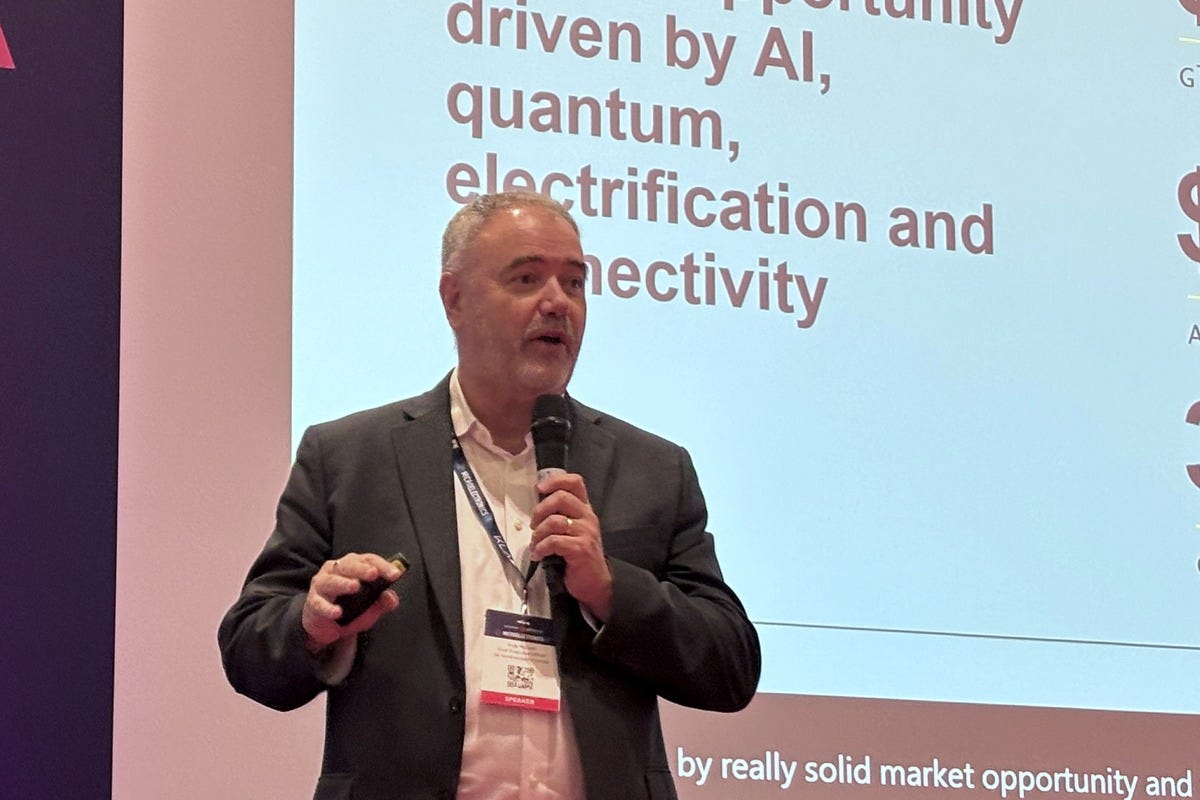
The government’s National Semiconductor Strategy, published in 2023, committed up to £1 billion over 10 years. McLean said study groups that followed found strong clusters in South Wales, Northern Ireland, Scotland, Cambridge and northern England, but nothing linking them.
“We have incredibly strong communities throughout the UK. They don’t talk enough,” he said.
Britain has about 700 semiconductor-related companies, around 300 of which list chips as their main business. Those 300 firms generate about £11 billion a year, while some 16,000 people name semiconductors as their primary employer.
McLean said that leaves the UK with roughly 1% of a global market now worth more than $1 trillion.
“Whilst it’s a good number generating a lot of economic value, we’ve got some work to do to become relevant in the global semiconductor market,” he said.
“There is no better place in the world for research [and] innovation, everything from fundamental research through to applied science. But we have a problem. We haven’t been able to scale,” McLean said.
He named three obstacles:
Investment
Skills and workforce
International partnerships
Dozens of skills programs now run from primary school initiatives to PhD student exchanges, though every country reports a shortage of semiconductor talent.
“We feel as if the UK has been a little bit too myopic in looking at what we can do here, and maybe not as aware of what we could do by developing stronger and more effective international relationships,” McLean said.
He recently led a UK delegation to Taiwan to introduce the Taiwanese chip industry to what is happening in Britain.
Government as lead customer
McLean put recent government support for the sector at about £10 billion, while acknowledging that the total double-counts some programs.
“The government can’t fund to the extent that’s necessary to invest and grow into that $1 trillion or $2 trillion opportunity. But what government can do is seed some of this activity and indicate to the broader private investment community that they should be taking note of what’s going on in the semiconductor sector,” he said.
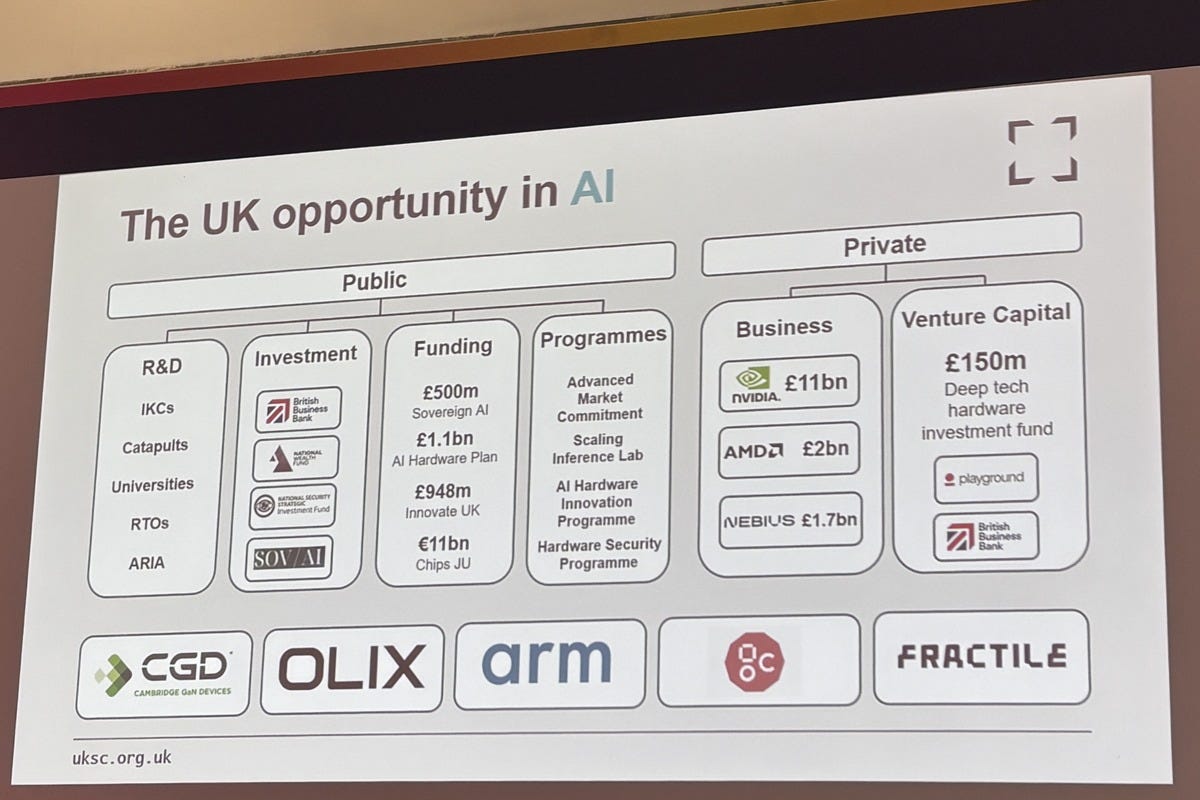
Under an advance market commitment in the AI Hardware Plan, £150 million of the chip budget will buy next-generation inference chips, with the government acting as lead customer. McLean said startups need a lead customer to secure investment.
He said scaling also needs multinationals, venture capital and spinouts. Public backing includes up to £150 million from the British Business Bank for a Playground Global fund and the £500 million Sovereign AI Fund, an investor in Olix. Private money is now following.
His slide also listed £948 million from Innovate UK, the National Security Strategic Investment Fund and the €11 billion EU Chips Joint Undertaking, alongside commitments of £11 billion from Nvidia, £2 billion from AMD and £1.7 billion from Nebius.
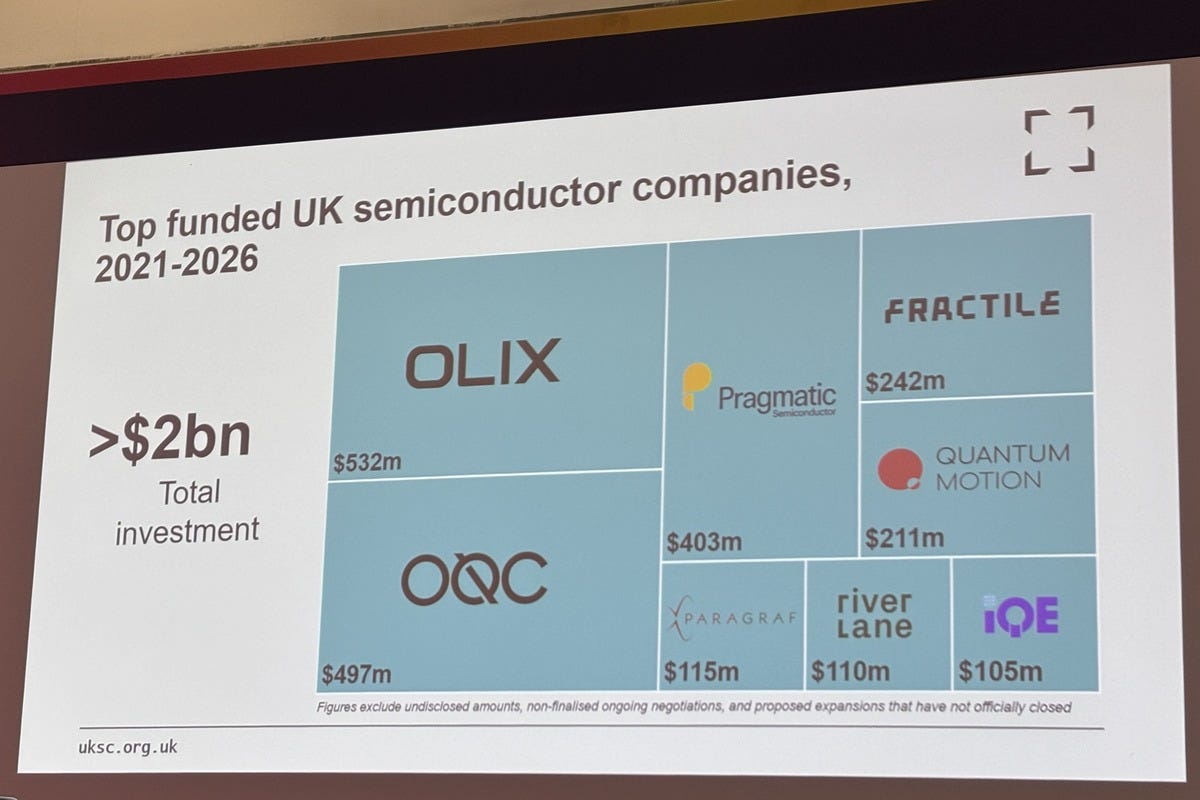
A UK Semiconductor Centre chart shows the country’s top-funded chip companies raised more than $2 billion between 2021 and 2026, led by Olix at $532 million, Oxford Quantum Circuits at $497 million and Pragmatic Semiconductor at $403 million.
“If I had put this slide together six months ago or a year ago, you wouldn’t be seeing these kinds of numbers. You’d have been seeing $10 million or $15 million here and there,” McLean said. “It takes $100 million or $200 million just to get to a prototype.”
Much of the investment so far has come from overseas, and he said the center wants more from British investors.
Responding to an audience question raised earlier in the day about when the UK would build an advanced complementary metal-oxide-semiconductor (CMOS) chip plant, McLean gave a blunt answer.
“My answer is pretty straightforward. Never. We don’t need one,” he said. “There are already six of them below 5 nanometers in development right now.”
One belongs to Rapidus in Japan. In June, the UK Semiconductor Centre signed a memorandum of understanding (MOU) with Rapidus giving UK companies access to its 2-nanometer plant being built in Hokkaido. McLean said Qualcomm, Nvidia and Arm all grew through partnerships.
“You can’t do it all on your own, or at least you shouldn’t do it all on your own. If you don’t have a capability or resources to go do something, go partner and get it done,” he said.
He said forecasts keep running behind the market. A $1 trillion market by 2030 looked bullish only a few months ago, but global sales have already passed that mark and are now heading for $1.5 trillion to $1.6 trillion this year.
AI drives most of that growth, though electrification and digital infrastructure lifted the industry before the AI boom.
“I’m sure everyone here has an opinion on quantum, but without a doubt, it will happen, and it will be double-digit growth for many years,” McLean said.
He said $2 trillion by 2030 may prove an underestimate, with quantum computing and silicon photonics emerging as further sources of growth.