


An artificial intelligence (AI) agent built to handle routine police contacts is instead becoming a first point of confidence for victims of some of the most serious crimes.
The system, known as Bobbi, was designed to filter out non-emergency calls, freeing officers to focus on genuine crime. But it has also revealed an unexpected pattern: people who are too anxious to speak to an officer often open up to the agent first.
Policing’s use of AI has drawn scrutiny before, particularly over facial recognition. Officers built strict guardrails into the system, limiting it to internal language models (LLMs) rather than external ones. The force believes Bobbi is the first agentic AI deployed in UK policing, possibly the first in the world.
“People who perhaps aren’t confident enough to pick up the phone and talk to a police officer will actually engage with the agent and have that conversation,” said Rob Brind, Superintendent and Head of Operational Delivery for Contact Management at Thames Valley Police and the Hampshire and Isle of Wight Constabulary.
“We’re seeing it in serious sexual offense cases and also domestic abuse, where people will speak to the agent, get advice and build up their confidence before we start dealing with it,” Brind said. “That was a real eye-opener to us. We didn’t expect that contact to come through, and it came through within days of us going live.”
Zahra Bahrololoumi, President, UKI at Salesforce, said the tool’s rapid rollout reflected months of preparation rather than a rushed deployment.
“Agent Bobbi was operational within 12 weeks,” she said. “But the level of vigilance and hypercare in educating and testing the data sets meant they didn’t just let Agent Bobbi out into the wild. They were very thoughtful and vigilant about that.”
Brind said the tool now handles about 14,000 citizen contacts a year, work that would otherwise require two to three additional contact center staff.
He said it took three to four weeks to build the system, but far longer to test it and add guardrails to ensure the advice it gave remained accurate.
He stressed that the goal was never to cut costs but to redirect capacity toward victims of serious crime and free officers from routine administrative work. The platform lets the force make changes quickly, without waiting on traditional software development cycles.
Room to be human
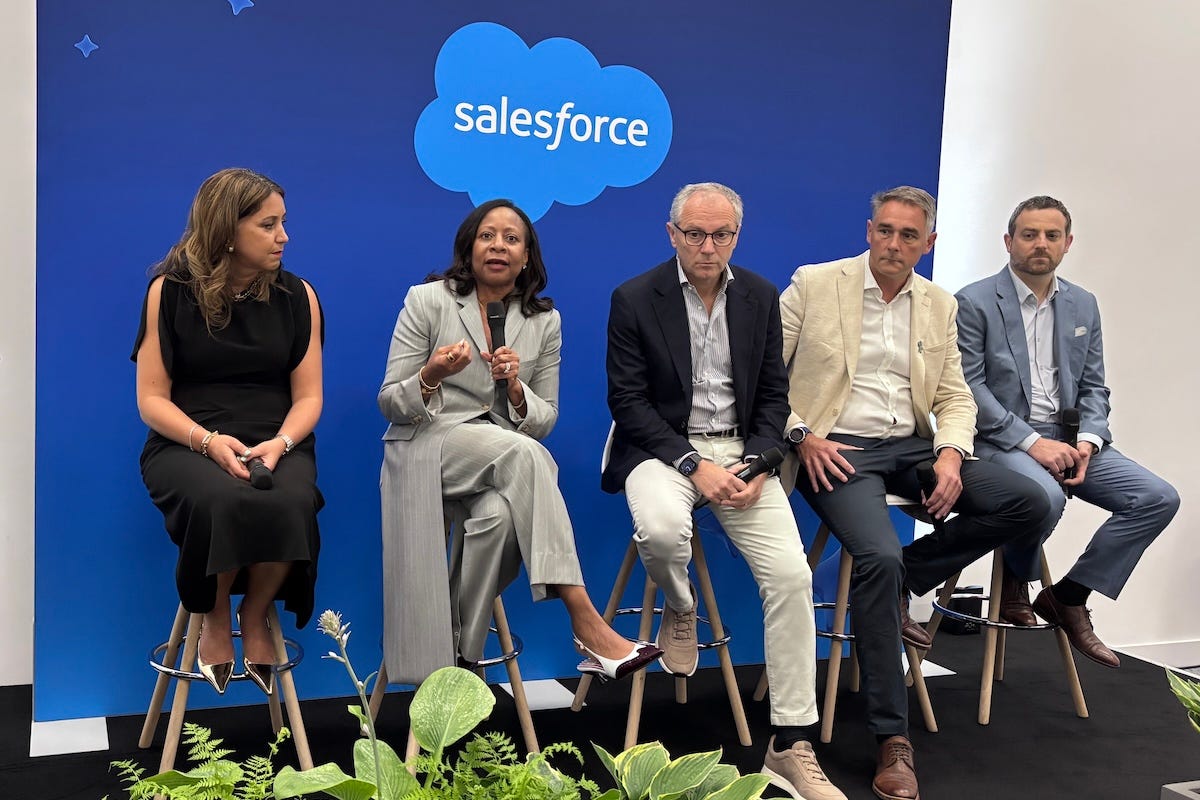
The comments came during a Salesforce media briefing at the Agentforce World Tour in London last month, moderated by Fiona Williams, Senior Vice President of Global Communications at Salesforce. The panel discussed scaling agentic AI from pilot projects to full production.
“We are a sport that is evolving and transforming. Without the right people and knowledge, this is impossible,” said Stefano Domenicali, President and Chief Executive Officer of Formula 1 Group, whose sport has grown its fan base from 400 million to more than 831 million in recent years.
“We are racers. Competition is part of our journey, and in a positive way. We want to use it to engage more people. Because the world of sport and entertainment is big today, our fans can choose us or other things.”
He said AI supports race-day decisions, from race directors to driver safety signals, while the sport’s budget cap, which limits team spending, prevents AI investment from becoming a competitive differentiator between teams.
“We will never go with autonomous driving. The drivers will always be physical. That is not negotiable,” he said. “The differentiator will always be in our sport because we are talking about emotions and about the way we connect with people. There will always be a human factor.”
That balance between automation and judgment carried into a broader theme on the panel, which turned to using AI to free staff for higher-value work rather than replace them entirely.
“These agents are not here to replace people. They’re here to do work so people can focus on more impactful things,” said Joe Inzerillo, President, Enterprise and AI Technology at Salesforce.
Bahrololoumi made a similar point about Simply Health, a UK health cash plan provider that applied the same approach to its own contact center, using agentic AI to take over much of the routine administrative work that staff used to handle by hand every day.
“It released human capacity within the contact center, and those humans remained within the contact center,” she said. “Because they were doing higher-value work on more complicated cases, Simply Health took a bold decision to actually pay them more.”
Inzerillo pointed to Pentagon Federal Credit Union, known as PenFed.
“Their hiring is flattish, but they’re not releasing a bunch of people. They’re putting them on higher-value work,” he said. “This technology is going to enable them to be twice as big without needing twice as many people, and that growth is more sustainable.”
Its chief executive said in a video that revenue is expected to double from $3 billion within a couple of years.
Robin Washington, President and Global Chief Operating and Financial Officer at Salesforce, highlighted new roles emerging alongside the technology, describing positions such as forward-deployed engineers that did not exist before agentic AI became part of Salesforce's operations.
“I believe it’s a multiplier effect because of the growth opportunities we have in front of us now,” she said.
Beyond the pilot stage
Even as customers such as Thames Valley Police and Formula 1 scale their use of agentic AI, panelists said most organizations are still held back by more basic obstacles.
Inzerillo said three obstacles most often stall enterprise AI adoption:
Fear of picking the wrong technology as AI models leapfrog each other;
Institutional change, particularly attempts to replace an entire job with one agent, rather than automating specific tasks;
Technical debt, though newer models can increasingly reason through messy legacy data.
“Start simple, fail fast, don’t overengineer. It is iterative,” Washington said.
She said this isn’t the old model of provisioning software and delivering a solution 18 months later. It is a continuous iteration that must evolve as the organization evolves.
Bahrololoumi said the UK remains one of the most attractive places in the world to build such capability.
“The UK is the third-largest AI market globally,” she said. “In 2025 alone, it attracted some $65 billion in VC (venture capital) funding, driven predominantly by AI, and this year alone the country has attracted $12.5 billion of investment and 10 new unicorns.”
Salesforce has invested $6 billion in the UK, including a new AI center in London that serves the wider European region.
“We’re seeing what we call refilling the tank,” Washington said. “Fifty percent of our bookings last quarter came from existing customers, and globally we have 150,000 customers, or more than a million counting Slack.”
That foundation increasingly rests on data infrastructure, a topic that had gone unmentioned up to that point.
Salesforce bought Slack for about $27.7 billion in 2021 and completed the acquisition of Informatica for about $8 billion last November.
“Informatica is a critical component of everything we’re doing. It sits in that Data 360 layer,” she said. “I have not seen an acquisition happen as seamlessly as Informatica has. It’s greatly increased our ARR (annual recurring revenue).”
Inzerillo said Salesforce now talks less about Informatica by name and more about Data 360, the broader platform it sits within.
“If you think you’re integrating 10 products, that’s daunting. But if you can say you’re using one stack that just works, it’s a much easier message,” he said.
Salesforce said it will keep expanding the AI center’s regional role across Europe as customer demand grows.