


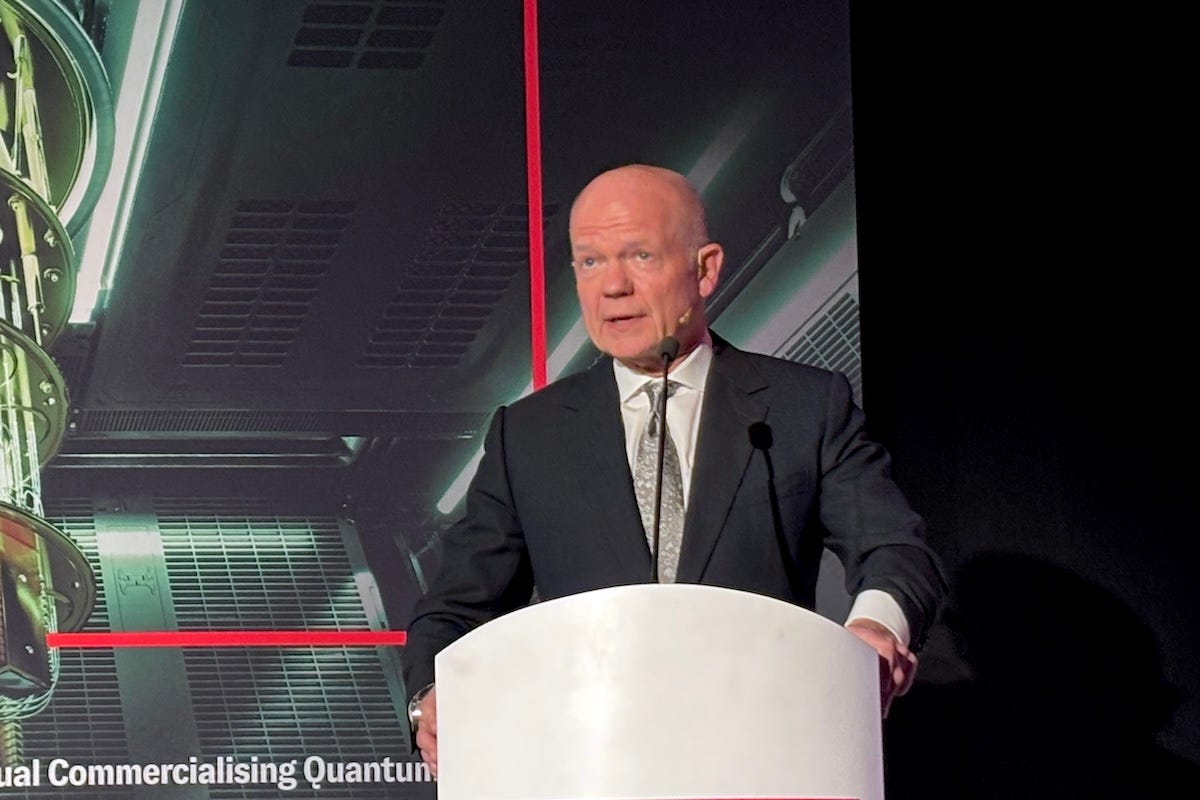
Britain ranks third globally in academic quantum research, is home to the second-highest number of quantum startups, and has a growing record of real-world deployments. Yet the country is failing to convert that scientific leadership into commercial scale, with the economic and national security benefits of quantum technology at risk of accruing to other nations.
The warning came from Lord Hague, former foreign secretary and chancellor of the University of Oxford, speaking at a major quantum conference in London. He co-authored a quantum strategy paper with former Prime Minister Tony Blair, published by the Tony Blair Institute for Global Change in November 2025.
“While Britain is a global leader in all these respects, we often fall short in converting this research into commercial applications. Action is needed to ensure the value of innovation generated by UK quantum research remains within our country, rather than slipping away,” he said.
“Last year, Oxford Ionics was acquired by a globally leading American quantum company in a $1 billion deal. Such a valuation is a phenomenal achievement that underlines the strength of our ecosystem, but imagine how far our talented quantum companies could go if they had the British or European capital they needed to grow into global leaders in their own right,” he said.
The stakes are considerable. McKinsey analysis found that quantum could generate up to $2.7 trillion of economic value worldwide within a decade, with global investment in quantum startups nearly doubling to $2 billion in 2024 and the sector forecast to grow by 35 percent annually until 2032.
Lord Hague identified three problem areas holding the UK back:
Research and development: the country leads in long-term foundational work but must do more to focus it on specific engineering challenges that block commercial deployment, such as finding the most efficient paths for qubits to interact and reducing errors in quantum calculations.
Capital: most interest in British quantum companies currently comes from Silicon Valley, leaving domestic firms without the funding needed to scale at home.
Resilience: UK startups remain dependent on foreign suppliers for critical components including cryogenic cooling systems, while the country lacks the advanced packaging facilities needed to scale quantum computers.
On resilience, he said UK startups remain dependent on foreign suppliers for critical components including cryogenic cooling systems, while the country lacks the advanced packaging facilities needed to scale quantum computers.
“Without the support of a broad and resilient ecosystem, our companies will be forced to move abroad in order to scale,” he said.
The stakes extend beyond economics. Lord Hague adapted Theodore Roosevelt’s celebrated maxim to argue that military and diplomatic power alone is insufficient in an era of strategic technology competition.
“In today’s world of technological acceleration, big sticks are no longer sufficient. You also need a deep stack with your big stick,” he said. He added that some degree of domestic quantum capability will be critical to national security.
The exodus of British technology startups, largely to the United States, has long been attributed to a shortage of domestic private capital and the limited size of the UK’s home market, according to some industry experts.
The government has sought to address this through two state-backed vehicles: the £500 million Sovereign AI Fund and the £27.8 billion National Wealth Fund, both designed to scale domestic technology champions and retain high-value companies in the UK. But with mandates spanning a wide range of industries, neither fund has been able to direct the concentrated, high-risk capital that deep technology sectors such as quantum demand.
Policy momentum at risk
Lord Hague was speaking at Commercialising Quantum Global 2026, organised by Economist Enterprise and held in London on June 16. The annual conference brings together researchers, investors and policymakers to discuss how advances in quantum technology can be translated into commercial applications.
He acknowledged that both recent governments have made meaningful progress. Former Prime Minister Rishi Sunak’s 2023 National Quantum Strategy set out a framework of research hubs, challenge-led innovation funding and talent programs. The subsequent administration built on those foundations, announcing five new quantum research hubs shortly after taking office.
“Earlier this year, the technology secretary, Liz Kendall, committed £2 billion to invest in the sector. Her plans include funding to help companies scale quantum computing and develop new uses in areas like pharmaceuticals and financial services,” he said.
Kendall’s package also covers quantum sensors and navigation, additional support for the network of quantum research hubs and funding for Edinburgh’s Quantum Software Lab. Lord Hague praised the scale of the commitment but was unambiguous that more is needed.
He said that regardless of any change in leadership, it will be vital for the government to remain committed to supporting quantum and to go further in addressing the three key challenge areas of research, capital and resilience.
With other countries investing heavily, Lord Hague said the UK must be more ambitious. He called for a quantum translational research group to bridge the gap between academic science and commercial deployment, potentially modeled on Finland’s Technical Research Centre, which already works with Finnish quantum companies to overcome engineering constraints.
“It will be vital to ensure that this funding is well spent, with a focus on real-world applications in areas like healthcare and defense, rather than hitting technical benchmarks,” he said of the government’s £1 billion procurement plan for quantum computers.
The speech drew heavily on the Blair-Hague report, which warned that despite the UK’s strong starting point, the country risks failing to convert its quantum research leadership into commercial scale and strategic value.
“Tony Blair and I, despite our past political differences, worked together last year to author a paper on quantum technologies. Both of us know that technology and innovation are the key ingredients for the UK’s economic prosperity and national resilience,” he said.
The quantum paper was the seventh in the pair’s New National Purpose series, which has called on the government and MPs of all parties to make technology leadership a defining national priority. Lord Hague noted the personal irony: when he was leader of the opposition, most of his energies were spent trying to defeat Blair, which he described as “the least successful part of my entire life.”
“For the most part, politicians and civil servants are waking up to the importance of artificial intelligence (AI). They have not all done so yet with quantum, and this is frustrating, given that the global AI market has already concentrated around the US and China, while there is greater scope for Britain to play a significant role in the global quantum market,” he said.
The Blair-Hague report identified the same three structural failures Lord Hague outlined in his speech:
Translation gap: world-class physics is not being consistently converted into deployable products.
Capital and adoption gap: the UK’s largest quantum hardware funding announcements are ten times smaller than those of France and Australia.
Stack gap: only 513 companies in Britain’s extended quantum supply chain, compared to 1,128 in Germany and 658 in France.
The Q-Day threat
Beyond the economic case, Lord Hague set out a stark national security argument. Quantum computers are expected to break classical encryption methods by the 2030s, a milestone already referred to as “Q-Day.”
“Britain’s enemies are already stockpiling our encrypted communications to break open. Quantum computers will not expose small flaws in the cyber security of encrypted software, but break the encryption altogether,” he said.
Too few organizations are taking serious steps to prepare for this eventuality, he warned. The Blair-Hague paper recommended requiring regulated critical industries to publish updates on their quantum-migration plans every two years, through bodies including the National Cyber Security Centre and the MI5 National Protective Security Authority.
Lord Hague highlighted recent UK demonstrations of quantum’s practical potential:
The Royal Navy trialed quantum navigation systems over the Arctic with researchers from Imperial College London, providing a more secure alternative to satellite-based positioning.
Bristol University demonstrated the first long-distance secure transfer of data over a quantum communications network.
Oxford Quantum Circuits recently received a £100 million investment from the British Business Bank.
Quantum’s breadth as a general-purpose technology extends to drug discovery, the development of cheaper, more climate-friendly fertilizers and advanced weather and disaster forecasting. Exeter College, Oxford, is planning a quantum innovation district at the western gateway to the Oxford-Cambridge growth corridor.
On specific policy interventions, Lord Hague proposed fiscal incentives including research and development (R&D) tax relief and reduced employer national insurance contributions for quantum-related hires in sectors such as finance and pharmaceuticals. He also called for quantum procurement champions with technical expertise to be appointed in each relevant government department, tasked with horizon-scanning for new use cases and running regulatory sandboxes.
“Advanced market commitments work by setting out a commitment to purchase or subsidize a product if someone can invent and produce it to a high standard. They have been used to galvanize the creation of new vaccines, and similar advanced market commitments for quantum technologies could galvanize the sector and unlock new use cases,” he said.
Lord Hague also called for the National Wealth Fund to co-invest in quantum-enabling infrastructure, particularly domestic cryogenic cooling capacity, to de-risk private investment. Strategic bilateral partnerships with allied nations, including Germany, the Netherlands, Japan and Canada, would be needed to address supply chain gaps identified through a formal capability-mapping exercise.
The choices made by the next government, he concluded, will determine whether Britain leads in quantum or becomes an incubator for other countries’ industries.