


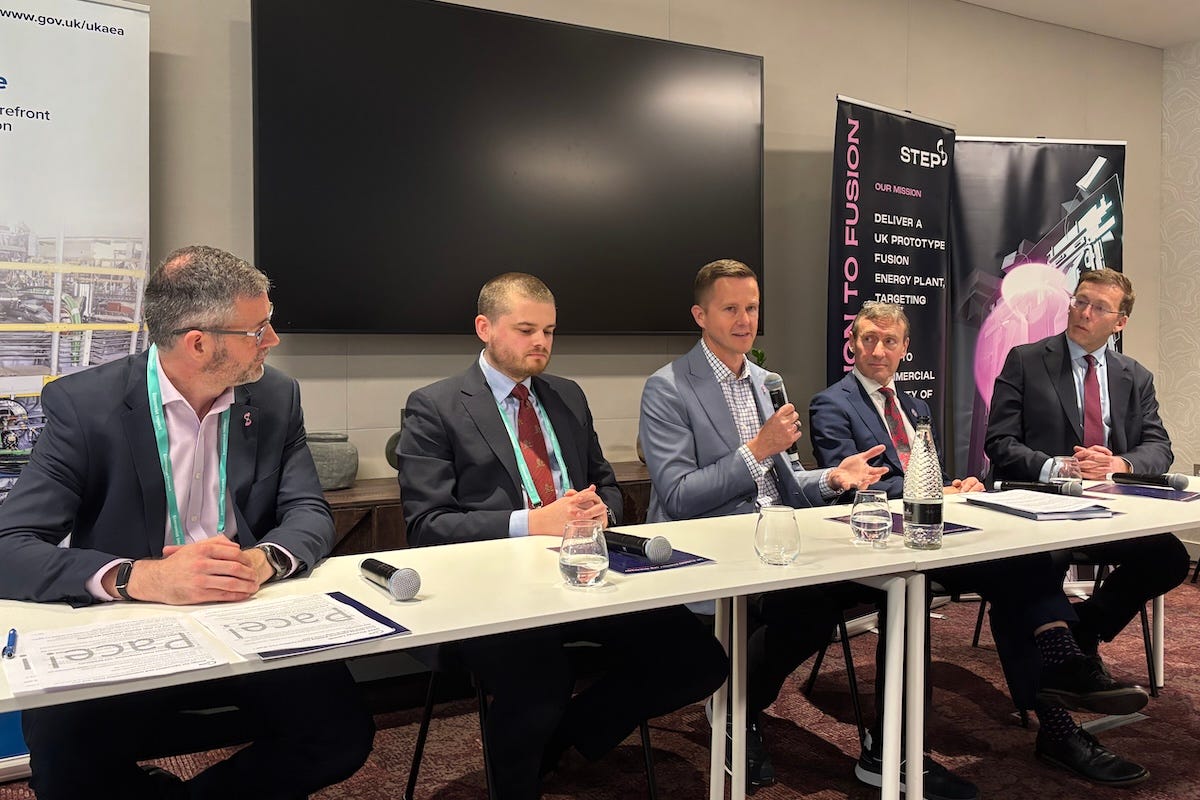
Turning fusion into a commercial energy source is becoming less about scientific breakthroughs and more about securing capital to scale deployment. For now, most investment in the UK’s fusion sector remains government-led, highlighting the urgency of attracting private funding as projects move toward commercialization.
At the 2nd annual Fusion Fest in London, organized by Economist Impact, policymakers, engineers and industry leaders focused on how to translate decades of research into investable projects with clear pathways to deployment, scale and returns.
Dr Tim Bestwick OBE, chief executive of the UK Atomic Energy Authority (UKAEA), said the government’s approach is to create investable opportunities by putting public funding into supply chains, spinning out companies and forming joint ventures so capital can flow into tangible businesses.
That involves funding supply chains, backing spinouts and forming joint ventures so investors are presented with tangible businesses rather than early-stage research programs, he said.
“We are actively trying to generate investment opportunities,” he told TechJournal.uk during a media briefing. “I believe that international investment capital will flow to where the opportunities are. The prime tactic is to create the opportunity.”
Paul Methven CB, chief executive of UK Fusion Energy (UKFE), a wholly owned subsidiary of the UKAEA, said public funding should be seen as a catalyst for private finance, not a substitute for it. He said the point of state support is to reduce risk, build confidence and give companies a more credible commercial platform.
“Government investment is not in place of private investment. It is there to generate private investment,” Methven said. “The government backing gives confidence and takes some of the risk out of it. That creates a landscape where the private sector and private investors can come in with much more confidence.”
The investment case is beginning to move from theory to assets. National programs are putting money into the supply chain, supporting technical capability in industry, spinning out companies and creating joint ventures that can become investable businesses.
That shift matters because fusion companies are no longer asking investors to back only a long-term scientific promise. They can point to facilities, contracts and government-backed demand that indicate how future revenues may emerge.
“You’re not selling with PowerPoint. You’re selling with real facilities, with government as customer,” said Warrick Matthews, chief executive of Tokamak Energy, a private company spun out of the UKAEA in 2009. “It is the catalyst that allows us to address investors with a totally different narrative.”
The emerging model is therefore neither purely public nor purely private. It is a coordinated attempt to use public money to lower early-stage risk, create industrial traction and make fusion look less like a speculative bet.
Building an industry
The broader UK ambition extends beyond a single demonstration plant. The aim is to build a domestic fusion industry capable of delivering a prototype power plant while supporting a sustainable supply chain around it.
Bestwick said the UK’s national fusion strategy is built around two parts of the same mission. The national laboratory base within UKAEA develops fusion technologies and commercializes them. UKFE, the entity leading the delivery of the Spherical Tokamak for Energy Production (STEP) program, integrates them into a power plant.
“The UK laid out a national fusion strategy, which talks about building an industry to deliver fusion,” he said. “It is one mission through two different mechanisms.”
Methven said UKFE’s role is to act as the UK’s integrator. That means pulling technologies together for a prototype fusion energy plant at the former West Burton coal-fired power station site in Nottinghamshire, in the East Midlands of England, while also building the industrial base needed beyond that first project.
“If we want to create a sustainable industry, we can’t just think about a single-shot prototype,” he said. “We have to think about a sustainable industry and a sustainable supply chain beyond that.”
The STEP program is intended to anchor that approach. Its role is not simply to prove that a fusion plant can be built, but to organize the companies, technologies and construction capabilities needed for a repeatable model.
A major early signal came with the April 14 announcement of a £70 million contract awarded to Tokamak Energy as the Magnet Systems Partner for the STEP program. UKFE said the contract, which runs through March 2029, covers eight work packages spanning magnet systems, tokamak integration and plasma-related work, delivered in close coordination with the program’s integrated team.
The work will be led by TE Magnetics, Tokamak Energy’s high-temperature superconducting (HTS) division, which provides design, manufacturing and testing for advanced magnet systems. The company also contributes through its focus on spherical tokamak architecture, a design central to compact fusion systems.
The supply chain story also includes smaller companies. Thomas Davis, co-founder and chief executive of Oxford Sigma, said the STEP program had given specialist firms clearer requirements, a stronger long-term vision and the stability needed to build resilience.
Oxford Sigma, a 25-person company based in Oxford, works on advanced materials for fusion. Its work includes tritium breeding materials, radiation shielding and other specialist components needed for reactor programs.
Davis said the ecosystem of small and medium-sized enterprises around fusion is becoming part of the UK’s industrial value proposition. These firms may be niche, but they hold capabilities that large fusion programs need and can export as the global market grows.
From lab to plant
The technological challenge remains formidable. Fusion requires not only plasma science, but magnets, materials, construction systems and operating models that can survive in a demanding energy environment.
Tokamak Energy’s spherical tokamak approach relies heavily on HTS magnets. In simple terms, these magnets can carry electric current with extremely low resistance at higher temperatures than older superconducting systems, enabling stronger magnetic fields in a more compact machine.
“You can’t do a compact fusion magnetic confinement machine without HTS magnets,” Matthews said. “Big players in the industry had picked up this technology. They had tried it, they had failed and they had abandoned it. For us, it was a necessity to master it.”
The company initially wrote down about 30 reasons why the technology might fail, then worked through those barriers. It now operates the ST40 fusion device and the Demo4 magnet system, which support both research and industrial magnet development.
ST40 is a high-field spherical tokamak designed to demonstrate compact fusion performance, while Demo4 is a dedicated platform for testing and validating HTS magnet systems at an industrial scale, bridging the gap between laboratory research and commercial deployment.
Materials are another pillar. Davis said Oxford Sigma had benefited from UK grants and collaboration with UKAEA, which helped the company develop intellectual property and manufacturing capability. Much of that work is now being used to support exports to the United States and Europe.
Construction may be just as decisive. Simon Matthews, program director for ILIOS, said fusion is often described as a scientific breakthrough, but that breakthrough depends on facilities that can be designed, built, operated and maintained safely for many years.
ILIOS is a consortium appointed in March 2026 as the construction partner for STEP, acting as the main contractor overseeing design, build and coordination across the project.
“Fusion isn’t just about first plasma. It’s about reliable performance year after year,” Simon Matthews said, adding that efficiency is not about speed but about getting it right the first time.
He said early involvement of construction partners is essential because decisions made at the design stage shape safety, cost and schedule for years. Facilities must be planned with operations and maintenance in mind from the beginning.
The STEP delivery model is designed as an integrated “team of teams,” rather than a chain of handovers between designers, builders, operators and maintenance specialists. Digital systems are expected to create a single source of truth from design through commissioning and operation.
The international dimension remains complex. Bestwick said the UK no longer has a formal relationship with the International Thermonuclear Experimental Reactor (ITER) after leaving the European Union, although it remains in touch where possible.
Methven said collaboration remains essential, but not every fusion project needs to be a vast multinational program. The UK is working with the United States on fusion-related areas, including national laboratory links and artificial intelligence, while companies are building their own international partnerships.
Future fusion plants are therefore likely to be shaped by a pragmatic balance: national strategy, company-led execution and selective overseas collaboration. For the UK, the next test is whether that mix can turn public backing, private capital and industrial capability into a credible commercial sector.