


The UK’s state-backed artificial intelligence (AI) fund wants other countries to depend on British chips and technology, saying full technology independence is beyond reach for any nation.
It is focusing on the layers of the AI stack where Britain already has deep engineering talent, with chips at the top of the list. It sees inference, rather than model training, as the race where the UK could plausibly compete.
“We tend to think of technology sovereignty not as pure independence, because no country, not even the US, is purely independent. They are as reliant on ASML as we all are,” said Suzanne Ashman, managing partner of the Sovereign AI Fund. “It’s about having interdependence, so that other nations are as reliant on a UK or European tech stack as we currently are on theirs.”
“Companies will only be built into global champions if they have fantastic founders with relevant technical expertise,” she said. “Chips is one of those categories where there’s a talent density that we think could be used to build global champions.”
She said the UK can draw on engineers from chip designer Arm and AI chipmaker Graphcore. The government-backed fund, which invests from seed stage to Series B, launched in April with £500 million and has since grown to £620 million.
“The UK doesn’t have a competitive player on the training side, and the infrastructure and particularly energy costs make that incredibly problematic,” Ashman said. “But in the next race, whether that’s in inference and beyond, it is plausible that we have a better set of conditions to be able to compete.”
Johan Bergqvist, chief financial officer of Paris-based AI lab Mistral, said Europe needs its own inference chip, as the hardware stack is equally important for sovereignty.
“We’re going through this transformational shift, and it’s probably bigger and happening faster than any other transformational shift in the past,” he said. “We are trailing behind, but that doesn’t mean the race is lost yet. We do need to take some pretty drastic and quick decisions to catch up.”
Mistral’s chief executive, Arthur Mensch, recently published a “build or surrender” manifesto saying European companies pay more than €260 billion a year to US cloud and software providers. Bergqvist said 80% of Europe’s software spending goes outside the region, adding that Europe kept up in the industrial revolution but was less successful with the internet.
Three months behind
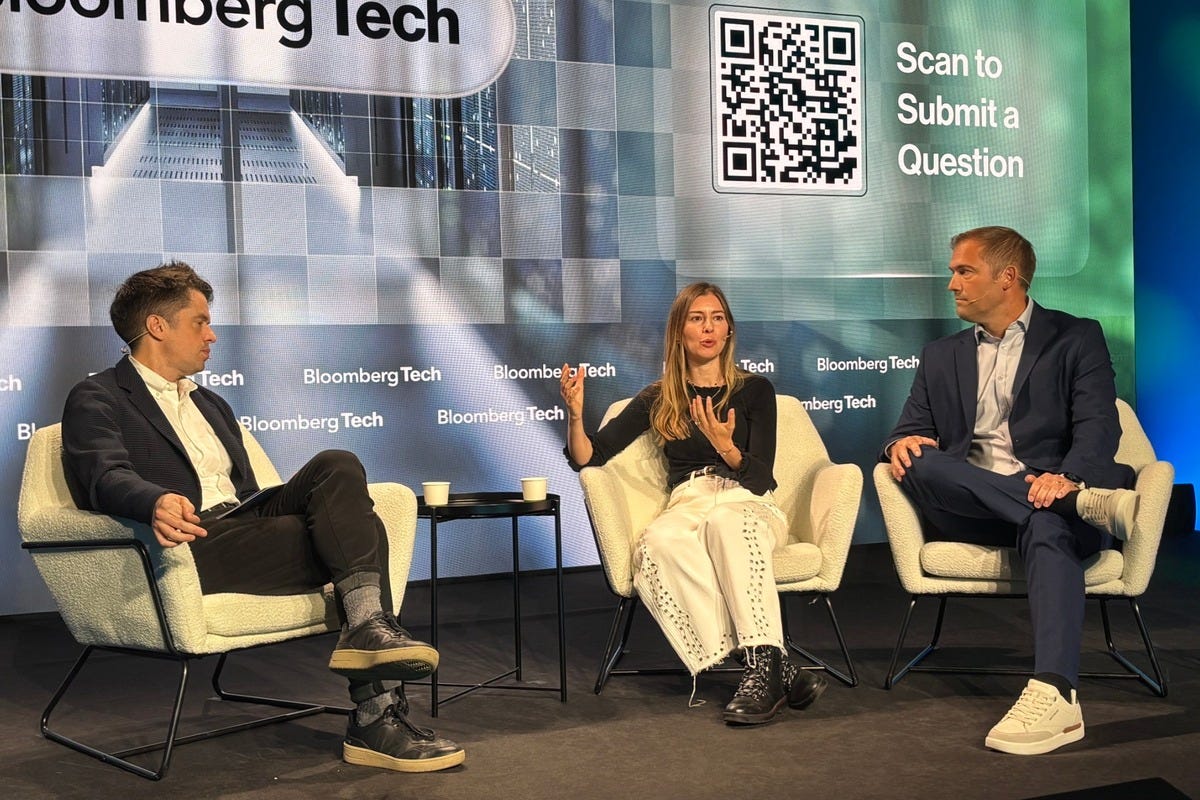
The panel took place at Bloomberg Tech London, organized by Bloomberg in London on November 3. Mark Bergen, a senior reporter at Bloomberg, moderated the discussion on Europe’s AI sovereignty.
Bergqvist said Mistral, founded three years ago, is tracking well against Anthropic, which is about five years old, and OpenAI, which is around 11. He said Mistral trained its latest flagship model, Large 4, on 3,800 Nvidia Grace Blackwell graphics processing units (GPUs), while its rivals train on many times that number.
“What we do need is more compute to train our models,” he said. “The main difference between the models we are releasing, maybe around three months behind the real frontier models, is the amount of compute that we have available.”
He said Mistral is building its next model, Large 5, on Nvidia’s compute as part of the chipmaker’s Nemotron Coalition.
Mistral will open more data centers in Europe within the next two years and hopes to build one in the UK, he said. Its target of 1 gigawatt (GW) of capacity by 2030 under its Mistral Compute unit still holds, and he said Europe needs AI infrastructure run with full-stack sovereignty.
“The reason why we’re building it out is more strategic than maybe for neoclouds, because we need that compute ourselves,” Bergqvist said. “It’s a way for us to lower our cost for our training, and we also need it to serve our customer base.”
“Compute is clearly an incredibly important part of the jigsaw, and 15% of global compute is in Europe. Clearly, that is not enough,” Ashman said.
Nscale, Britain’s main neocloud, had already outgrown the fund’s remit by the time the fund launched in April, but she said compute is a category it would consider.
She said the state’s biggest lever is being a customer rather than an investor, pointing to a £180 million advance market commitment under which the government will buy chips from firms that meet set technical milestones. The money should go to a handful of potential UK champions, not 100 companies.
“In the UK and Europe we have been quite squeamish about picking winners in a way that they haven’t been in the US,” she said. “If governments are serious about having winners and global champions from their country, you have to put real capital and support behind them.”
She cited US government support for SpaceX and said Europe has shown it can back winners in defense, through companies such as Helsing and Stark Defence, and in France with Mistral.
Trust in the equation
An audience member asked whether keeping pace with Chinese open models such as DeepSeek means trading away safety. Bergqvist said no, calling safety one of Mistral’s most important considerations when releasing models.
“We take safety very seriously, and the last model that we released with the cyber capability was very potent,” he said. “So we made sure that the right parties got access to it, and we also limited some of those capabilities in our public release.”
Ashman said Europe probably over-indexes on trust, but that this helps in regulated sectors. She said the UK’s AI Security Institute (AISI) is the best funded of its kind in the world. When choosing between a Chinese and a European open model, cost and performance are only part of the decision.
“People say, ‘Will you use a worse European or UK-based product?’ And the answer is no, because trust, security and sovereignty should be taken into account as part of the equation on which providers you go for,” she said.
Asked about the heavy customer concentration shown in Anthropic’s recent listing documents, Bergqvist said it is not a concern for Mistral because it sells differently.
“We sell bilaterally to our customers, so more of a sales-led motion like Palantir,” he said. “At the same time, we are a frontier lab, so it’s somewhere in between the Anthropic and the Palantir model.”
He said training models is costly but lets Mistral customize them for each customer’s use case. Customers increasingly favor open-source models because they can control which sovereign cloud runs them and how their data is used for training, he said, adding that most of Mistral’s customers are outside France.
Ashman said the fund backed Ineffable Intelligence, the lab of former Google DeepMind researcher David Silver, which is raising $1 billion at a multibillion-dollar valuation, because investors weigh founders heavily and he is one of the world’s leading researchers.
The fund has also backed at least a handful of startups founded by other DeepMind alumni, who are spinning out to launch new companies. It has invested in Isomorphic Labs, the drug discovery company founded by Google DeepMind chief executive Demis Hassabis.
Only a tiny share of UK households hold public stocks, unlike most households in the US.
“The challenge for the UK and for Europe is, with this wave of blockbuster IPOs (initial public offerings) and the wealth creation that happens around them, is the UK effectively sitting that out?” she said. “We do need to find ways to make individuals and consumers in this country feel the benefits of AI and feel the benefits of the wealth creation.”
Bergqvist, who was at Spotify for its direct listing in 2018, said Mistral has no plans to go public at the moment but intends to list at some point, in whichever market makes sense for the company, its shareholders and its customers.