Agentic artificial intelligence (AI) has moved from corporate pilots into frontline operations across the UK, with live deployments now running in policing, conservation, retail and aviation, handling everything from victim support to passenger queries and veterinary records.
In policing, the applications range from real-time guidance on violence against women and online harms to the analysis of digital evidence in criminal investigations. One of the most advanced deployments is “Ask Em,” an AI agent built by the National Centre for Violence Against Women and Girls and Public Protection (NCVPP) with Salesforce’s Agentforce.
Ask Em, which will be deployed to forces soon, will give frontline officers consistent, empathetic guidance at any hour, across all 43 forces in England and Wales.
“At three in the morning, when you’re faced with a problem and there’s no one to ask because you’re the only person on patrol in 100 square miles, you’re thinking: who do I ask and what do I do?” said Claire Hammond, Temporary Detective Chief Superintendent at the NCVPP. “Ask Em has become that person.”
Built on Salesforce’s Agentforce platform, the tool embeds guidance in deliberately empathetic language. Officers receive not just the correct procedural answer but the right words to use with a victim.
“We put into the tool everything frontline officers need, in empathetic language, so when they ask, they get the right language back on how to speak to a victim and what they should do,” Hammond said. “Victims can expect the same level of service at all times, no matter what time of day it is or which station they go to.”
The name carries its own symbolism. Emily, the Salesforce engineer who built the tool, inspired the first part. The second came from James Bond, whose fictional supervisor M is one of the franchise’s most powerful characters.
“M is a strong character in James Bond. She controls MI5, she’s in control, and that’s what we really wanted,” Hammond said. “Not only does it honor Emily, who built it, but Ask Em is the opportunity to say we’re asking a strong, powerful woman to give you the answer on how to deal with these offenses.”
The NCVPP, just over a year old, is preparing to roll out the toolkit nationally.
Hammond noted that resistance to technological change within policing is a broader challenge: experienced officers with decades of service are harder to convince than newer recruits who are entirely at home with digital tools. Simplicity and single sign-on have helped overcome that friction.
The explosion of digital evidence has also fundamentally changed what a single criminal investigation involves.
Asked by TechJournal.uk during the Q&A about the role of AI in crime-solving, Hammond said the challenge is no longer a lack of evidence but rather the sheer volume of it. Where a burglary case once required witnesses, fingerprints, and perhaps some DNA, a single incident now generates vast amounts of material from phones, routers, cameras and social media.
“For one burglary, I’ve got 16 phones, four routers and 25 cameras. I need to scale it to work out who that one burglar was and at what time they went through that door,” Hammond said. “AI has a real opportunity for us there.”
Risk and safeguarding decisions will remain with humans. The National Decision Making Model at the heart of British policing will not be replaced.
From nature to pets
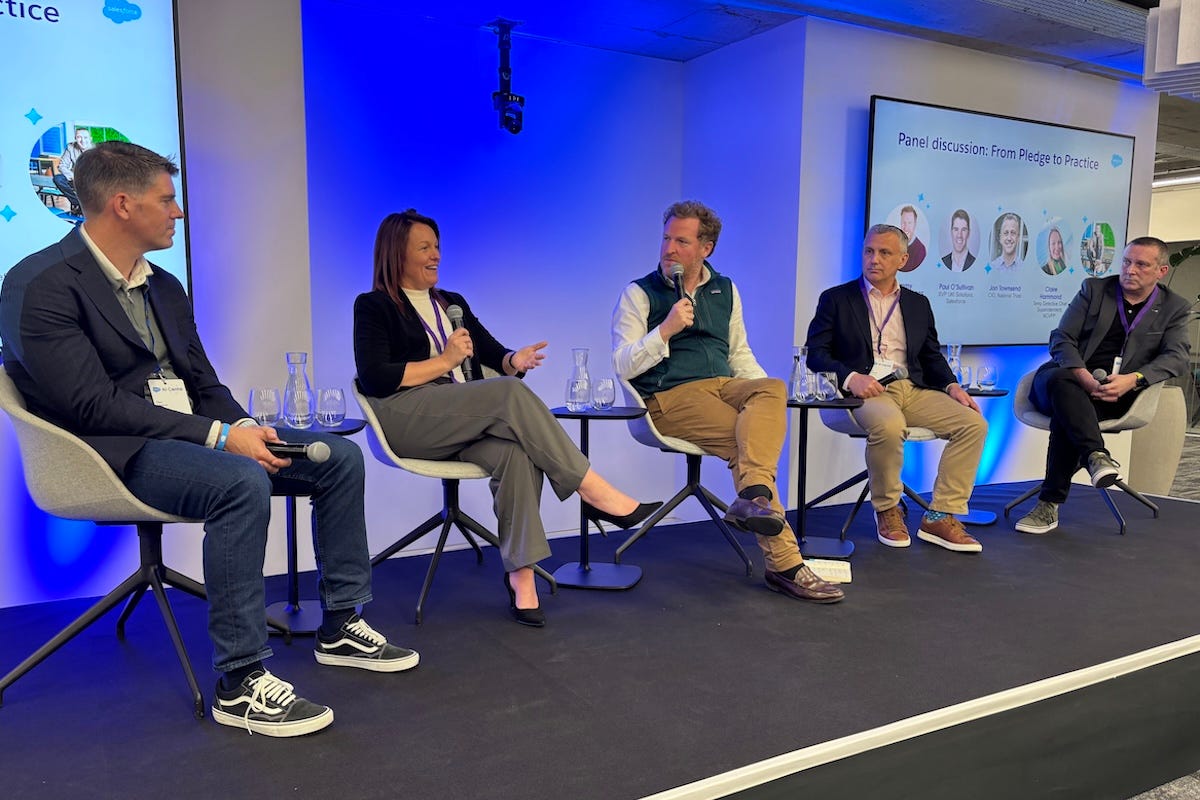
The discussion took place on May 20 at the opening of Salesforce’s new AI Center in London, moderated by Jimmy McLoughlin OBE, founder of Jimmy’s Jobs of the Future. Leaders from policing, conservation, retail and enterprise debated how AI is moving from pilots into production.
The National Trust, Europe’s largest conservation charity, faces a challenge of reach. Around 5.5 million people are currently members, yet the organization believes roughly half the UK population is aligned with its mission: restoring nature, ending unequal access to heritage and inspiring future generations.
“Today we have around 5.5 million members. If you’re talking about shifting that so we’re regularly engaging with 15 million people, you’re going to either need a much bigger organization or you’re going to need help from agentic AI working alongside those people,” said Townsend.
The organization has deployed Salesforce’s platform to deliver hyper-personalized engagement at scale, with AI handling most interactions and human staff stepping in for complex cases.
Click-through rates on the Trust’s own web platforms are declining as large language models (LLMs) increasingly mediate audience content consumption. He said ensuring accurate representation by AI intermediaries is becoming as important as producing the content itself.
“The big challenge for us is not about what we as an organization think about AI. It’s actually what does AI think about us?” he said. “How are the different AI models presenting our content to people accurately, so they can consume it without necessarily having to click through to our website?”
At Pets at Home, AI deployment spans retail, veterinary care, healthcare and a forthcoming insurance business. Simon Ellis, Head of AI Transformation and Enterprise Architecture at the company, said the guiding principle is invisibility.
“The key for us is seamless, invisible technology done well. Our colleagues are the most important part of our business, the empathy, the care, the showing up,” Ellis said. “We are very much focused on how we can use AI to free them up from the grunt work, so they can focus on the pet and the customer.”
In veterinary practices, ambient digital scribes listen to consultations and automatically transcribe clinical notes, with a human always reviewing the output. Pets at Home has approximately 16,000 colleagues across its lines of business.
The company launched a full version of its Pets Data Academy this week, covering everyone from store floor to executive suite, with apprenticeships embedded throughout. The ambition is not to train people on tools but to shift their role: from doers to orchestrators of work, managing digital coworkers alongside human ones.
Meet Agent Murphy
At Heathrow Airport, an AI agent named Hallie, accessible via WhatsApp, has moved well past the pilot stage. Matthew Pinkham, Solution Engineering at Salesforce UK, demonstrated the agent live at the event.
Pinkham showed it pulling real-time security wait times from a live gate feed and filtering restaurant recommendations based on whether a passenger was before or after security.
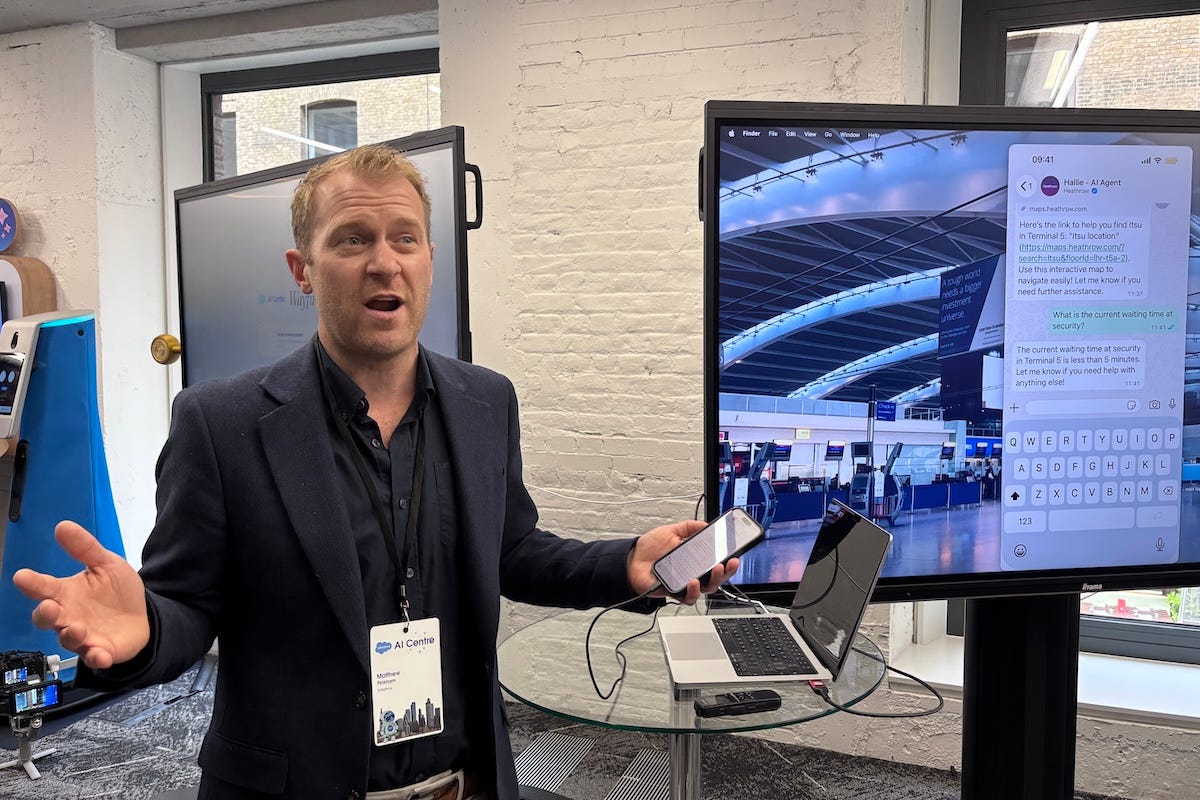
Over 90% of WhatsApp conversations are now resolved without human escalation. Overall, contact center volume has fallen by 50%, and efficiency has improved by 40%.
Paul O’Sullivan, Senior Vice President of Solutions Engineering and UKI Chief Technology Officer at Salesforce, said the agent illustrated what separates capable AI from a simple chatbot.
“I started asking it questions about which terminal and then what shops were at the airport, and intuitively it came back to me and said: before or after security?” he said. “That was insightful, because it starts to learn and understand the actual process and how the operation runs.”
Heathrow plans to extend the agent to its native app and website later this year.
Meanwhile, a poll conducted alongside Salesforce for McLoughlin’s podcast found that 51% of workers have received no employer-led AI training. Only 18% use AI daily and around half use it less than once a month.
Townsend said closing that gap demands more than technical instruction.
“Not only do we have to give people the technical and data skills, but we also have to give them the soft skills. The art of delegation is not a skill that everybody in the workforce has. What are you delegating to this agentic AI?”
O’Sullivan noted that his team of eight, augmented with AI tools at a 97% adoption rate, now operates with the throughput of a team of 35.
Beyond the panel, a separate deployment announced on the same day underlines how broadly agentic AI is being adopted across UK public services. NHS Shared Business Services (NHS SBS), England’s largest provider of corporate services to the health service, processes £395 billion of NHS funding each year.
NHS SBS has built SBS One, a new AI-powered help center on Salesforce’s Agentforce 360 for Public Sector platform.
At the center of SBS One is Agent Murphy, an intelligent AI agent that handles natural language queries from NHS staff and suppliers. It resolves routine inquiries instantly and routes complex cases to human specialists with full context.
The results have been substantial: 84% of queries are now initiated through the platform, average handling times have fallen by 20% and most queries are resolved within 24 hours. The time required to raise a query has dropped from 12 minutes to three.
NHS SBS expects Agent Murphy to handle up to 50% of total service demand in the future, freeing frontline teams to focus on higher-value work and, ultimately, patient care.