Britain is closing in on one of the most consequential technology decisions it has ever made: which quantum computing platforms deserve £1 billion in government backing, and which do not. The first contracts will be announced in October.
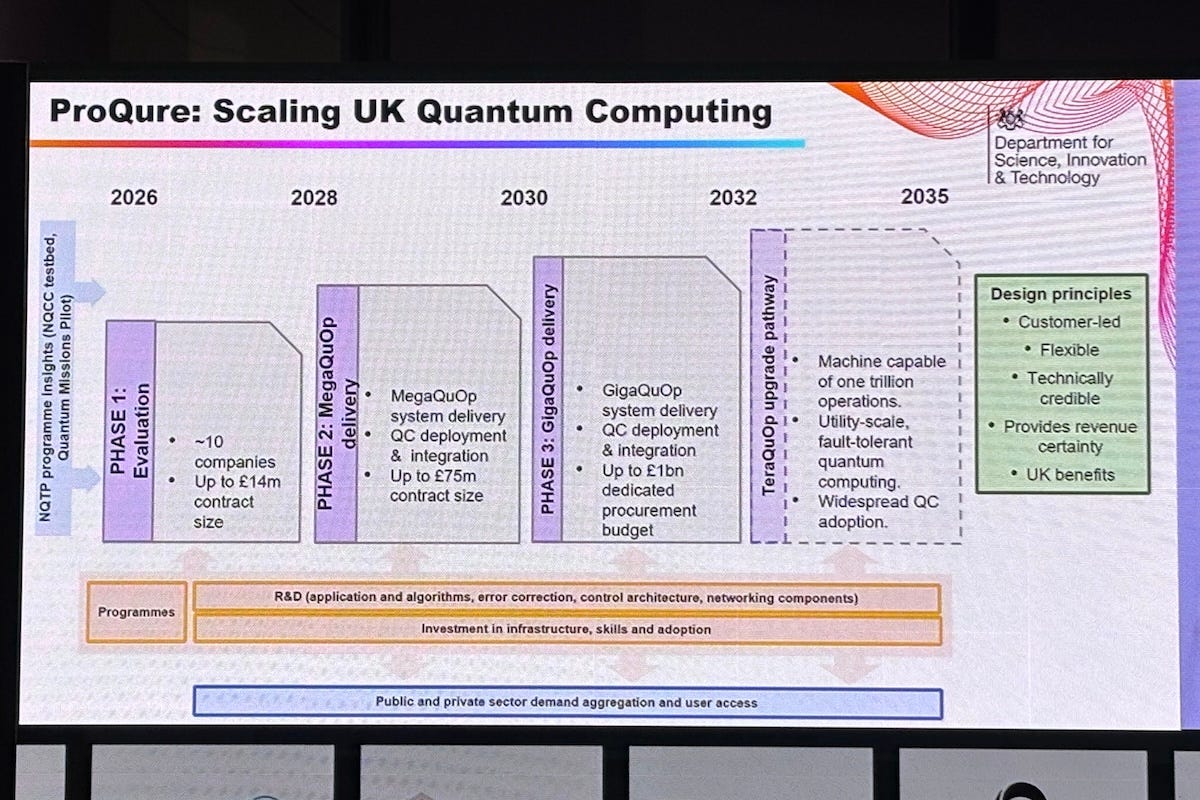
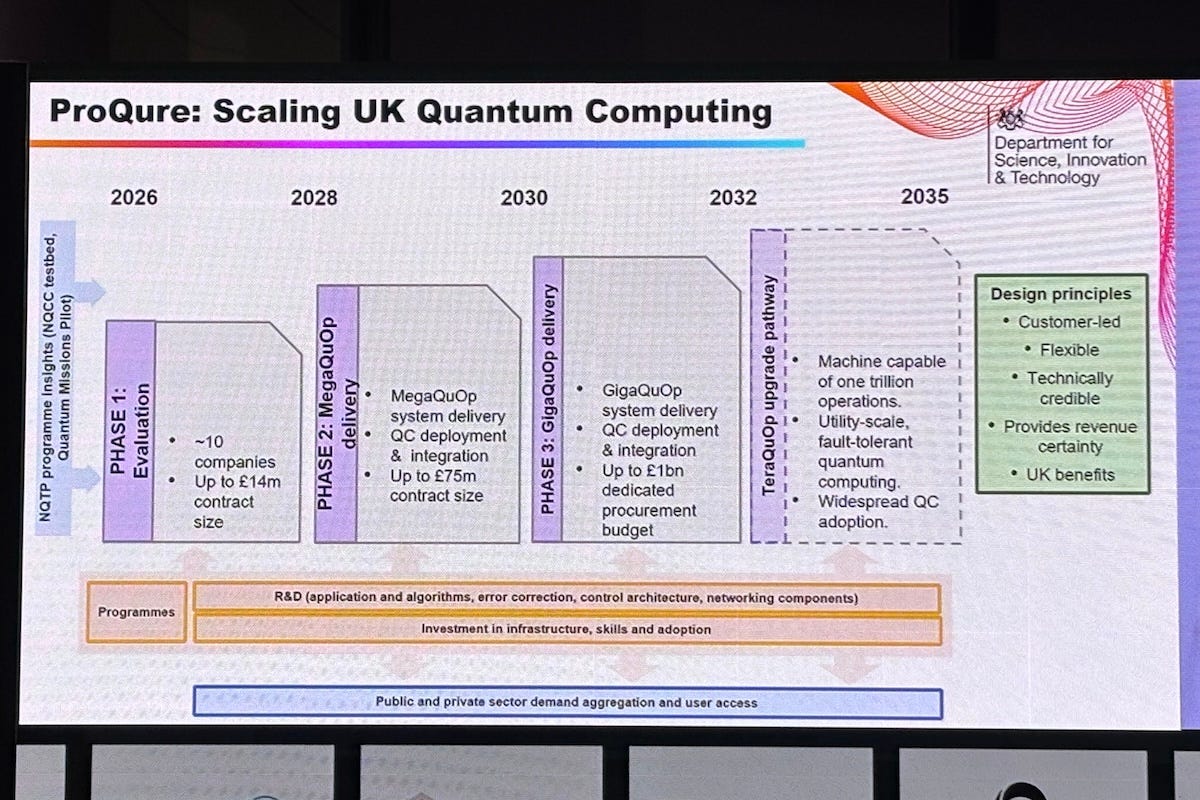
ProQure: Scaling UK Quantum Computing, the government’s phased procurement programme, is designed to answer that question through competitive evaluation rather than political choice. Phase 1 offers contracts of up to £14 million; later rounds scale to £75 million per company.
“We will fund 10 companies, up to about £14 million each, in that demonstrator phase to show that you have a potential route towards scalability,” said Sir Peter Knight, chair of the UK National Quantum Technology Program (NQTP)’s Strategic Advisory Board (SAB).
Knight said that companies advancing to the mega-QOPS evaluation round would see contract values rise to approximately £75 million each.
“That’s where the billion investment will be on the winning platforms,” he said.
A quantum operation per second (QOPS) is the standard unit for measuring quantum computing performance. The performance ladder runs from kilo through mega, giga and terra-scale, with one trillion QOPS (1 TQOPS) set as the UK’s national mission target by 2035.
Unlike classical bits, which hold a value of zero or one, qubits can exist in multiple states simultaneously, allowing a quantum machine to explore vast solution spaces in parallel. That makes quantum systems potentially transformative for drug discovery, cryptography, financial modeling and materials science.
At least £140 million will be committed at the Phase 1 stage. Interviews for shortlisted applicants are scheduled between July 20 and August 3, with the first contracts to be announced in October.
Knight said the programme must be customer-led, flexible and technically credible, with revenue certainty for companies.
“Who needs this stuff is a question that we should be asking all the time,” he said.
ProQure draws on the structure of the US Defense Advanced Research Projects Agency’s Quantum Benchmarking Initiative, but goes further by integrating procurement and validation, combining demand creation and performance testing into a single framework.
The NQTP operates two distinct advisory bodies to guide the sector. The SAB advises the government on overarching national strategy, while the Strategic Advisory Committee (SAC) sits directly within the National Quantum Computing Centre (NQCC) to guide its specific technical programs.
No single platform wins
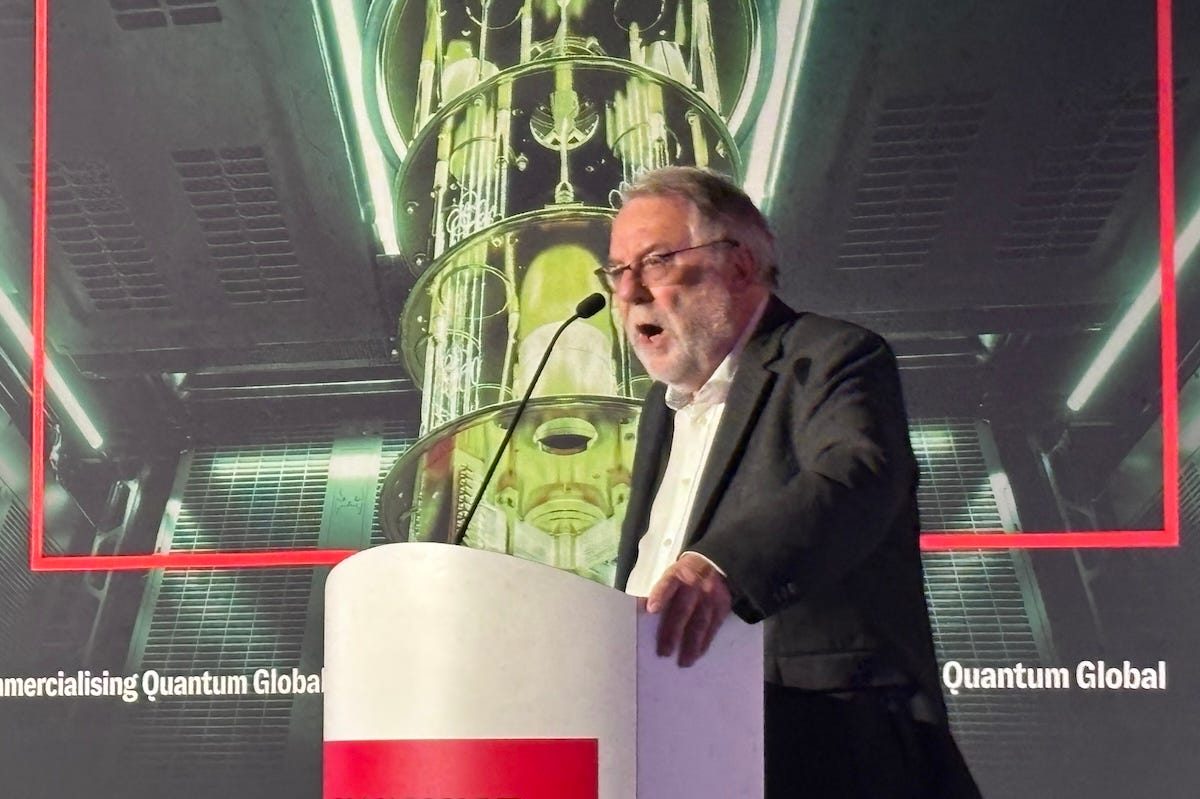
Knight was speaking at Commercialising Quantum Global 2026, organised by Economist Enterprise on June 16 in London. His presentation, titled “So many platforms, so little time? When and how to start narrowing the field,” addressed the challenge of choosing between competing quantum hardware architectures at a pivotal moment in the technology’s development.
Knight chairs the UK NQTP’s SAB and has shaped the country’s quantum strategy since its inception in 2014. He is a professor of quantum optics at Imperial College London and has long advocated using government procurement as a policy lever to drive innovation to commercial scale.
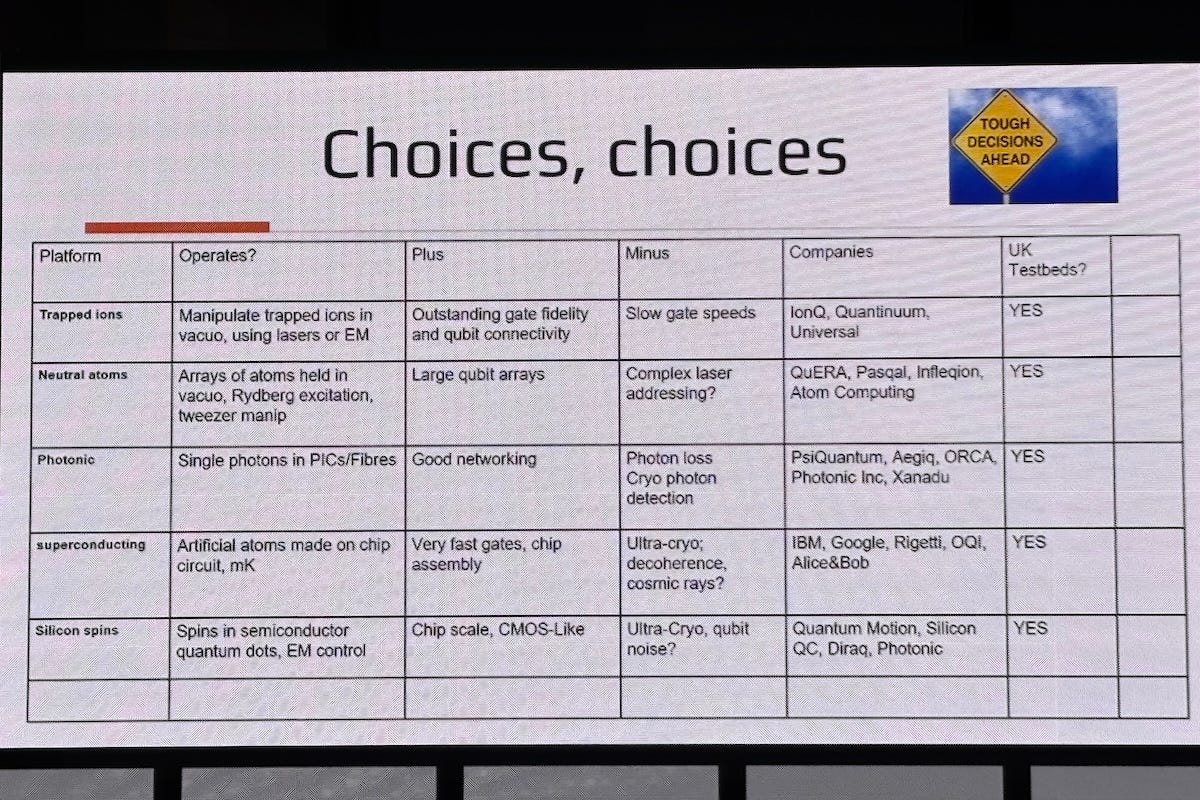
ProQure must navigate a hardware landscape of unusual diversity. Six competing classes of quantum computing architecture are under active development globally: trapped ions, neutral atoms, photonics, superconducting circuits, silicon spin qubits and others.
“There are lots of pluses and minuses. There are companies in every single space,” Knight said.
The NQCC hosts test beds for each platform, having invested £30 million in an initial evaluation phase to allow researchers and policymakers to assess prototypes directly rather than rely on vendors’ own claims.
“The point of this was to accelerate our view as an informed customer and a user of these things, so that we could make advice on how this actually works,” he said.
Knight said he does not expect the global race to converge on one dominant technology. Different user communities have distinct computational needs, and no single architecture currently satisfies them all.
“I am almost certain there will be winning platforms, because the user community has different needs. It would be surprising to me that there would be a single platform that will be the winner,” he said.
He said the 1 TQOPS national mission cannot be delivered by hardware alone. Competitive commercial capabilities must span the full stack: hardware, control architecture, error correction, supply chain, software and algorithms.
“We need to combine the operational capability with the algorithmic development, so the hardware and software people work seamlessly together to make sure that this will work,” he said.
Evidence before politics
With billions of pounds at stake and six competing architectures in the field, Knight said the critical safeguard is objectivity. Platform down-selection must be driven by evidence, not political preference.
“It is really important that we have an evidence-based decision-making process, which enables us to choose things based on where we see the scalability is going to go,” he said.
Benchmarking is led by the NQCC in partnership with the National Physical Laboratory and the Quantum Software Lab at the University of Edinburgh, covering hardware, software and real algorithm applications.
Knight said objective comparisons of noisy intermediate-scale quantum machines against the path to utility scale are essential for establishing the baseline needed for fault tolerance.
“The gap between the fidelity that you have on a qubit [one error in 10³ to 10⁴ operations] and what is needed for a fault-tolerant machine is enormous. We have got to make sure that error correction is really part of the whole procedure,” he said.
Innovate UK is leading parallel work on critical supply chain resilience, hybrid quantum algorithms and collaborative research with the high-performance computing sector.
He said critical supply chain work was essential to identify the pinch points in delivering a utility-scale machine.
“We need to understand where we get the stuff from and where the limiting pinch points might be,” he said.
ProQure is the latest step in a 12-year national effort. The UK’s quantum programme, backed by more than £1 billion in public funding since 2014, now draws 2,500 participants to its annual showcase, demonstrating the journey from laboratory concept to commercial product.
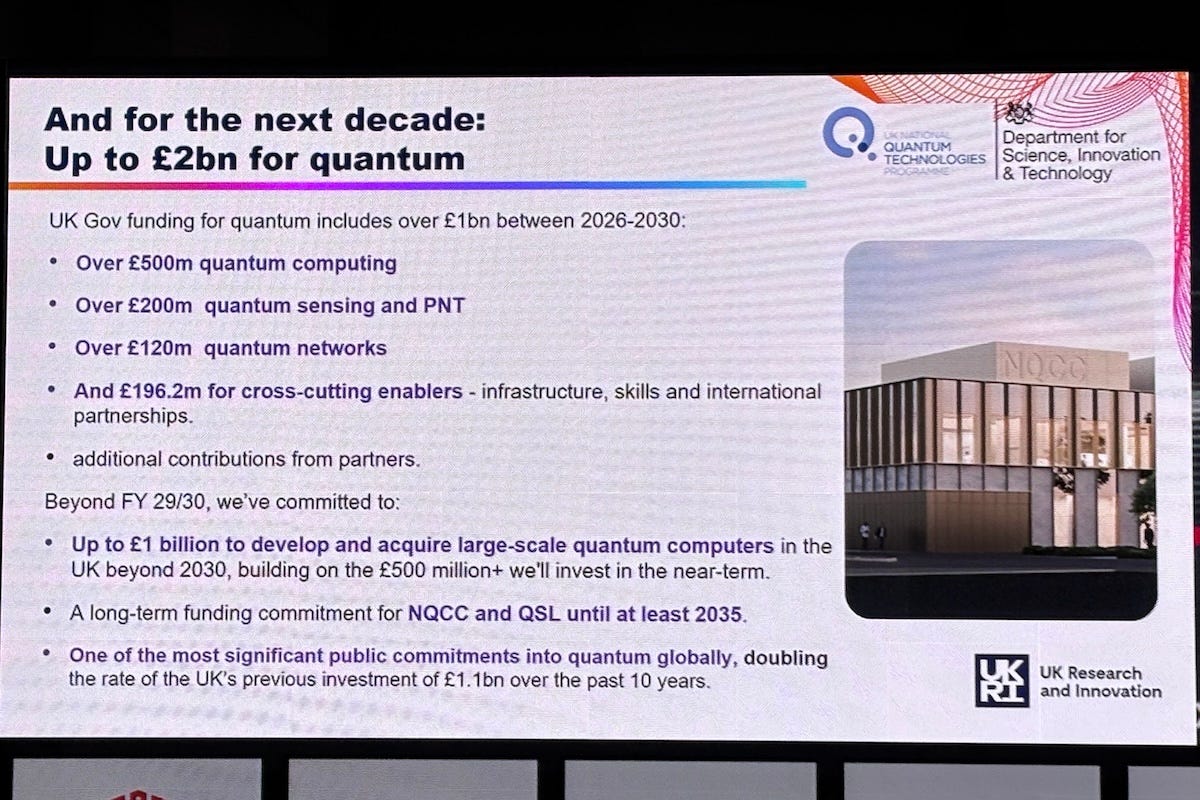
The 2026–2030 spending review commits a further £2 billion to the broader quantum programme, with approximately £500 million for quantum computing, £200 million for sensing and positioning, navigation and timing, and £120 million for quantum networks, roughly doubling the UK government’s total quantum investment.
With Phase 1 contracts due in October and larger evaluation rounds to follow, the next two years will determine which platforms and which companies the UK is prepared to back at scale. Knight said those decisions will be made on the evidence, not in advance of it.