


The next crypto allocation cycle may be driven less by speculative token prices than by the migration of financial market infrastructure to blockchain networks.
After a sharp market pullback in October 2025 and a year of weaker liquidity, the deeper opportunity in 2026 may lie in tokenization, stablecoins and the use of digital assets to make collateral, payments and real-world assets easier to move and manage.
“The plumbing is being upgraded. Everything in financial markets, everything being done digitally, is being upgraded,” said Ray Dillet, head of financial institutions, Europe, at Bitwise.
Stablecoins are best understood as tokenized payments that can move faster and more cheaply than legacy systems. Tokenization extends that logic to assets, collateral and other parts of financial-market infrastructure.
Dillet said tokenization would make real-world assets machine-readable, allowing assets such as hotels, houses and railroads to be used more efficiently in digital portfolios.
He said investors should look beyond the recent drawdown in Bitcoin and other digital assets. Adoption of blockchain technology had continued across Bitcoin, Ethereum, stablecoins, tokenization and smart contracts, while excess leverage and exuberance had been removed from the market.
That distinction matters for allocators because tokenization is increasingly being discussed as a financial infrastructure question rather than only a crypto-native investment theme. The shift is moving attention from token prices to cash flows, settlement, collateral, payments and the networks on which those activities may run.
Stablecoins are one of the clearest examples. Dillet said they had reached about US$33 trillion in transaction volume, up 74% year on year, showing that tokenized payments were already operating at scale.
He cited Tether as an example of how large stablecoin issuers had become in traditional asset markets. The company had become a major buyer of short-term US Treasuries and gold, while also holding a large Bitcoin position.
Barry Thomas, partner and managing director at Forteus, said the strongest growth in tokenized assets had come from tokenized treasuries rather than equities, private credit or real estate.
“The growth in tokenized assets has really come from tokenized treasuries,” he added. “The clear advantage is the ability to make improvements in collateral management and capital efficiency.”
Decentralized stress test
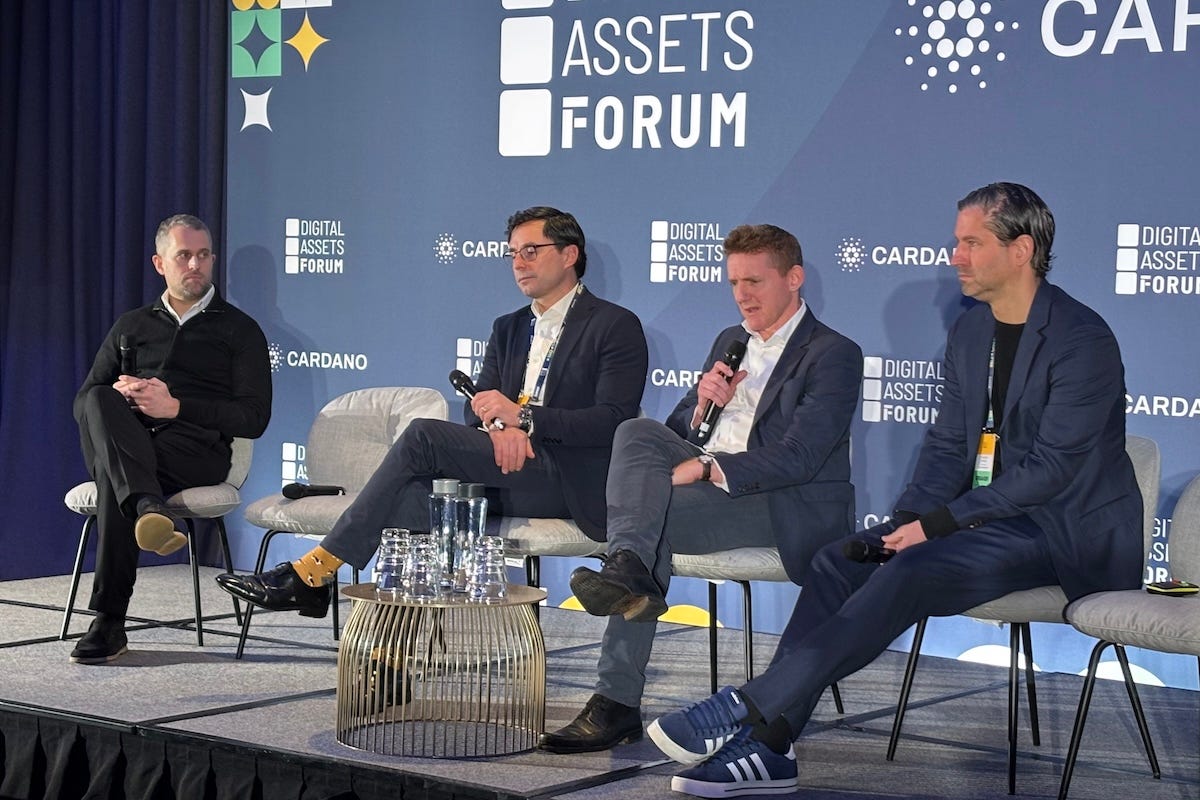
The comments were made at the Digital Assets Forum 2026 in London during a panel titled “Where Are the Opportunities for Crypto Allocation in 2026?” The event was organized by the European Blockchain Convention.
Carl Szantyr, managing partner at Blockstone Capital, moderated the discussion with Dillet, Thomas and Christopher Siedentopf, head of business development at Qapture Investment.
The panel took place against a difficult market backdrop. Bitcoin had fallen sharply from its previous high, liquidity had weakened and investors were still assessing the damage caused by a major liquidation event last year.
On October 10, 2025, the cryptocurrency market suffered its largest flash crash on record after US President Donald Trump announced a 100% tariff on Chinese imports. More than US$19 billion in leveraged positions were liquidated within 24 hours. Bitcoin dropped sharply and more than 1.6 million trader accounts were wiped out.
The market shock changed retail investors’ behavior and damaged confidence in parts of the sector.
“If you go back to October 10, I want to put it into perspective. It was more harmful to the industry than FTX,” Siedentopf said. “Retail completely disappeared. [Investors] got burned really badly.”
FTX, a Bahamas-based cryptocurrency exchange, filed for bankruptcy in November 2022 after a surge in customer withdrawals exposed a US$8 billion hole in its accounts.
Some retail capital that might otherwise have gone into crypto was attracted by leveraged trades in silver and gold. Yet decentralized finance (DeFi) infrastructure outperformed the market narrative suggested. It could attract wider adoption from both retail and institutional investors if the sector has the right infrastructure in place.
“DeFi has weathered these storms really well. The infrastructure performed as it should have done,” Siedentopf said. “There is just a perception change that needs to take place.”
That view sits alongside the broader tokenization argument. As assets, payments and financial applications move on-chain, investors have to decide which ecosystems are most likely to benefit.
For traditional finance users, tokenized treasuries may provide the first practical bridge. Their growth reflected a need for better use of collateral and greater capital efficiency, Thomas said.
He said tokenized treasuries are also easier for institutions to understand than more speculative digital assets. Their rise suggests that the next phase of crypto adoption may begin with low-risk assets and operational efficiency, rather than with new token launches or retail trading cycles.
Options take shape
The opportunity set for active managers is also changing after a difficult year for short-term trading strategies.
The difficult market backdrop also hit active managers. Thomas said 2025 had been hard for liquid and market-neutral strategies, especially through the third quarter, as macro uncertainty, geopolitical risk, lower trading volumes and weaker liquidity created a more fragile trading environment.
“What we saw was a gradual reduction in liquidity and volumes throughout the year,” he said. “Then what we saw in October was a significant stress event and liquidation event in the crypto space.”
Short-term strategies were hit particularly hard, especially in December, when statistical arbitrage and other short-term trading strategies struggled amid thinner volumes and abrupt price moves in smaller tokens.
At the same time, the development of new instruments could create fresh opportunities for more sophisticated managers.
One area to watch is the growth of crypto-linked options. Liquidity was improving in options on Bitcoin exchange-traded funds (ETFs), although the market remained in an early stage.
“The options market is still relatively new and immature, but that is changing,” Thomas said. “You are going to get more structured products, as you see in traditional finance.”
Digital asset treasuries may add to that shift as companies and funds look beyond simple buy-and-hold exposure. Some may use options strategies to generate yield on Bitcoin or other digital assets held on their balance sheets.
“You have the dynamic of the digital asset treasuries, which are having to evolve from a buy-and-hold strategy to actually generating a yield on their treasuries,” he added. “That typically involves call overwriting.”
Greater use of options could compress volatility and create opportunities for volatility arbitrage, a strategy that seeks to profit from differences between expected and realized price swings.
For allocators, the core message was not to rely on a single exposure. The market now includes passive Bitcoin products, active strategies, directional funds, market-neutral managers, stablecoin yields and DeFi opportunities.
“From an allocator's point of view, diversification is a must,” Siedentopf said. “Whether you are comfortable holding Bitcoin and running a yield on it, or whether you want to go directional, market neutral or stablecoin yields and DeFi, there is a lot on offer.”
“It is very rare that you find an allocator who only goes into one strategy in one space and goes all in,” Dillet said. “They generally diversify. Having exposure across the board is exciting.”
The next allocation cycle will test whether digital assets can move from price-led speculation to infrastructure-led adoption. For investors, the challenge will be separating durable financial plumbing from crowded trades, weak liquidity and operational risk.