


Tokenization promises faster, cheaper capital markets, but its biggest test may be whether more-automated finance also becomes more fragile.
The debate is shifting from build-out to resilience. The key question is whether market infrastructure can withstand stress once assets, cash and margin calls move around the clock.
“Ultimately, the goal of tokenization is to make the system bigger, better, faster and cheaper. But we should remain mindful that when systems become more efficient, they also tend to become more fragile,” said Hilary Allen, professor of law at American University Washington College of Law. “There will be circumstances in which tokenization’s increased efficiencies ultimately aren’t worth the attendant risks.”
“The increased financialization, speed and automation envisaged by proponents of tokenization all have precedents in the lead-up to the 2008 financial crisis,” Allen said. “The more bespoke and unfamiliar the assets are, the more likely they are to become illiquid in a panic.”
Allen said tokenization could reduce flexibility during a crisis because smart contracts are not typically programmed to handle unexpected events. Automated margin calls could also trigger forced sales, push down asset prices and accelerate market-wide deleveraging.
That warning goes to the center of the institutional debate. Tokenized markets could improve settlement, reduce manual processing and allow assets to move more quickly. The same design could make markets more rigid when discretion is needed.
Victor Jung, managing director and head of digital assets at Hamilton Lane, took the opposite view. Tokenization can cut friction in private markets, where onboarding and subscription processes can still involve long documents, slow approvals and high minimum commitments.
Jung said tokenization could reduce a US$10 million minimum commitment in private markets to US$500, opening access to an asset class that has historically been limited to institutions and wealthy investors.
For Jung, the issue is not whether blockchain should replace regulation. It is whether compliant and permissioned structures can make old market processes faster and more accessible. Private-market investing remains difficult for many investors, even as they can buy volatile crypto assets or concentrated public equities.
That creates the strategic fault line for financial institutions. Tokenization could become an operating upgrade for capital markets, but only if the legal, risk-management and investor-protection framework develops as quickly as the technology.
Stablecoin catalyst
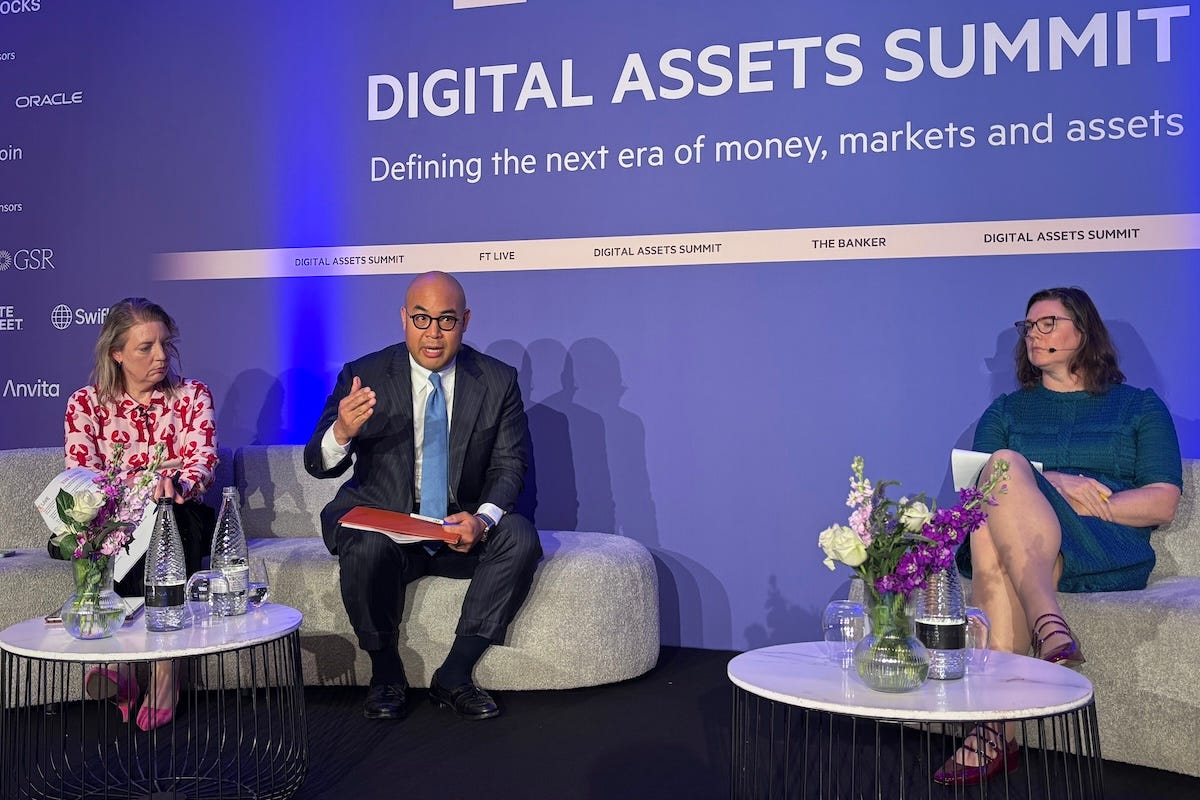
The debate took place at the Financial Times Digital Assets Summit in London on May 13. Moderated by Claer Barrett, consumer editor at the Financial Times, the session asked whether tokenization would transform capital markets within five years, or whether meaningful adoption remains a decade away.
Jung said stablecoins could be the catalyst that moves tokenization from pilot projects into functioning market infrastructure. Stablecoins are digital tokens usually designed to track the value of fiat currencies such as the US dollar.
“Stablecoins feed tokenization. Without stablecoins, tokenization is just not complete,” Jung said. “If you have no cash, no fiat, you cannot buy anything. You need to have the cash there.”
Fiat money is government-issued currency that is not backed by a physical commodity such as gold.
“There is a verdict from TradFi and DeFi that stablecoins are a better way,” Jung said. “It is money reformatted through blockchain rails that is cheaper, better, faster.”
TradFi (Traditional finance) covers banks, asset managers and other established financial institutions. DeFi (Decentralized finance) describes blockchain-based financial services that use code, smart contracts and digital wallets rather than conventional intermediaries.
Jung added that stablecoins provide the cash leg needed for tokenized assets to trade, settle and move across markets. Without that layer, tokenization remains only half of the infrastructure needed for practical adoption.
Stablecoin market capitalization had grown from about US$10 billion six years ago to at least US$300 billion, he said. Stablecoin transaction volumes had reached tens of trillions of dollars in 2025, exceeding Visa’s annual transaction volume.
The adoption argument is not limited to stablecoins. Traditional finance, decentralized finance, retail platforms and business-to-business platforms are all moving toward blockchain-based assets, although their reasons differ.
That momentum does not remove the hardest barriers. Tokenization is often discussed as a technology problem, when the deeper issue is legal recognition, market governance and regulatory alignment.
“When we are assessing the prospects for tokenization, it is important to appreciate that the technology is usually the easy part,” Allen said. “The harder challenge is the legal uncertainty about the alignment between the ownership of the token and the ownership of the real-world assets.”
“You don’t need a public, permissionless blockchain for tokenization,” Allen said. “It is the features of programmability and composability that people are excited about, using smart contracts to automate transactions.”
Physical assets pose a legal problem because ownership of a digital token must align with ownership of the underlying asset. If a painting changes hands outside a ledger, the ledger alone cannot solve the ownership dispute.
Mortgages face a similar challenge. Putting mortgages on a blockchain does not remove the need for legal systems to recognize title by registration. Cross-border tokenized deposits face another barrier: multiple countries would need to accept one ledger as compliant with anti-money laundering (AML) rules.
Retail risk
The private-market access argument gives tokenization a practical use case. It also raises a policy question: whether broader access to complex products is always a public good.
Jung said tokenization could open private-market exposure to investors excluded by high minimum commitments and manual subscription processes. Blockchain can reduce friction while keeping access inside compliant structures.
Allen challenged that framing, especially in the US retirement and savings market.
“I honestly find the financial inclusion arguments about tokenization, at least in the United States, very frustrating,” Allen said. “The issue is not that they do not have good investment opportunities. It is that we do not have a social safety net.”
Many US households live paycheck to paycheck, so the priority is not necessarily to give them access to more complex and riskier assets. The concern is that financial-inclusion language may be used to justify putting private equity and crypto-linked products into ordinary savings plans.
Retail exposure becomes more sensitive when tokenized markets trade around the clock. Ordinary investors may not have the same risk-management capabilities as hedge funds or professional trading firms.
“Retail investors are being encouraged to invest in 24/7 trading markets where, if they are margined, they can be liquidated while they sleep,” Allen said. “That is fine for a hedge fund that has 24/7 capabilities. It is not fine for your average person who does need to sleep.”
Automated markets also depend on operational resilience. Smart contracts rely on programmers to avoid code errors and security vulnerabilities. They also rely on oracles, or external data feeds used by smart contracts. Those feeds can become targets for manipulation or technical failure.
Allen said a problem in October 2025 involving an oracle maintained by Binance triggered mass liquidations in crypto markets. Her broader warning was that automation does not remove accountability. It shifts trust to coders, data feeds, cybersecurity controls and recovery procedures.
That caution appeared to land in the room. Before the debate, 88% of the audience voted that tokenization would transform capital markets within five years, while 12% disagreed.
After the speakers had made their case, support fell to about 67%. The shift showed that even at a digital-assets summit, the strongest argument for tokenization must be matched by a convincing operating model for regulation, resilience and investor protection.