


Tokenized finance is moving toward a decisive market-structure question: whether new digital rails will open financial markets or rebuild today’s clearing and settlement systems on the blockchain.
The answer may determine who controls future capital flows and how quickly assets can move. It may also decide whether startups can build new financial services without having to recreate the existing system's expensive back-office machinery.
“What we’re seeing at Offchain Labs, as we talk to teams about building out rails, reminds me a lot of the early days of building out the internet’s data rails,” said Ed Felten, co-founder and chief scientist at Offchain Labs, a blockchain infrastructure developer. “What we ended up with was something in the middle that combined most of the advantages of both extremes.”
Felten said crypto rails may follow a similar path, with a limited number of major corporate-controlled networks operating inside a system defined by openness and interconnection.
He said the early internet did not become either a fully peer-to-peer network of home computers or a single closed proprietary garden. It became a system built and operated by companies, but shaped by openness, standards and interconnection.
That analogy matters because tokenized finance faces the same trade-off. Corporate-backed rails can attract capital investment and scale. Open standards can allow users on different networks to interact as if they were operating within a single financial universe.
Basil Al Askari, founder and chief executive of MidChains, a UAE-based digital asset trading and custody platform, warned that the industry could otherwise end up close to where it began.
“We could end up where we started, where essentially the clearing infrastructure that currently exists ends up owning the rails and fundamentally, nothing really changes,” Al Askari said.
Alastair Sewell, senior investment director at Aviva Investors, the asset-management arm of UK insurer Aviva PLC, framed the issue as a battle over control of capital markets.
“It is probably the most fundamental economic question of the day,” Sewell said. “Who controls where that capital flows?”
The risk is not only incumbents' dominance. It is that digital assets become a new wrapper for old processes, rather than a new operating layer for finance.
Felten said programmable rails can do more than move assets. They can let developers build functions directly on top of the infrastructure and connect them. That would resemble the way internet applications were built on top of basic data rails.
“The rails were the enabler, but it was the innovation beyond that that was really revolutionary,” he said. “If they remain open enough and standards-based enough, we’ll get the benefits of openness and reduce barriers to entry.”
Stablecoin dilemma
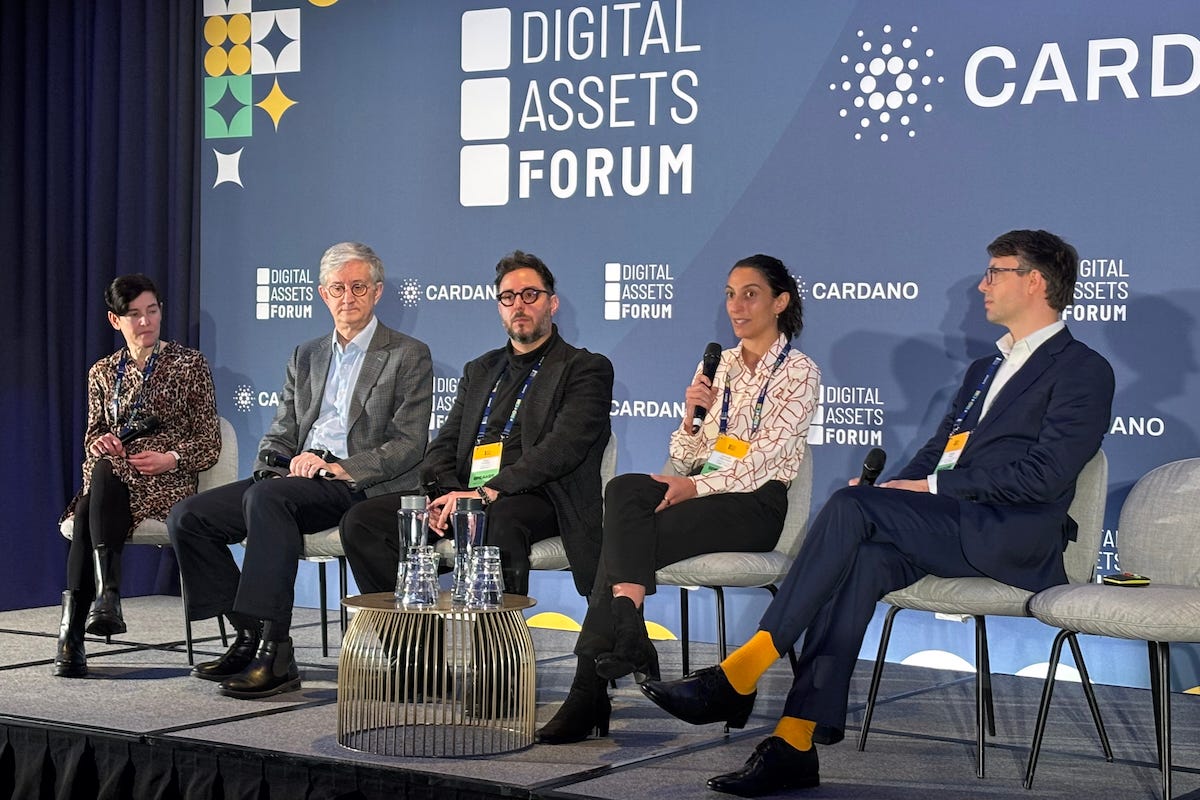
The discussion took place in London during a panel titled “Who Owns the Rails of Tokenized Finance?” at Digital Assets Forum 2026, a digital assets industry conference organized by European Blockchain Convention. The session was moderated by Su Carpenter, executive director of CryptoUK, a UK trade association for the crypto and digital asset sector.
The contrast with tokenized funds remains stark. Sewell said global money market fund assets stand at about US$13.5 trillion, compared with about US$12.5 billion in tokenized money market fund assets.
That makes tokenized money market funds small by comparison.
But the strategic risk is that incumbents focus only on a profitable existing business while a new market structure develops around them.
“This is the classic innovator’s dilemma. We’re facing a business which is great. We can invest more in it. We can listen to our customers. It will do well,” he said. “If we don’t do this, we run the risk of being severely disrupted in our future activities. This is why it matters, and this is why organizations like Aviva Investors need to be bold.”
Bringing a tokenized product to market still requires outsourced technology reviews, legal work and other complex project steps. For traditional asset managers, the question is whether the cost of learning now is lower than the cost of falling behind later.
“Tokenization is an enormous opportunity,” Sewell said. “It’s a bridge. It’s the opportunity for traditional investment managers to mitigate that risk of being materially disrupted.”
Al Askari said they remain the clearest working example of tokenized finance, both for investment activity and for small and medium-sized enterprises making cheaper cross-border payments.
“When we talk about tokenization, we forget that the real, proven and successful use case that we’ve seen so far is stablecoins,” he said. But stablecoin growth is also creating fragmentation risk.
He said regional banks are beginning to issue their own stablecoins. That could leave users dependent on specific banking relationships when they want to redeem those tokens.
“What I’m seeing is too many new stablecoin issuers popping up, and it is starting to become a risk,” he added. “You have to hope that MidChains either has a relationship with that bank or you directly have a relationship with that bank. It becomes a very convoluted way of taking your transit currency and going back into fiat currency.”
Aviva Investors is interested in using stablecoins for mutual fund subscriptions and redemptions.
But institutions need an objective framework, tested with third parties, to decide which stablecoin best serves clients and mitigates risk.
“We are specifically interested in the use of stablecoins as a means of subscription and redemption to mutual funds,” Sewell said. “But that does pose a very important question, which is: which stablecoin?”
KYC bottleneck
The biggest barriers remain legal and operational.
Anoosh Arevshatian, chief product officer at Zodia Custody, a digital asset custodian and wallet platform, said digital rails raise fundamental questions about who holds legal title, how a digital asset is recognized, and which legal form applies across jurisdictions.
“One of the examples that comes to mind is legal clarity,” she said. “Depending on the jurisdiction you’re in, who has legal title? How is that digital asset recognized?”
The UK and Abu Dhabi are relatively advanced. But many jurisdictions do not follow the same principles, making cross-border tokenized finance harder to scale. Compliance is another brake on adoption.
Sewell said anti-money laundering (AML), Know Your Client (KYC) and client-understanding obligations are mission-critical for institutional investors.
“Compliance, AML, KYC, and understanding our clients are mission-critical for us,” He said. “If there is a failure there, then that is not only a reputational risk. It becomes a strategic risk.”
KYC and AML rules differ across jurisdictions and sometimes across license types inside the same jurisdiction. Those differences can make it difficult to move assets between counterparties or issue tokenized assets for international projects.
“KYC is not the same in Dubai as it is here in the UK,” Al Askari said. “Those slight variations can create big challenges when you’re trying to deal with takers or makers outside of your home jurisdiction.”
Private markets remain one of the more practical opportunities.
Al Askari said he entered digital assets after working in private equity because he wanted to make private-market liquidity more efficient.
“One of the reasons I got into this space is to find ways to make private market liquidity more efficient,” he said.
MidChains wants to use its licenses to create a market where participants can trade tokenized assets that may represent individual assets or funds.
Those products would have to meet risk criteria being developed with regulators. The end-state, however, may be infrastructure that most users barely notice.
Arevshatian said users who are not speculating do not care which chain underpins an asset.
“The end users, if they’re not looking at speculation, don’t really care about what chain it is,” she said. “They need to have all of this abstracted away to be like any other asset.”
Felten described the desired system as low-cost, fast and trusted, with settlement moving beyond T+1 toward near-instant execution. Standards and best practices will also be needed before institutions and end users can trust the technology at scale.
Tokenized finance will therefore be judged less by the language of blockchain than by the operating discipline of market infrastructure. The winners will need to combine speed, compliance, liquidity and trust without turning the new rails into a closed version of the old ones.