


Europe’s fragmented regulatory landscape is emerging as the defining obstacle to large-scale bond tokenization, while the United States moves ahead with sweeping regulatory clearance, leaving the continent locked in a legislative process that could delay the development of meaningful market infrastructure until the end of the decade.
The contrast could hardly be sharper. The contrast could hardly be sharper. In December 2025, the US Securities and Exchange Commission (SEC) issued a no-action letter to the DTCC [Depository Trust and Clearing Corporation], clearing the way for a national-scale tokenization pilot program. Europe's equivalent framework is not expected to be operational until 2029–2030.
“We have 27 national regimes in Europe. There is no real harmonization. Yes, we do have MiCA [Markets in Crypto-Assets Regulation], but honestly, still 27 regimes, 27 national regulators, 27 bunches of problems for everyone,” said Jan Klesla, Chief Designer and Head of International Relations at DEUSS, which is building European public DLT infrastructure for small and medium-sized enterprise (SME) bond markets.
Mark Kepeneghian, Vice President of ADAN, the European digital asset industry association, spelled out the regulatory disparity. The SEC's no-action letter to DTCC, which holds a monopoly as the country's central securities depository, enabled tokenization to proceed at scale with minimal regulatory friction. In Europe, the DLT [distributed ledger technology] Pilot Regime 2 was reintroduced into the legislative process in December, but will not be live until 2029–2030.
Michael Ashby, chief executive of AlgoQuant, a multi-strategy hedge fund, said he does not see the situation as a zero-sum competition. Europe has deep financial history, and the UAE is already issuing tokenized securities and real estate bonds ahead of both the US and Europe. He said once Europe's 27 regulators eventually align, it will help the entire global ecosystem develop.
Klesla agreed that the UAE’s regulatory approach, which draws heavily on European frameworks, could serve as a basis for broader international coordination. Europe can still lead if it is willing to work openly with the UK, the US and other jurisdictions rather than treating harmonization as an internal matter.
Demand already institutional
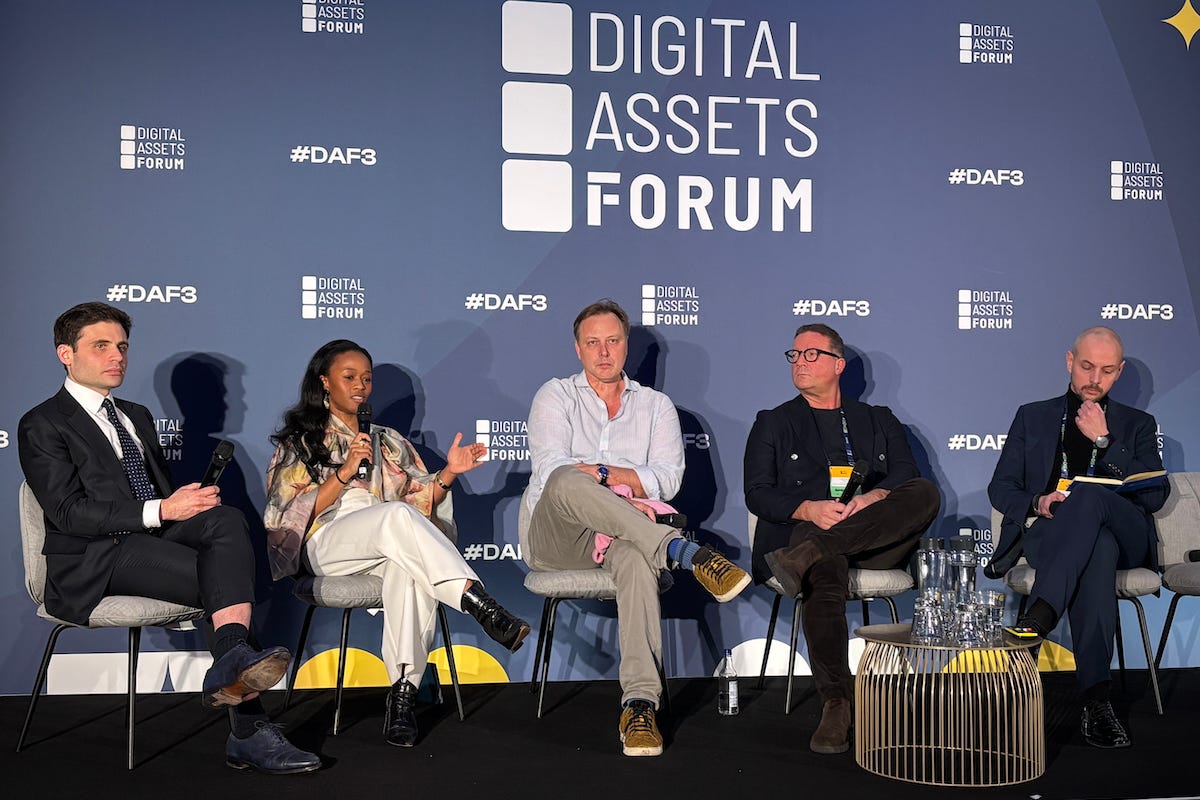
The panel was convened at Digital Assets Forum 2026 in London, organized by the European Blockchain Convention. Kepeneghian moderated a discussion on the practical mechanics, demand dynamics and liquidity challenges of tokenized bond markets.
He was joined by Klesla; Ashby; Jessica Hakizimana, Alternative Investments Program Manager at Belfius Private, the second-largest Belgian private bank; and Lorenzo Savi, Board Member of Falcon Investment Management, a crypto and digital asset manager.
On the demand side, Hakizimana made the most comprehensive case for tokenized bonds. Research from the University of Bayreuth in Germany found that tokenization can automate more than 2,000 tasks in the bond issuance process, saving roughly 1,000 person-hours per issuance. What previously took 12 weeks can now be compressed significantly, with bookkeeping periods cut by more than 50%.
A separate McKinsey study from 2024 found that end-to-end tokenized bond lifecycle efficiencies of at least 40% are achievable.
“Tokenization is not just a new narrative. It’s not an asset class. It’s a new distribution strategy, and the real impact comes when you manage to connect those tokenized assets and tokenized bonds to powerful channels,” she said.
She pointed to a generational wealth transfer as a major structural driver. UBS estimates that approximately $84 trillion will pass to the next generation globally by 2048, with $6 trillion of that among billionaires alone by 2040. The bulk of this transfer is happening within the next 10 years.
Next-generation beneficiaries in Europe already allocate on average more than 12% of their portfolios to crypto and digital assets. A recent EY report found that close to 70% of high-net-worth individuals plan to allocate 5% or more of their portfolios to tokenized assets.
“We have crossed the threshold from hype to institutional strategy. When you see BlackRock saying that they are expanding their tokenized assets and tokenized offering, it’s a game changer,” she said.
She also cited the NASDAQ, the New York Stock Exchange and the CFTC [Commodity Futures Trading Commission], which issued guidance in 2025 confirming tokenized assets can be used as collateral. SEC Chairman Paul Atkins has added further weight to the institutional shift.
Despite the strong case for demand, Ashby said the secondary market for tokenized bonds remains underdeveloped.
“Tokenization has been around for a while now, and there is really no demand function. There is a lot of supply of paper, but the reality is that the demand function has been quite low,” he said.
The problem is largely one of distribution. Crypto markets developed through retail channels and technologists rather than through the institutional frameworks that govern bond markets. Morgan Stanley recently rehired a digital assets team, though this happened only weeks before the forum and will take time to translate into active market-making.
On the decentralized side, HyperLiquid, a DeFi [decentralized finance] perpetuals platform, has emerged as the dominant player over the past six months.
During silver's surge to an all-time high in late January 2026, more than 10% of the silver supply was traded in tokenized form on the platform. Such volumes will never attract institutional participation due to KYC [Know Your Client] and AML [anti-money laundering] requirements, but they demonstrate genuine underlying demand for tokenized traditional assets.
“Tokenization is the golden ticket that actually brings institutional capital into crypto. We do think there is a huge market, first for bonds, but then for structured products. If you look at gold, there is a huge structured-product market for gold and oil. There is nothing for Bitcoin in relative terms,” Ashby said.
He estimated the market is 12–18 months away from meaningful institutional liquidity, contingent on both regulatory progress and technology upgrades. A significant technical barrier remains legacy back-office infrastructure: token quantities can extend to 20–30 decimal places, but most traditional systems cap at eight, making it impossible to book the trades.
With most large institutions carrying 20–30 years of technology debt, rebuilding systems to handle tokenized instruments will take considerable time.
Italy leads early issuances
DEUSS is building its infrastructure on top of a ledger developed by the European Commission, giving conventional institutions a regulated and familiar anchor point.
“To build a market that will help finance the real economy, you need infrastructure that offers two things: all the benefits of decentralized technology and the blockchain space, but also it has to be trusted — the trust of traditional finance and the traditional real economy,” Klesla said.
“In five to 10 years, we will be able to serve a usual entrepreneur in Norway, in Greece, in Spain, in Scotland with the whole spectrum of financial products based on DLT infrastructures,” he said.
DEUSS emphasizes full interoperability across public and private ledgers, financial intermediaries and distributors, while issuing standardized bonds that conform to existing legal frameworks. Reducing intermediaries is a long-term goal: SMEs seeking financing will continue to work through banks, brokers and investment firms for now.
Real-world evidence of early adoption is emerging from Italy. Lorenzo Savi, Board Member of Falcon Investment Management, noted that the Italian SMEs leading tokenized bond issuances are predominantly technology and artificial intelligence (AI) companies.
Metrica, an AI and data solutions provider, issued a €1.8 million tokenized bond with Banca di Sabina, a regional Italian lender. UniCredit and Cassa Depositi e Prestiti (CDP) underwrote a separate €5 million tokenized bond issued by E4 Computer Engineering, an engineering and AI firm.
“The SMEs that tend to issue tokenized bonds in Italy are either AI-related or AI-driven. They already have technology and digital in their DNA,” Savi said.
At the institutional level, Falcon Finance is in advanced discussions with fund managers interested in launching what could be the first portfolio composed entirely of tokenized bonds.
“At Falcon, we are in talks with a couple of fund managers that want to launch a portfolio dedicated only to tokenized bonds,” he said.
Family offices and private banks are well positioned as early adopters, Hakizimana said, given their clients’ appetite for new asset classes, lower minimum tickets and greater transparency. Trust and education are the final critical bottlenecks.
“Education is not just about educating the investors, but also the regulators and the financial advisors,” she said. “Trust is verifiable on blockchain.”
Savi drew a parallel to other disruptive technologies, noting that adoption curves tend to be slow at first before accelerating sharply.
"As with any new and disruptive phenomenon, at the beginning you need to build up an ecosystem. It progresses slowly, and then at some point there will be exponential growth, perhaps in two to three years," he said.
With infrastructure consolidating, institutional interest building and early issuances proving the model, panelists agreed that the remaining variables are regulatory alignment, technology modernization and time.