


Tokenized assets are entering mainstream finance faster than the systems needed to verify who controls them, how they work and whether the infrastructure beneath them can be trusted.
That gap is becoming harder to ignore as stablecoins, real-world assets and blockchain-based market rails move from experiments into regulated financial products. The next question for institutions is not only what can be tokenized but also whether the underlying system can establish trust before risk reaches clients.
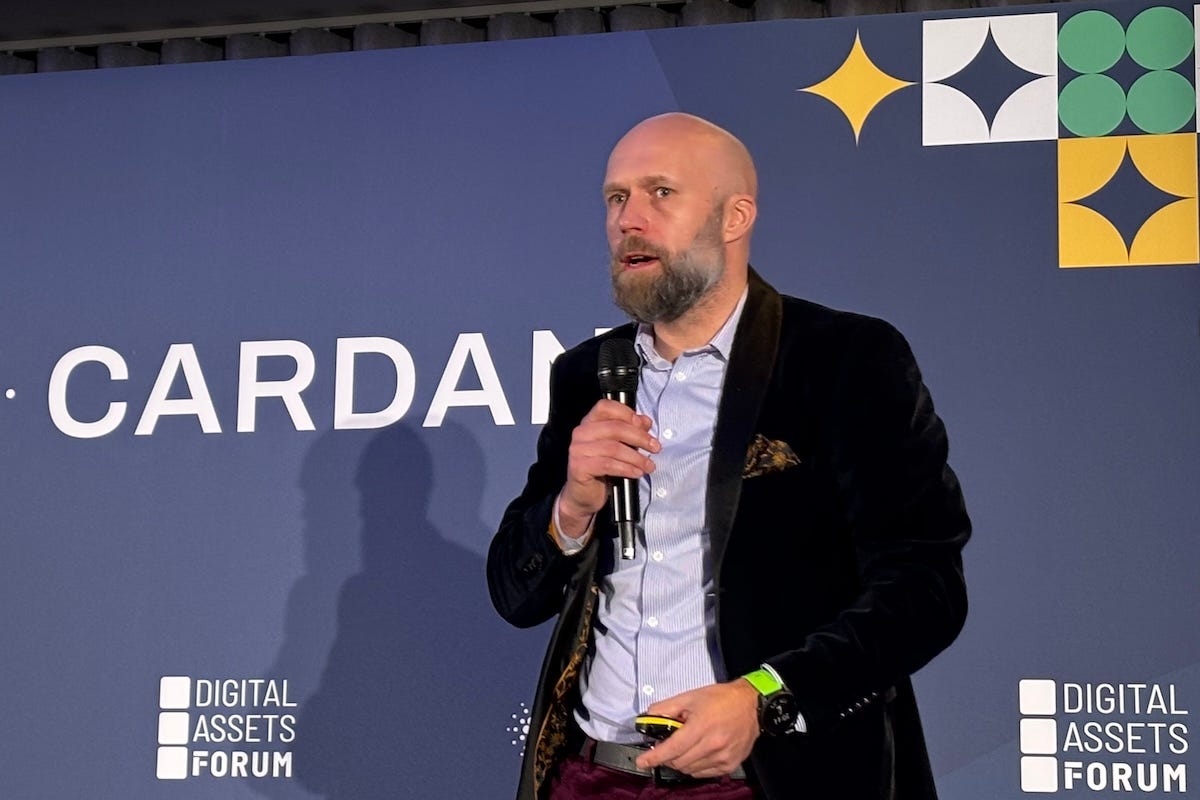
“Markets do not scale on technology at all. They scale on trust. It is no longer about who tokenizes first. It is about who thinks about trust as an architectural shape,” said Frederik Gregaard, chief executive of the Cardano Foundation.
“The real bottleneck for institutional adoption is whether institutions can trust the rails beneath the interface. This is no longer about getting headlines and doing proof-of-concept projects,” he said.
Stablecoins and tokenized assets are already operating at scale, with large asset managers including Fidelity, BlackRock and Franklin Templeton looking at tokenization and new financial rails. The concern is that the trust layer supporting those markets is not developing at the same pace.
For financial institutions, the problem is practical. Blockchain developers can tell investors, auditors and business executives to inspect the code, but that answer does not work when a major network can contain hundreds of thousands of lines of code.
Gregaard said Cardano alone has about 900,000 lines of code. A new generation of users may ask a large language model to identify where trust is established in that code, but that raises another problem: artificial intelligence (AI) systems cannot be blindly trusted either.
That turns verification into a board-level infrastructure question. If tokenized funds, stablecoins and programmable assets are to become part of real financial markets, institutions will need to prove identity, authorization, code integrity and governance in ways that non-developers can audit.
The shift also changes the competitive benchmark. Speed, cost and product launches remain important, but they do not answer whether a counterparty is authorized, whether a smart contract is accountable or whether a digital asset can survive scrutiny from regulators, auditors and institutional clients.
Identity infrastructure
Gregaard made the comments during a keynote titled “The Integrity Economy: Why Digital Trust is the New Global Currency” at Digital Assets Forum 2026 in London. The event was organized by the European Blockchain Convention.
The Cardano Foundation is a Switzerland-based organization that supports the development and adoption of Cardano, a public blockchain network. The keynote framed digital trust as a core operating requirement for financial institutions and enterprises, not only a reputational issue.
Gregaard said the next phase of competition will depend on whether companies can make digital integrity part of their operating systems, not just their public image.
That shift matters as digital assets move into real financial infrastructure. Companies can no longer treat trust as a message to customers after a product is launched, because verification must be built into the system from the start.
He said companies are moving into an environment shaped by AI, machine learning, automated execution and regulated digital markets. In that setting, trust cannot rely only on manual governance, audit logs, release controls or checks carried out after systems have already been built.
The pressure is especially clear in institutional decentralized finance (DeFi), real-world assets and enterprise pilots moving into production. These markets need to know who is behind a smart contract, who has authority to act and who can be held accountable if something fails.
That is why digital identity sits at the center of the infrastructure debate. Identity should not be treated only as compliance, but as an economic infrastructure that supports verifiable credentials, decentralized identity, and transparent governance.
“This is not about wallets. It is about entities, permissions and accountability. Who is acting, who is authorized, and how can I prove that the person who was acting and was authorized really is that person?” Gregaard said.
He added that the identity layer also needs to work across infrastructure. A system tied only to one blockchain would force institutions into one network, while banks, asset managers and enterprises need identity tools that can operate across different business models.
That makes off-chain verification an important part of his model. The identity system must remain verifiable, but it cannot be locked into a single chain if it is to support broad institutional use.
One example is the Legal Entity Identifier (LEI), a 20-character code used to identify legal entities. Its digital counterpart, the verifiable Legal Entity Identifier (vLEI), is designed to help counterparties verify the identity, authority and role of people acting for an organization.
The same logic applies to administrative efficiency. Stronger digital identity systems can reduce friction in public-sector and financial-market processes by making entities, credentials and permissions easier to verify.
Real-time auditability
The urgency is increasing as AI changes the cost and speed of digital deception. Companies now operate in an environment where deepfakes, AI-generated data and automated execution make authenticity harder to prove.
“We now live in an age of deepfakes, AI-generated data and automated execution. The ability to prove authenticity is the new currency,” Gregaard said.
“Every single company here that is successful will have bots and AI trying to take down your brand and trying to share misinformation. The cost of doing that is close to zero, and it is becoming a commodity,” he said.
AI-generated data is already outpacing older verification tools. Governance frameworks that depend mainly on human review, manual sign-offs and conventional audit logs may struggle as AI agents begin to act across enterprise and financial systems.
For those agents to execute safely, they will need verifiable identity, delegated authority and clear operating conditions. Otherwise, companies may struggle to prove whether an action came from an authorized system, an altered system or a malicious imitation.
That is where auditability becomes a business requirement. Legacy systems were not designed for round-the-clock liquidity, cross-border digital value or real-time auditability, but digital markets now increasingly require all three.
“Legacy systems were not designed for 24/7 liquidity, cross-border digital value or real-time auditability. But the world we are working in now requires that,” Gregaard said.
Clients and stakeholders increasingly expect faster verification of assets, balances and processes. Waiting many months for traditional audit cycles is becoming less compatible with markets that can move continuously across borders and asset classes.
The long-term goal is not only to speed up audits. It is to enable auditors and stakeholders to review larger data populations rather than relying mainly on spot checks, creating a more continuous assurance layer for digital markets.
Cardano’s own positioning is built around formal methods, peer-reviewed research and decentralized governance. That company context matters, but the broader argument is that financial infrastructure will increasingly need trust designed into the architecture from the beginning.
“The future of infrastructure, specifically critical infrastructure, belongs to the verifiable. To be verifiable means that you need to have it in your architecture,” he said.
If tokenization continues to expand, institutions will need to prove more than ownership of a digital asset. They will need to prove the identity, authority and audit trail behind the systems that move it.