


Tokenization is beginning to look less like a crypto-market experiment and more like a way to reduce risk in the plumbing of wholesale finance.
One of the clearest use cases is not retail trading or speculative digital assets. It is the automation of collateral movement in repo and derivatives markets, where counterparties still rely on legal agreements, valuation checks and margin calls that can be slow, manual and fragmented.
“The idea is that we can automate the valuations and the process of moving collateral between the two entities in the trade,” said Peter Left, head of digital and market innovation at Lloyds Banking Group. “That is very much what we all benefit from with centralized clearing right now, and that moving margin every couple of hours through LCH [London Clearing House] reduces all of that counterparty credit risk to each other.”
“Not everyone can participate in central clearing,” he said. “This technology allows us to bring the benefits of central clearing and reduce counterparty credit risk to bilateral transactions. That is what excites so many in the repo space and financial markets ecosystem.”
Repo, or repurchase agreement, is a short-term financing transaction in which one party sells securities and agrees to buy them back later. It is widely used by banks, asset managers and other financial institutions to raise cash against collateral.
Left said repo is a strong tokenization use case because margin must move when the price of the underlying bonds changes. Tokenization could make that collateral more mobile, allowing it to move intraday rather than through slower operational processes.
He said Lloyds worked with Aberdeen last year to tokenize one of Aberdeen’s liquidity funds, enabling Aberdeen’s foreign-exchange trading desk to use it as collateral for derivatives trading with Lloyds. The tokenized version allowed full title transfer of the digital fund between the two institutions as market exposure changed.
The next step would be to digitize trading documentation, including International Swaps and Derivatives Association (ISDA) agreements for derivatives and the Global Master Repurchase Agreement (GMRA) for repo.
That could allow valuation and collateral workflows to be automated between the two sides of a trade.
The appeal is practical. If margins can be calculated and transferred more frequently, exposures should be smaller and easier to manage. That does not remove the need for legal agreements, risk models or default procedures, but it suggests tokenization may deliver its first measurable gains in the less glamorous back office of institutional finance.
Real-money pilots
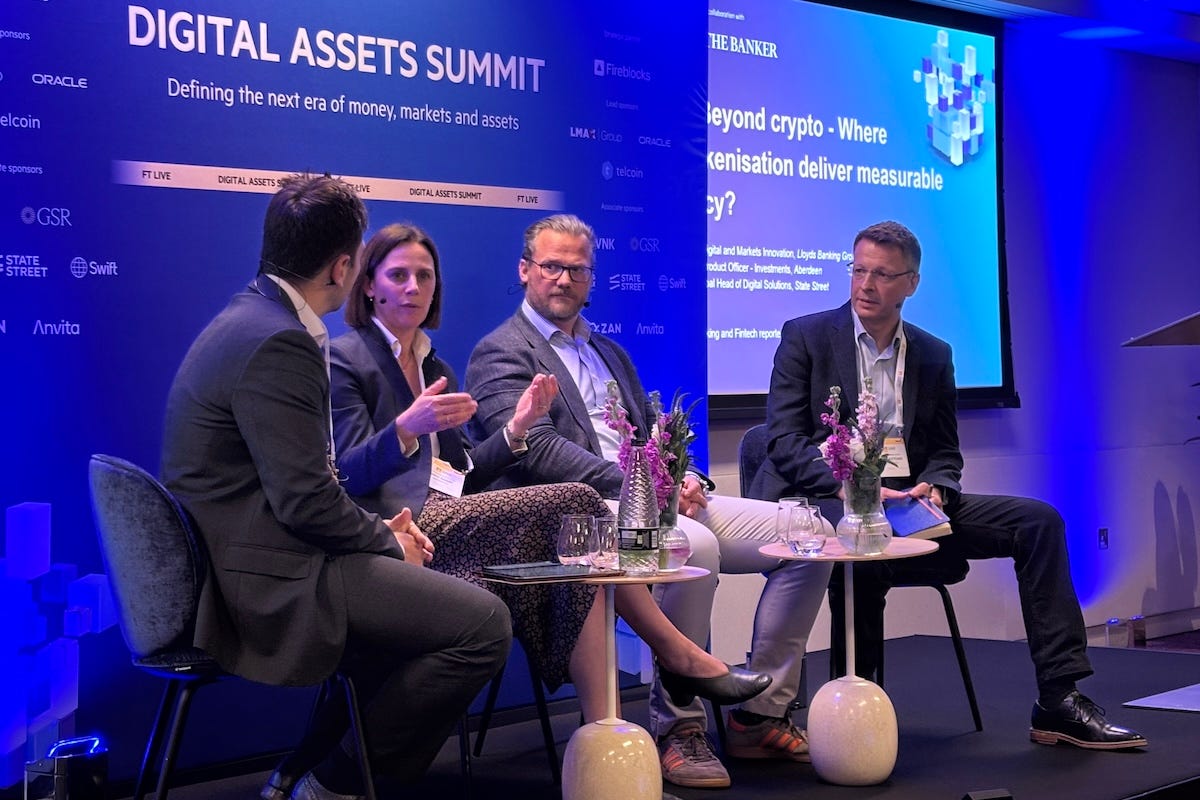
The comments came during a panel titled “Beyond crypto: Where does tokenization deliver measurable efficiency?” at the Financial Times Digital Assets Summit in London on May 13. The discussion was moderated by Laith Al-Khalaf, banking and fintech reporter at the Financial Times.
Their discussion focused on where distributed ledger technology (DLT) can deliver commercial value after years of pilots. One area of momentum is tokenized deposits, especially as banks seek to make digital deposits interoperable across institutions.
Left said he co-chairs the Great British Tokenized Deposit project. It is designed to ensure that tokenized deposits issued by banks such as Lloyds, HSBC, Barclays, Santander, and NatWest can work together.
“This isn’t proof of concept,” he said. “This is real money with real customers across real regulated balance sheets. One of those use cases is not the full home-buying journey, but it is the remortgage journey.”
The pilot links payments from the incoming lender to repayments to the outgoing lender, so the transaction can net off automatically. That could reduce the need for funds to sit with a conveyancer before completion.
Emily Smart, chief product officer, investments, at Aberdeen, said asset managers are approaching tokenization through the lens of client access and fund operations, rather than technology alone. Aberdeen does not currently hold digital assets in its funds, but is looking at whether a fund manager could hold a digital bond and use it as collateral.
“One of the examples we’re early-stage looking at is the ability to hold a digital bond, which the fund manager can then use as collateral,” she said. “We would obviously need our custodian to be able to custody the digital bond as well.”
She said the full benefit depends on several parts of the fund value chain moving together. Aberdeen can already offer front-end tokens, but those tokens still buy a conventional fund unit rather than creating a fully digitally native process.
“If you want to go fully digitally native, you will need all steps in the value chain,” she added. “Where we are today is that we can offer front-end tokens. People could buy a token in our fund, but you’re just buying a token that then buys a unit.”
Tokenized deposits also sit at the center of the debate over whether banks or stablecoin issuers will provide the dominant form of programmable money.
“Tokenized deposits are just deposits of Lloyds and other licensed institutions recorded on a new database technology, distributed ledger technology,” Left said. “They have FSCS [Financial Services Compensation Scheme] protections in the UK. They pay interest, and money today on Lloyds’ balance sheet and NatWest’s balance sheet is interoperable via schemes like Faster Payments and CHAPS [Clearing House Automated Payment System].”
Angus Fletcher, global head of digital solutions at State Street, said the market is unlikely to settle on one form of digital cash soon. Institutions will need to support tokenized deposits, stablecoins, wholesale central bank digital currencies, and upgraded central bank payment systems.
“We need to be able to support tokenized deposits, stablecoins and wholesale CBDC [central bank digital currency],” Fletcher said. “For us, it is largely customer-driven as to why we use one versus another. It is transacting as and when you want to, with cash and assets.”
Collateral and risk
Money market funds may provide another route to commercial adoption because they already align with collateral and liquidity management.
“Tokenized money market funds are really where everyone sees the core business case in the space,” Fletcher said. “It is all back to that collateral element, where being able to use fund units for collateral is absolutely critical.”
He said tokenized money market funds are being used in crypto markets and are increasingly being considered for over-the-counter (OTC) derivatives. State Street’s investment management business also announced a money market fund that accepts stablecoins and supports subscription and redemption outside normal working hours.
Left said the wholesale market needs more consensus around using money market funds as digital collateral.
The UK’s September 2022 mini-budget showed how quickly collateral demands can become a systemic problem for some investors, particularly liability-driven investment (LDI) strategies used by pension funds.
“I’d like to see more consensus in the wholesale market around the utility of money market funds as collateral in digital format,” he said. “If we can mobilize them instantly as collateral in our derivative trading agreements, that would be a real, powerful enabler and a stepping stone for more things to come.”
Private markets are another promising but less mature area. Smart said the use case remains theoretical in many cases, but tokenization could allow investors to buy smaller portions of an asset or smaller units in a private-market fund, where minimum investment sizes have traditionally been high.
“The technology gives you the ability to fractionalize that effectively,” she said. “You can buy much smaller lot sizes of either an asset directly, or you can buy into private-market funds in a much smaller lot size. If there is a secondary market, you can then trade that if you need liquidity.”
But the infrastructure is not yet mature. Smart said pension fund discussions are still focused mainly on long-term asset funds (LTAFs), rather than on tokenization, as a route into private markets. The technology may be ahead of where many clients are today.
Fletcher also warned that technology cannot create liquidity by itself.
“Tokenization doesn’t automatically create a liquid market,” he said. “There have to be buyers and sellers, and the underlying risks still remain the same. Just by tokenizing a building doesn’t make it any easier for it to be liquidated.”
The larger execution risk is fragmentation. He said traditional institutions will need to operate in hybrid markets for the foreseeable future, with old and new rails running side by side.
“We are going to live in a hybrid market for the foreseeable future,” he said. “There is something like 1,000 different blockchains out there, and that is a massive difficulty for us. There is a cost and a cyber risk associated with every single one of those connections.”
He said the industry will also need to decide which blockchains will become dominant once large-scale financial activity moves on-chain.
“Once we start having trillions of dollars worth of activity on a blockchain, we have to ask ourselves, what is a blockchain?” he said. “Is it a financial market infrastructure? Is it similar to something like a cloud provider? Is it a SWIFT equivalent that needs to be regulated in that way?”
For banks, asset managers and infrastructure providers, the near-term question is not whether tokenization can work in theory. It is whether the industry can agree on standards, legal frameworks and operating models before fragmented pilots become another set of costly silos.