


Stablecoins have become the sharpest inflection point in digital finance. Once constrained largely to trading, they now serve as instruments of economic strategy and capital mobility—giving governments and institutions new ways to move value across borders. Their ascent is forcing blockchain platforms to confront a landscape where fiat‑linked digital money may eclipse the role once played by native crypto tokens.
In this environment, developers and policymakers are reassessing the extent of stablecoins’ influence over global liquidity flows, cross‑border settlement, and monetary sovereignty. The competitive lines in digital finance are no longer defined simply between competing blockchain networks, but between currencies—and the jurisdictions backing them.
“One of the reasons U.S. policymakers pushed for stablecoins is that they saw it as a way to project the dollar abroad,” Arthur Breitman, co-founder of Tezos, told TechJournal.uk in an interview.
He said global adoption has accelerated far faster than many expected, with emerging markets turning to stablecoins to escape currency instability and institutions adopting them for faster settlement and operational efficiency. This has created a competitive environment defined increasingly by policy, liquidity and monetary influence rather than purely technological design.
Global Currency Strains
Breitman said that the U.S. dollar’s traditional safe‑haven status is weakening.
“The dollar is down 10% this year, and there seems to be less of a commitment to defend its value,” he said.
Despite this shift, he believes no major contender is positioned to replace it, citing China’s capital controls, Europe’s “managed decline,” Japan’s aging demographics, and the limited scale of smaller currencies such as the Swiss franc or Singapore dollar.
He also reflected on how rising geopolitical complexity affects stablecoin use in Asia.
Several Asian jurisdictions are considering local‑currency stablecoins, but he noted that global adoption will still follow U.S. regulatory leadership. If Washington continues to support stablecoins, many countries—Asia included—will follow because regulators “pay close attention to what the U.S. does.”
This environment, he suggested, strengthens the appeal of censorship‑resistant blockchains during periods of instability, reinforcing why public networks still matter despite the rise of regulated stablecoins.
However, he warned that if every jurisdiction issues its own stablecoin, competitive pressures will intensify.
“These stablecoins still rely on centralized issuers, and there will always be pressure. There will be seizures, and there will be capital controls,” he said.
In contrast, public blockchains maintain freedoms that are “much harder to impinge on,” ensuring they retain long‑term relevance.
Tokenized Commodity Markets
Breitman spoke on the sidelines of the London Blockchain Conference on October 22, where he outlined how Tezos’ development strategy increasingly intersects with real‑world commodities and institutional‑grade markets. Rather than alternating rapidly between comments and contextual facts, this section now reflects a smoother narrative built around his perspective.
Tezos, launched in 2018, was designed for applications requiring durability, auditability, and governance. Its upgrade mechanism and formal‑verification tooling have helped maintain long‑term stability—conditions Breitman said are essential for markets handling assets with multi‑decade relevance.
Breitman said blockchain developers are exploring tokenized real‑world assets that benefit from transparent ownership records and efficient settlement, without specifying individual commodities at this stage. He noted that Tezos’ staking economics—annual issuance slightly under 4% and rewards near 10%—help support applications that require predictable fees and institutional reliability.
Developers are increasingly assessing how tokenization can streamline the management of high‑value assets across borders. Breitman said interest is rising in sectors where immutable records and programmable settlement offer clear efficiencies for institutions.
He emphasized that interest is strongest in asset categories where transparent records and programmable settlement create operational efficiencies for institutions, and where Tezos’ long‑term stability supports sustained deployment.
When asked about advice for UK blockchain startups, Breitman said the market has matured, and expectations have risen.
“The days when you can just go on hype are already gone, and you need to demonstrate traction,” he said.
He noted that the Tezos Foundation in Switzerland continues to invest in startups aligned with the ecosystem.
Commodity Tokenization Wave
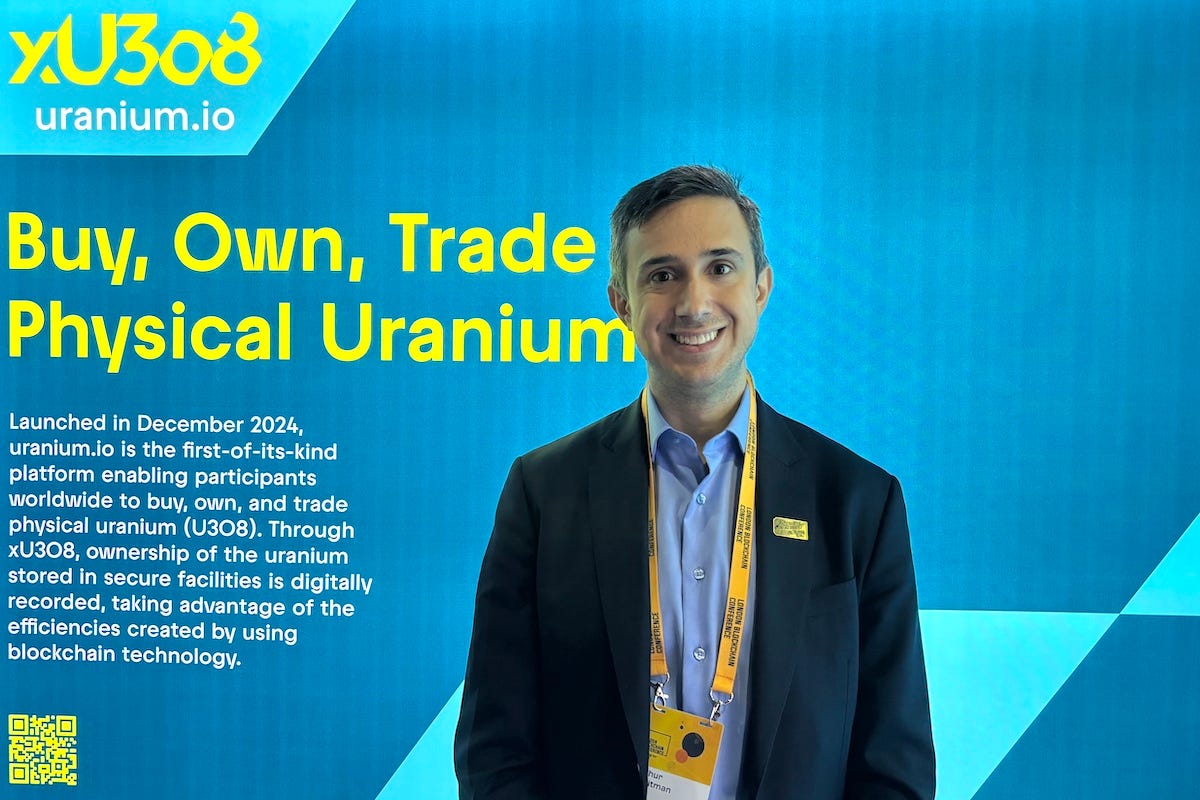
Beyond Tezos’ core network development, Breitman has widened his focus to tokenized commodities through uranium.io, a marketplace launched as a decentralized application for trading physical uranium. The platform is supported by Curzon Uranium, which has traded more than $1 billion of uranium, and Archax, the UK’s first registered crypto exchange.
Uranium.io arrives at a moment of accelerating global energy demand driven by artificial intelligence infrastructure. Data‑center operators are turning to nuclear power as a stable, carbon‑free baseload.
Major technology firms are making direct investments, including Microsoft’s plan to use a reactivated reactor at Three Mile Island and Amazon’s $500 million investment in X‑Energy. These trends have strengthened long‑term uranium demand.
Breitman said uranium stands out because of rising demand from nuclear projects supporting AI workloads. He said additional elements will be added to the platform.
“We’re looking at rare earths, lithium, and cobalt. Uranium is interesting. Hafnium is also interesting,” he said, stressing that the market size must justify tokenization. “Revert metals get talked about a lot, but the actual volume bought every year is small.”
Future Infrastructure
In parallel to his protocol work, Breitman remains involved in TriliTech, the London-based R&D hub supporting growth across the Tezos ecosystem. The team focuses on engineering, hiring, and product development for applications that must operate reliably at scale. The team focuses on engineering, hiring, and product development for applications that must operate reliably at scale.
“We’re trying to build a really high‑quality wallet at the moment,” Breitman said, noting the push for more robust user‑facing tools that can support institutional‑grade activity.
As digital finance continues to integrate with real‑world infrastructure, he said the next phase of development will hinge on whether blockchains can support markets that operate continuously and across borders without compromising regulatory alignment. He noted that institutional demand is shifting toward platforms that can upgrade seamlessly, handle higher throughput, and support asset classes that require long‑term operational certainty.
Looking ahead, Breitman said the broader evolution of Tezos will focus on delivering infrastructure that can support sophisticated, high‑volume applications without sacrificing the network’s upgradeability. He highlighted that teams within the ecosystem are developing advanced wallet frameworks, new gaming applications, and high‑assurance tooling aimed at institutional partners.
He also pointed to ongoing work with public‑sector agencies.
“We also have a project with the Department of Motor Vehicles (DMV) in California for the localization of car titles,” he said.
Breitman said these projects show how decentralized networks can provide long‑term reliability for government processes that require transparent, tamper‑resistant records.
He added that future upgrades to Tezos will target faster throughput and more efficient data availability, ensuring the network can support emerging categories such as verifiable digital identities, automated compliance, and cross‑chain interoperability.
These improvements, he said, are designed to position Tezos for an era when blockchains operate as underlying infrastructure rather than speculative assets.