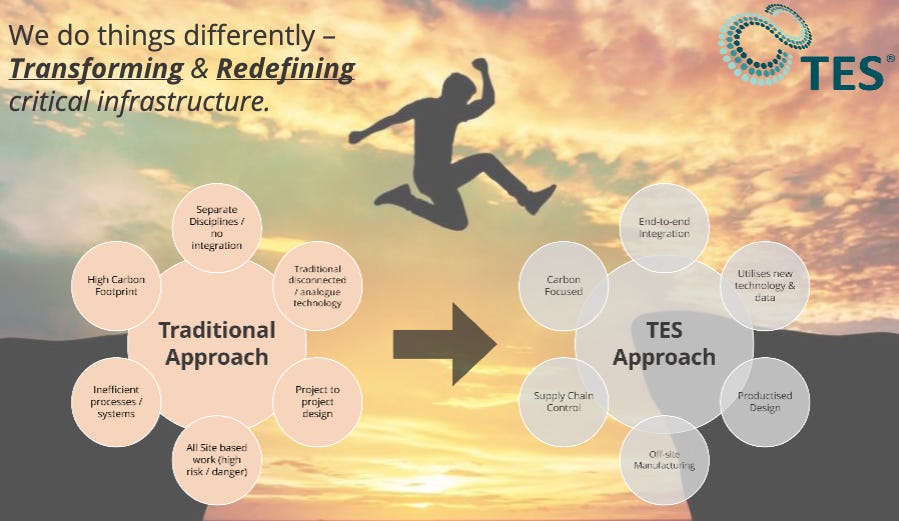
TES Group, a Northern Ireland-based water treatment systems builder and power equipment supplier, is riding a shift in data centers away from on-site power equipment and toward modular rooms built in factories.
These rooms, known as pods and skids, arrive packed with switchgear, uninterruptible power supplies (UPS), cooling units and batteries, cutting the labor needed on site.
“The whole industry has flipped now. Traditional data centers used to be constructed. Now they’re manufactured,” said Michael Beagan, managing director of TES Power. “The modular rooms are all everyone’s talking about, which is fantastic for us.”
“One reason you can’t build data centers like I used to is that you can’t find 1,000 people in 20 locations. That’s why it’s a modular building factory, which means you need 200 people, not 1,000, to build the site,” said James Peacock, chairman of TES Power.
Pods are clad units that sit outside a data center, while skids carry the same equipment unclad inside the data hall.
TES works to about 80% standardized and 20% customized design. A client building in Frankfurt, Warsaw and Milan wants the same product in each city, but every site needs changes to voltage, space or operation.
“Building switchgear and putting copper in boxes has never changed since the 1960s, and it’s not going to,” Peacock said. “There’s always going to be some sort of manual stuff. It’s about how we make sure that skill is used for the real skillful bit.”
Each switchgear board is bespoke but assembled from standard subassemblies. Units are now built and fully tested on their own mini skids before being lifted into the main skid, which has room for only a few workers.
“The critical thing here is about speed to market. That’s what people care about,” Beagan said. “They place an order, they want that gear tomorrow if they could.”
Peacock said data center builders used to wait about 24 weeks for a backup generator to arrive after ordering it. The wait grew to a year and now runs to 18 months. Circuit breakers, delivered in four to six weeks today, could soon take 10 to 12 weeks.
“There is going to be another supply crunch,” he said. “Particularly in Europe, there’s going to be an avalanche of work.”
Since the pandemic, supplier relations have turned into partnerships, and Schneider Electric, ABB and Siemens have set up stock hubs in Northern Ireland, he said.
TES was founded in 1999 by Brian Taylor and Noel McCracken to build motor control centers (MCCs) for water utilities.
It grew into a contractor that designs, installs and commissions the mechanical, electrical and control systems of water treatment works, leaving civil engineering to partners. Over the past few years, it has transformed itself into a maker of modular switchgear and power rooms, spinning off its data center work as TES Power.
It now aims to apply its water pumping experience to data centers, which need their own firefighting and cooling water systems.
French electrical group Legrand acquired TES in April from private equity firm Foresight Group. On the same day, it also bought Keydak, a data center rack maker based in Guangzhou, China.
TES then had about £72 million in revenue and around 300 staff, with data centers accounting for about half its sales.
Europe’s leasing record
The comments came during a media tour of TES Group’s sites in Northern Ireland on September 22 and 23, organized by TES. Journalists visited TES Water’s headquarters in Cookstown, County Tyrone, and TES Power’s campus in Ballykelly, County Derry, to see how the group serves the data center and water markets.
David Sandars, regional director for Europe, the Middle East and Africa (EMEA) at datacenterHawk, presented the industry outlook. The Dallas, Texas-based market intelligence firm was acquired by S&P Global on September 1.
“The first half of this year has been the most incredible and unprecedented six months in the data center industry in Europe,” Sandars said. “The market has grown in six months more than it has ever done in previous years.”
Leasing hit a record 678 megawatts (MW) in the first quarter of 2026 and 1.6 gigawatts (GW) in the second. The half-year total of 2.2GW beat every full year from 2023 to 2025.
The second quarter also brought Europe’s first deal above 300MW.
Planned capacity jumped from 58GW to 66.8GW in three months, though Sandars said there may not be enough energy to deliver it all.
Growth is shifting away from the FLAP-D hubs of Frankfurt, London, Amsterdam, Paris and Dublin, which absorbed under 200MW in the second quarter. The Nordics and Baltics absorbed more than 700MW in the same period.
“The FLAP-D markets are slowing, whereas the traditional tier two markets, the Nordics and the Baltics, are accelerating,” Sandars said.
He said new capacity in those markets is due between 2028 and 2029, against about 2030 in the FLAP-D hubs. Norway’s market has grown almost 70% a year since 2020, with most of that growth coming after ChatGPT launched at the end of 2022.
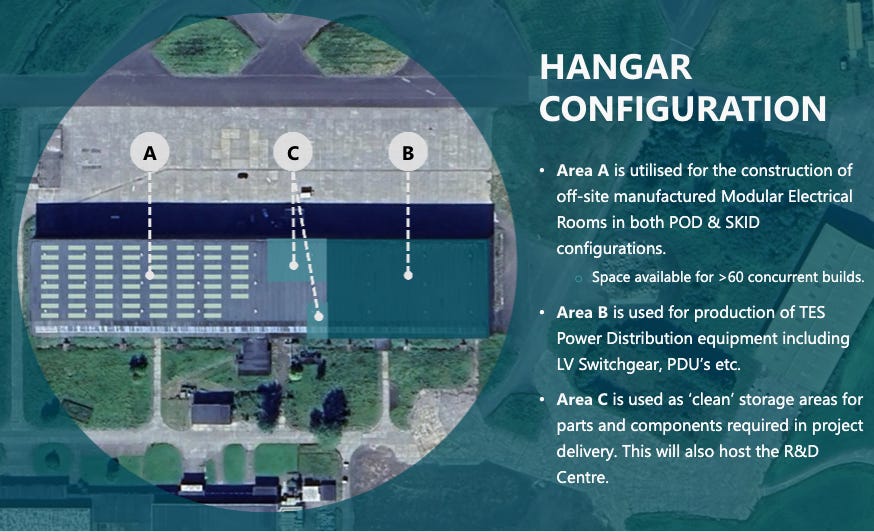
TES Power is chasing that demand from a former military base on the shore of Lough Foyle. The 770-acre site was run by the Royal Air Force (RAF) and then the British Army, and TES moved into its 1940s aircraft hangar four years ago.
“We came into this derelict building with no staff, no nothing, and just built this,” Beagan said. “It has been a very fun four years.”
TES has used the whole hangar, about 300,000 square feet, since early 2025. It fits about 60 pod-and-skid builds at once, and the company calls it Europe’s largest cantilever building, with no pillars in the way of 18-meter skids.
Gary McLorn, director of business development and marketing at TES Power, said turnover has grown from zero to about £80 million in a few years, all of it exported.
He said Northern Ireland’s post-Brexit status gives TES access to both the UK and European Union (EU) markets without customs checks.
“Next year we are set to more than double. Nothing is set in stone. There’s a very high probability that we double again,” Beagan said.
TES Power avoids hyperscalers and targets colocation operators only.
“Hyperscale would just swallow us up,” McLorn said. “We don’t want to work for one company, and we don’t want hundreds of companies either. We want five to 10 really good customers that want to scale and we can scale with.”
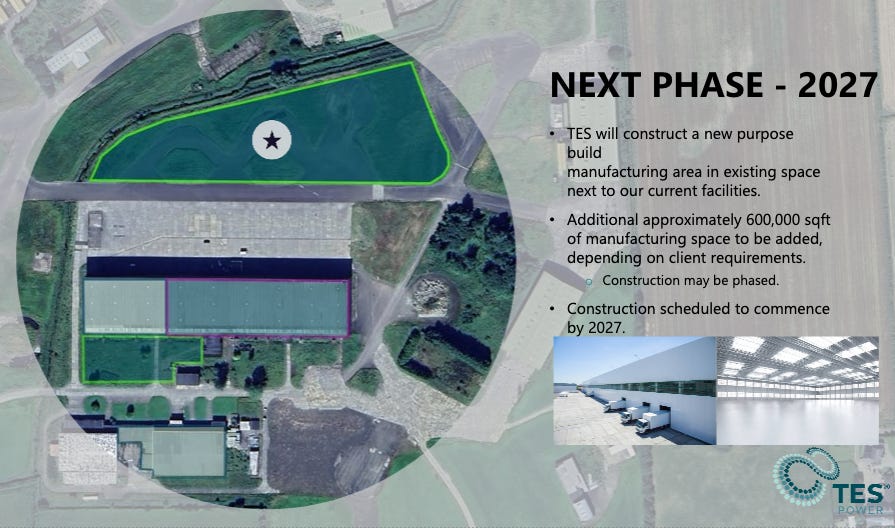
The company plans to start building a 600,000-square-foot expansion at Ballykelly by 2027.
The shift to DC
Beagan said switching from alternating current (AC) to direct current (DC) at rack level brings two advantages. Power conversion can move outside every rack, and conductors can shrink.
“In an AC system, you’ve got your fluctuating voltage and magnetic field, and you create what’s called the skin effect in conductors,” he said. “With DC, that eliminates that completely, so now you’re getting to utilize the full conductor.”
He said a hyperscaler he worked with 14 years ago shelved a low-voltage DC project at the last minute because nothing was driving demand. That driver now exists.
DC is now on TES Power’s research and development (R&D) roadmap, and part of the hangar will host a new R&D center.
“In the next three to five years, you’ll see some people adopt 800-volt DC totally, and you’ll see some hybrid designs,” Peacock said. “Nobody will want to be the guinea pig. But eventually one of the hyperscalers will adopt a staggered approach, and sheep follow sheep.”
He said solid-state transformers and breakers, now in early development with suppliers such as Schneider Electric and ABB, will eventually appear in TES panels.
The skids on the hangar floor also use nickel-zinc batteries from ZincFive instead of lithium.
“It doesn’t have the same fire properties as lithium, so you can store the batteries beside the machinery without having separate fire compartments,” McLorn said.
Asked whether the boom could burst, Peacock said construction is always lumpy, but he could not see data center demand stopping in his lifetime.
“Data centers are now a piece of global infrastructure. The world cannot survive without them,” he said.
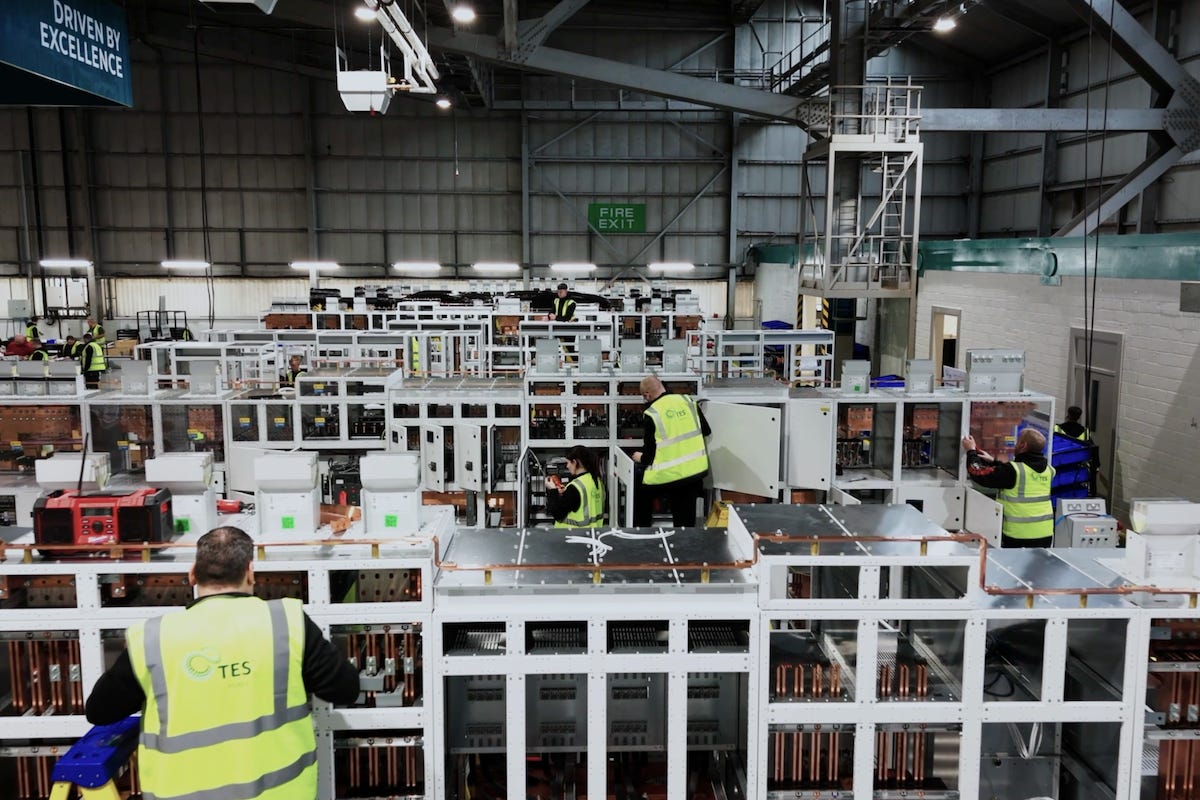
TES Power’s growth also depends on people. It has created about 200 jobs in two years and expects to double that within the next couple of years, McLorn said.
Training that workforce is its own challenge. TES Power has about 30 apprentices and took 16 recruits onto a new apprenticeship course at North West Regional College this year, though Beagan said trained commissioning engineers are often poached soon after.
Founders Taylor and McCracken were apprentices themselves. TES now recruits at universities, colleges and even primary schools, and is trying to attract more women.
Water follows the servers
TES Group runs TES Power and TES Water as two wholly owned divisions, and the water division is now following the power division into data centers.
“The water utility companies are imposing the same thing on the data centers,” said Mark Geddis, pre contracts director at TES Water. “If you’re building a data center that’s going to use a lot of water for cooling purposes, basically build your own treatment plant.”
New sites now harvest rain from roofs and car parks into tanks and treat it on site.
McLorn said visiting data center customers had long asked TES to build their water systems too.
About 18 months ago, TES took its first such project, for PolarDC in Norway. It built potable water and firewater pumping pods, with storage tanks and diesel pumps for sprinklers and hydrants, designed to carry heavy snow loads.
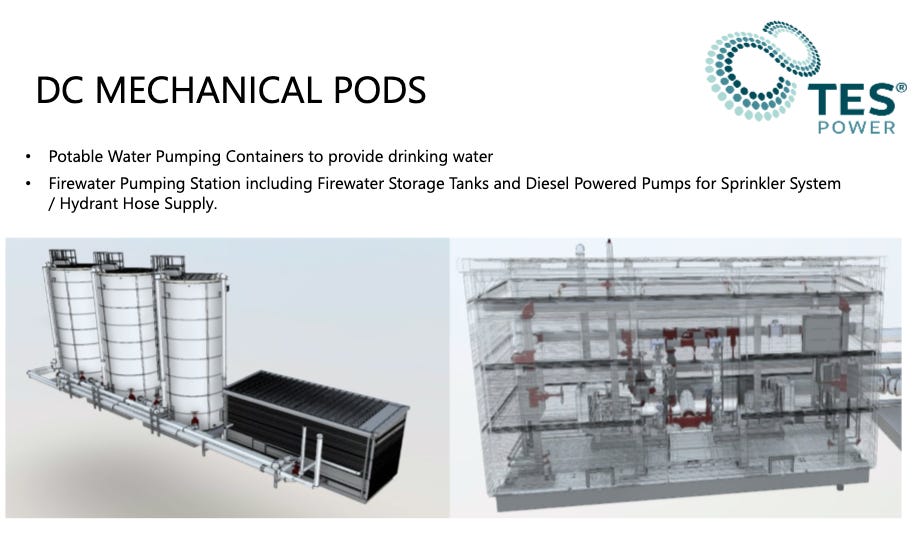
“We were able to use our supply chain in the water industry to deliver this project faster than what we could with data center suppliers,” McLorn said.
Water demand is rising at home too. UK water utilities spend in five-year asset management plan (AMP) cycles regulated by Ofwat, and TES Water’s clients include Thames Water, Anglian Water, Northumbrian Water and Uisce Éireann.
“The current AMP cycle, which started last year, was roughly double the previous AMP cycle in terms of spend, and the next one’s going to be about double again,” McLorn said. “The volume of work that has to be done is going through the roof.”
The shortfall is already biting in Northern Ireland, where Geddis said most treatment works are at capacity.
“Housing development within Northern Ireland has largely stopped, because Northern Ireland Water are saying we don’t have room,” he said.
Barriers to entry stay high. Contractors need at least 80% in an annual two-day audit to bid for work, and some frameworks now demand 90%. TES scored 100%, McLorn said.
The group’s biggest recent test is at Ringsend, the landlocked plant that treats Dublin’s wastewater.
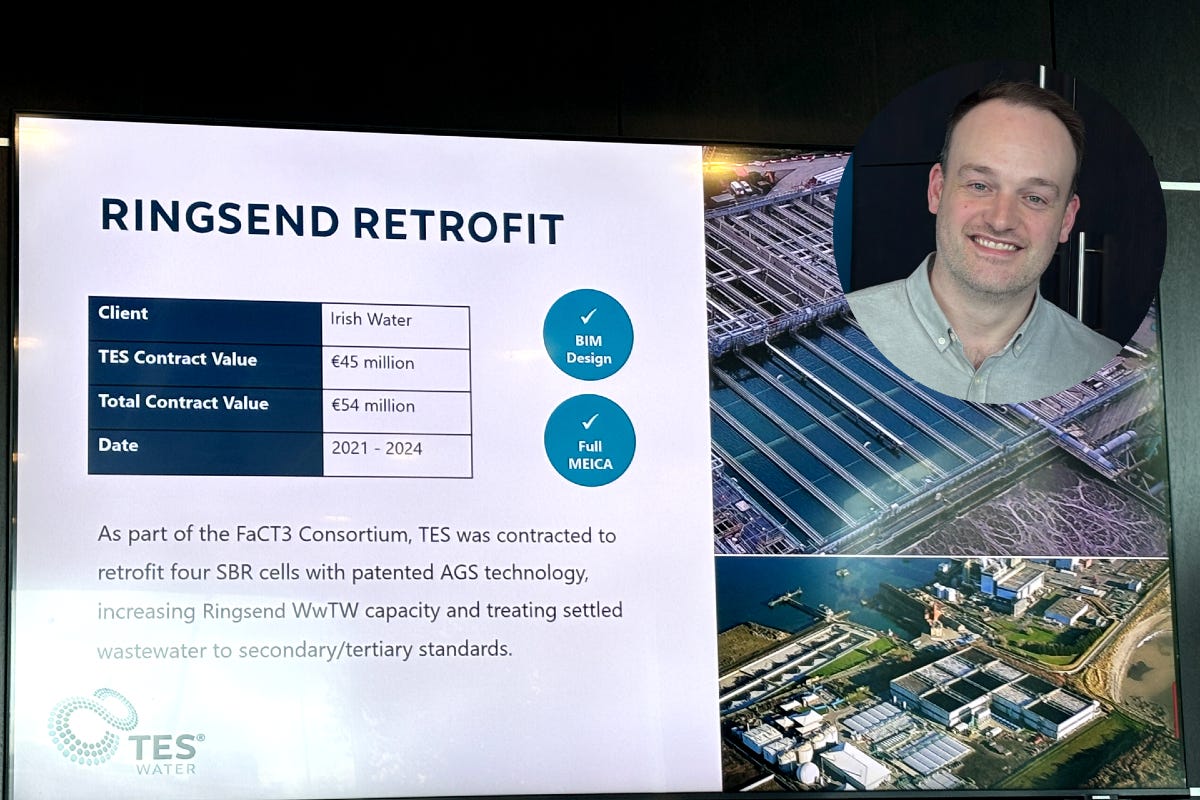
The upgrade lifts capacity to 2.4 million population equivalent within the existing site, while the plant stays live. Geddis said its 24 double-stacked treatment basins, each about 65 by 45 meters, are being converted to aerobic granular sludge (AGS), a Dutch technology licensed by Royal HaskoningDHV. TES retrofitted four of them.
“The concrete’s moved a little, so the walls aren’t nice and straight and the floor is not nice and level,” McLorn said. “With a laser scan survey, we were able to find all the movements, so it goes to site, and it fits the first time.”
TES’s contract, part of the FaCT3 consortium, was worth €45 million of a €54 million total and ran from 2021 to 2024.
McLorn said more than half of TES’s share went on metalwork, and that TES models every project in building information modeling (BIM) whether or not the client asks.
With the next AMP cycle expected to double spending again, TES Water is now talking to more data center operators as it looks beyond the utilities.