


A quantum algorithm has cut cardboard use by more than 200 kilograms across a benchmark of real orders.
The comparison covered 6,034 real orders, checked against the classical solver already running in the company’s production line and against what the existing software would have produced for the same shipment. Every box and kilogram of cardboard avoided lowers shipping costs and cuts material waste.
The same algorithm is projected to save the manufacturer €480 a day. It packs thousands of orders every day.
“They need to face thousands of bin packing problems every day. When I say thousands, I mean 6,000 of these problems every day,” said Dr. Eneko Osaba, principal researcher at Tecnalia. “The algorithm we have developed is better because it uses fewer boxes, with cardboard use more than 200 kilograms less.”
“We can say our algorithm is more sustainable. If they decide to deploy it, they are going to save €480 each day, which I think would be a very good indicator of whether you want to use a solution or not,” he said.
He said companies want to talk about money and sustainability, since those are the indicators they focus on.
Osaba works in Tecnalia’s quantum technologies group, a Spanish center that calls itself the country’s largest.
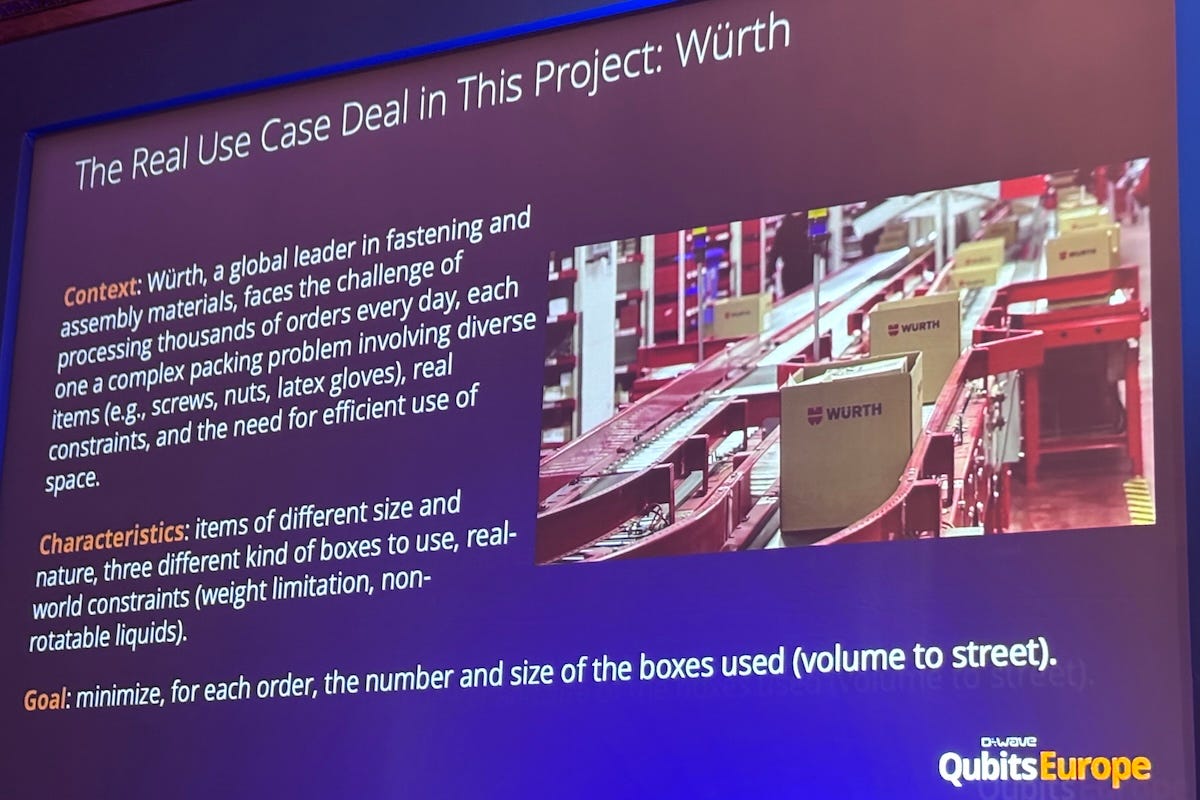
The client behind the benchmark, Würth, is a global market leader in the development, production and sale of assembly and fastening materials. Tecnalia describes its own mission as turning technology into gross domestic product, treating quantum computing as an applied research area it sells directly to industry rather than a purely academic exercise.
Osaba said the benchmark tracked several business indicators together rather than a single optimization score, including the total number of boxes used, the amount of cardboard consumed and the resulting shipping cost.
The team frames that combination as its clearest business case yet for quantum computing: fewer boxes, less material, lower cost.
The Würth case is the most advanced among several industrial quantum computing projects that Tecnalia has built with external partners. Osaba said each of the group’s published use cases has come with its own peer-reviewed paper, and this one is next in line.
Why boxes are hard
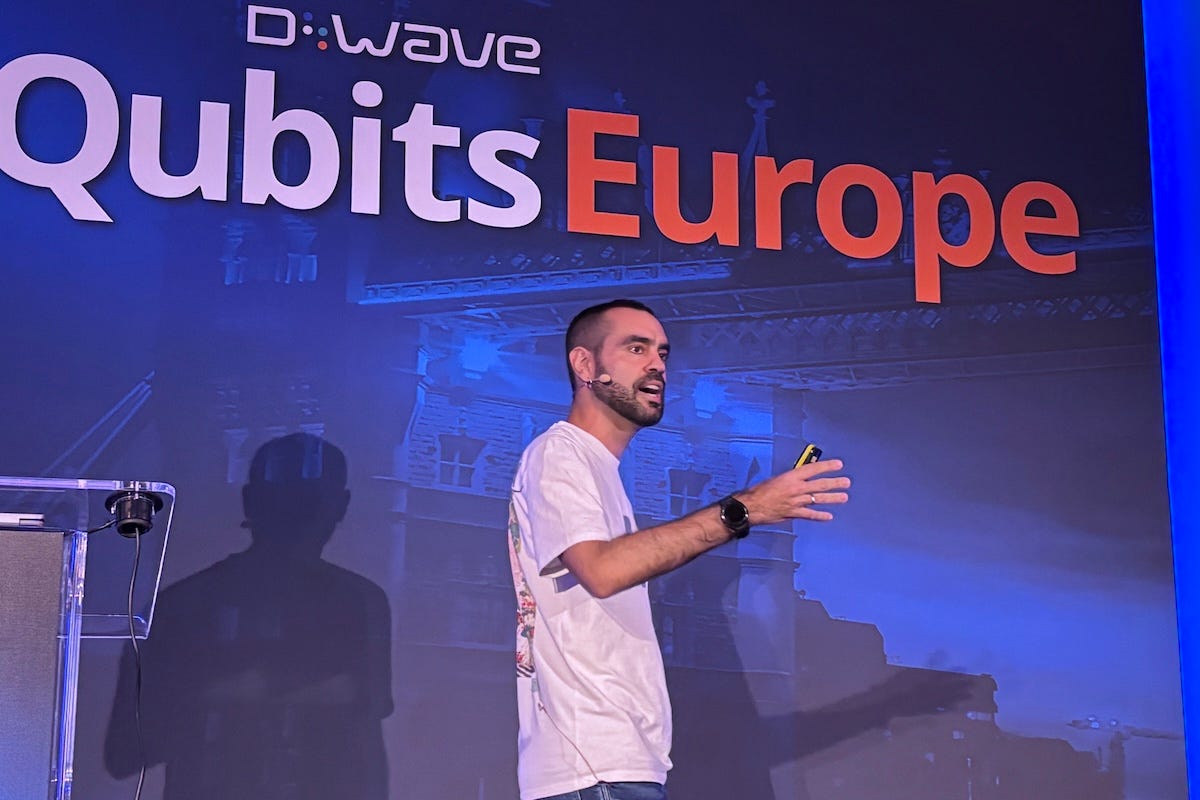
Osaba presented the work in a session titled “Applied Quantum Computing: 3D Bin Packing for Würth” at Qubits Europe 2026, a one-day quantum computing conference organized by D-Wave in London. The event focused on real-world business applications of quantum computing.
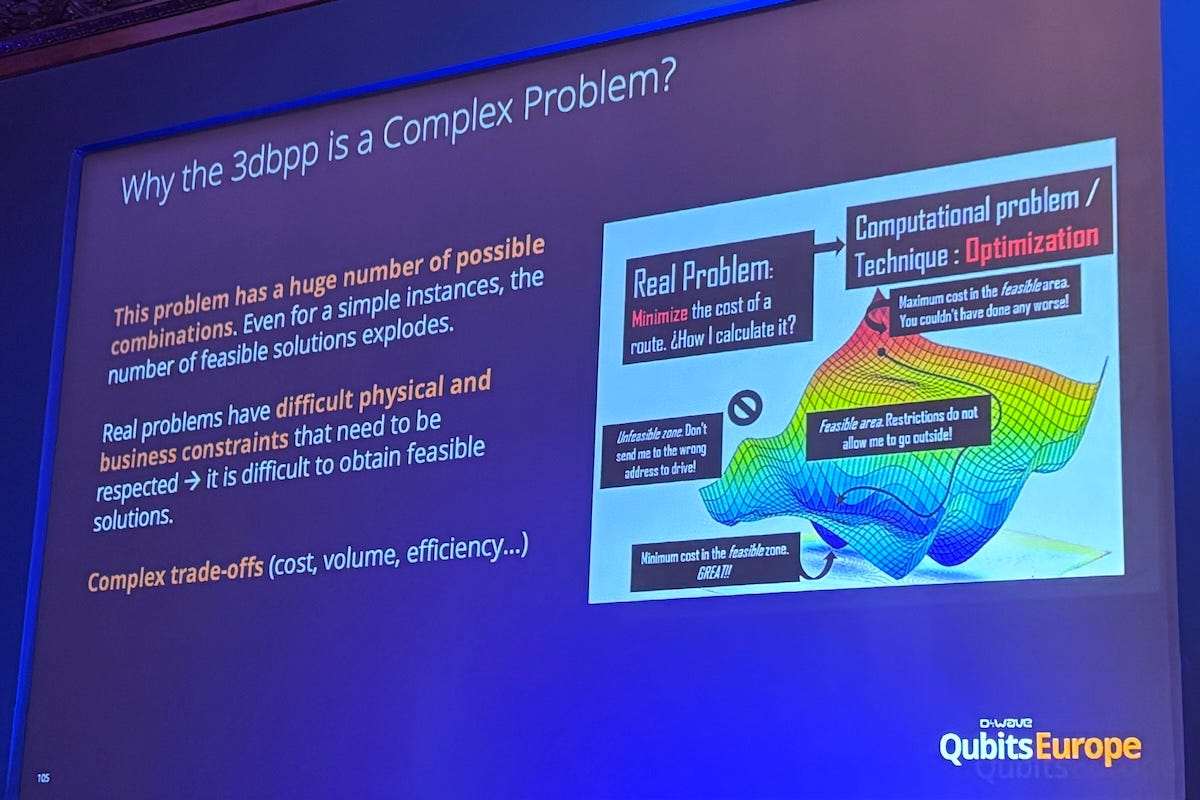
He said the bin packing problem (BPP), a decades-old logistics challenge, remains far from solved even with today’s technology. The task is to fit items of different shapes into containers using as few boxes as possible, a problem that gets harder as more items are added.
“It is very important even today, and it is not already solved,” he said. “The three-dimensional bin packing problem is complex because it is discrete, which makes it very interesting for quantum computers. It has a huge number of possible combinations.”
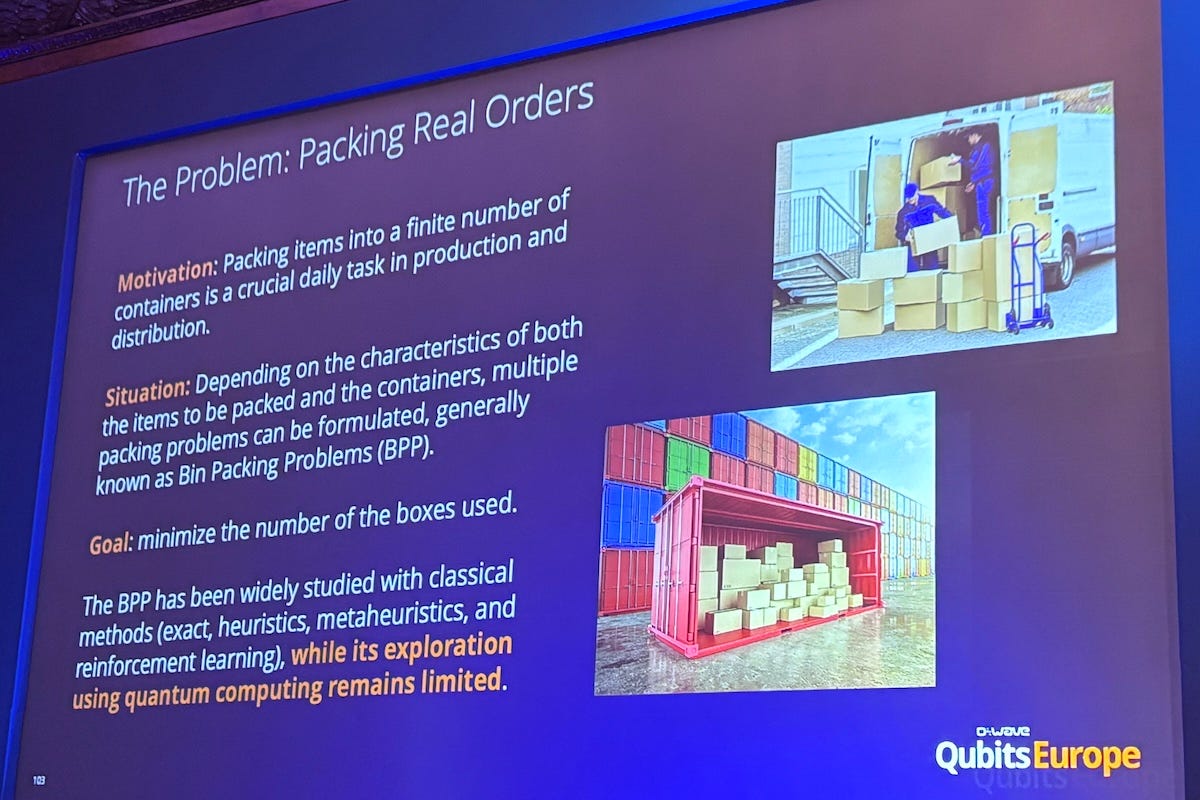
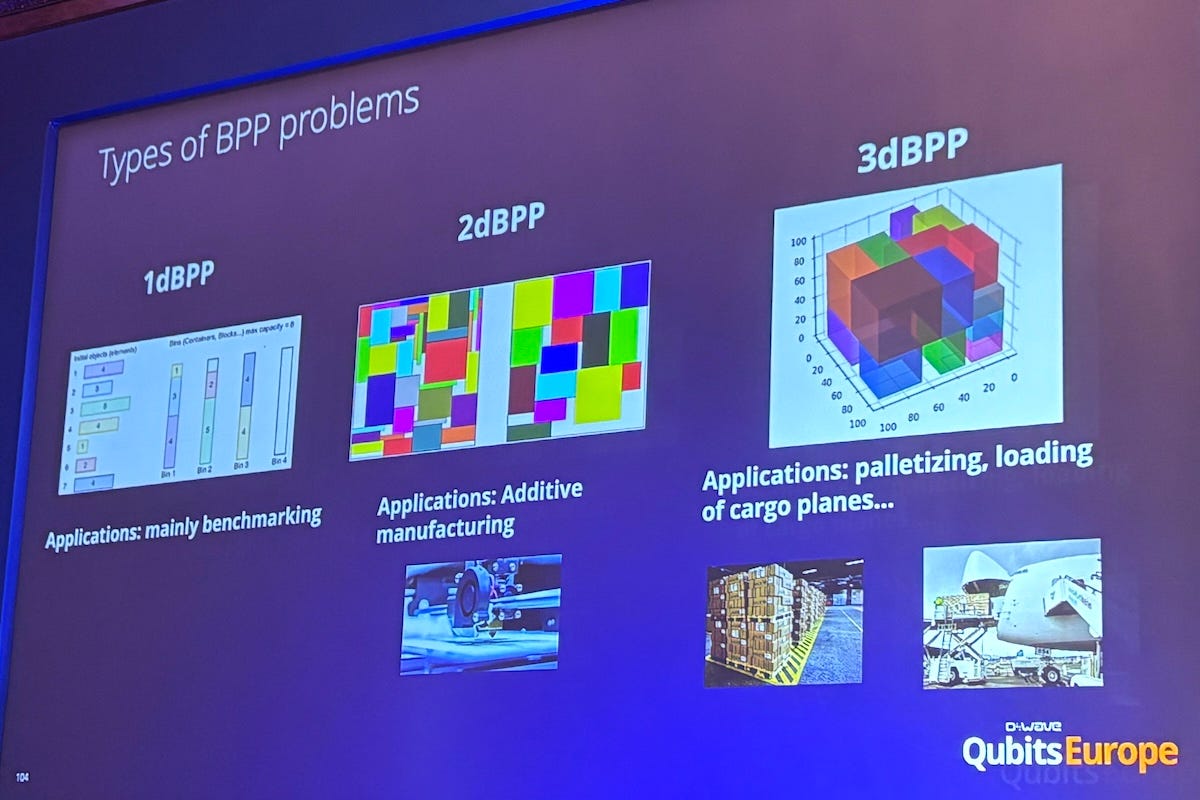
A real-world version adds further constraints: each bin has a maximum weight it can support, and every item must fit inside without extending beyond it. Würth’s operation packs items such as screws, nuts and latex gloves into three standard box sizes, with liquids that cannot be rotated among its trickiest constraints.
To solve it, Osaba’s team built an iterative process blending classical computing with quantum hardware.
“Our approach is an iterative algorithm,” he said. “First we do pre-processing, and based on the volume of all the items we need to package, a classical algorithm makes a first prediction. If all the items fit into the boxes it predicts, we have a solution.”
“We build the CQM [constrained quadratic model] formulation with D-Wave’s Leap CQM hybrid solver,” he said.
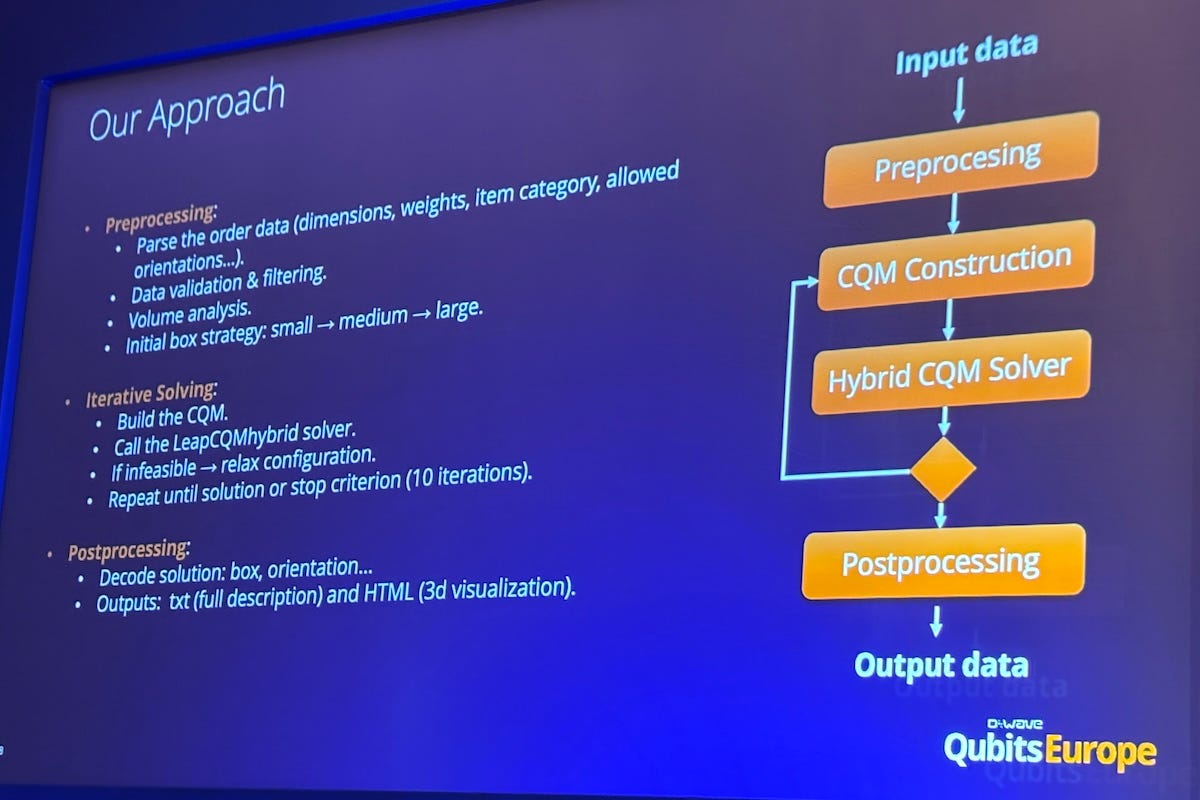
If the first prediction proves infeasible, the algorithm relaxes the configuration, for example switching from two small boxes to one small and one medium box, and repeats up to ten times before it stops.
During the session, Osaba ran a live query to show the process end-to-end. He picked one real order from a library of more than 6,000 stored instances, selected the Tecnalia solver built on D-Wave’s technology, and let the system return a packing layout in front of the audience.
Each run produces a results file that includes a visual layout of the final box, along with the cardboard and cost figures. In one example order Osaba showed, 17 separate packages were fitted into a single small box.
Proven on real hardware
The results were not produced by simulation. Osaba said the benchmark ran on real quantum hardware.
“This is not an emulation. This is not a simulation. This is not quantum inspired. This is real quantum computing,” he said. “We are not working with a synthetic data set. We are solving more than 6,000 real orders, and the executions ran on real hardware.”
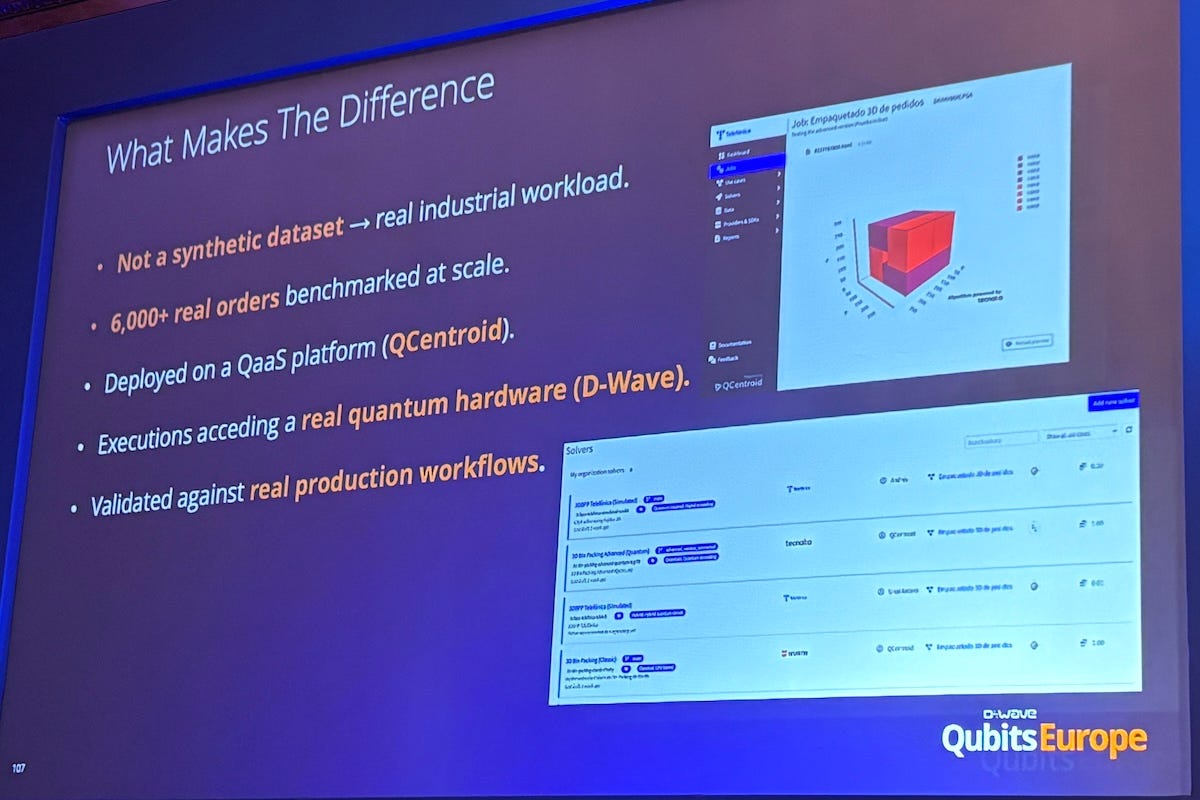
“We have validated every result against the real production workflow,” he said.
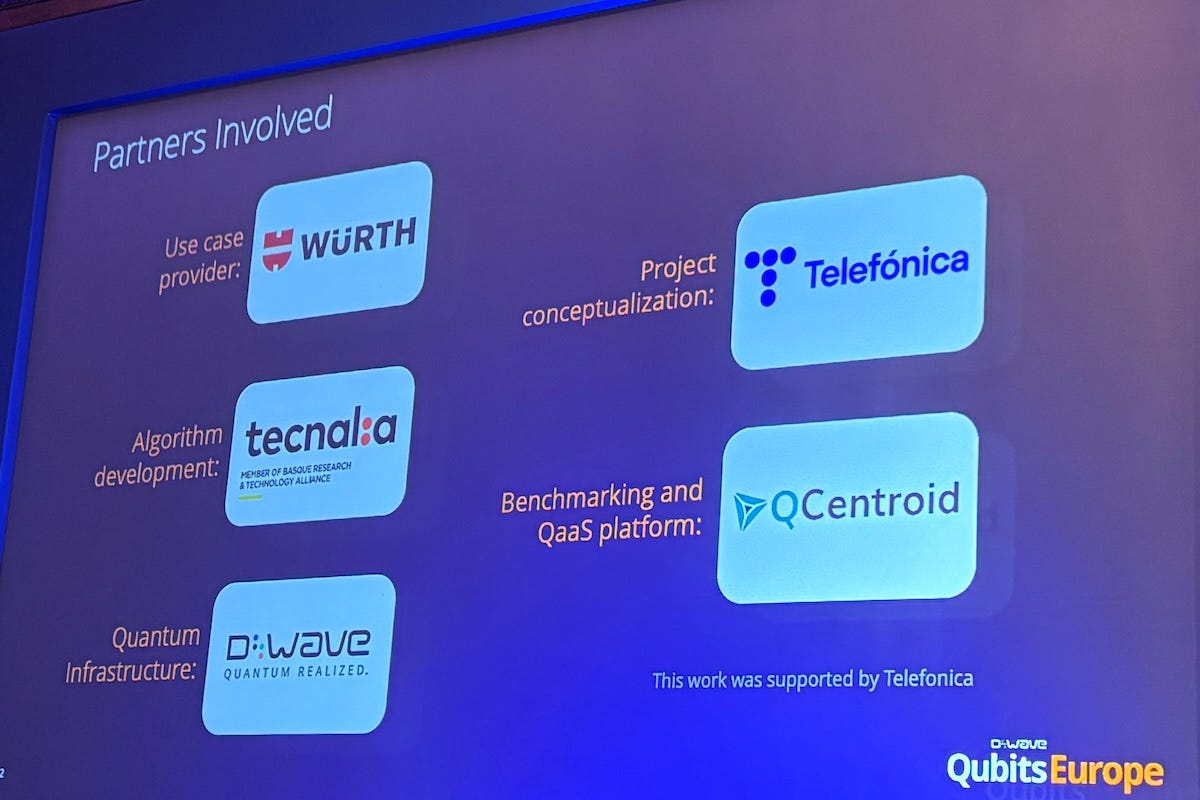
The benchmark was run on D-Wave’s Advantage 2 quantum annealer via QCentroid, a Bilbao-based platform that has partnered with Tecnalia since 2024. He selected each order from a library of more than 6,000 stored instances before submitting the job.
“Tecnalia is the largest applied research and technology vendor in Spain. We are around 1,500 people working across more than 14 technologies,” he said. “Within Tecnalia, there is a smaller area called data transformation, with around 120 people. Within that group is quantum technologies, where I work; we have at least 27 people.”
“We act as a middleware between companies and universities. We have academic projects at a low technology readiness level, and more mature projects with companies solving real-world use cases,” he said.
He said project conceptualization for the Würth case came from Telefónica. Tecnalia’s team will continue testing its algorithms against other real-world logistics and manufacturing problems.