


Specialty metals such as germanium and indium are turning mining companies into strategic players in semiconductor and artificial intelligence (AI) supply chains.
The shift ties miners more closely to chipmakers and other downstream high-tech industries.
“Some of these specialty metals that we produce, like germanium and indium, are incredibly important now for semiconductors and some of these high-tech applications that sit downstream of us,” said Jonathan Price, president and chief executive of Teck Resources. “We find ourselves now, as the mining industry and as mining companies, not just as miners, but truly as strategic actors here.”
He said data and AI are driving a supercycle of demand for Teck’s metals, not only copper, while governments play a more active role in every jurisdiction where the company operates.
“The industry has never been more complex, more important and therefore more interesting than it is today. And complexity does, in part, come from the geopolitics here,” he said.
“The thinking in government and the thinking in business have shifted from just in time to just in case,” he added, citing a colleague. “People want to ensure that they have security of supply to meet their domestic industrial strategies.”
Investors are paying more attention to where critical minerals come from, Price said.
“If you want to understand the vulnerabilities to AI, or to the power solutions required to support data centers, you need to understand where the raw materials and the critical minerals are coming from,” he said.
Teck Resources is a Vancouver-based miner. Its Trail facilities in British Columbia produce zinc, lead and specialty metals.
Since 2022, it has sold its steelmaking coal business, Elk Valley Resources, for nearly $9 billion and its stake in an Alberta oil and gas project. Completing its Quebrada Blanca (QB) mine in Chile helped lift copper output about 70%. In 2025, it agreed to merge with London-based Anglo American to form Anglo Teck.
Anglo Teck has committed up to C$850 million to Trail, including a potential expansion of germanium and other strategic metals.
Mines lag data centers
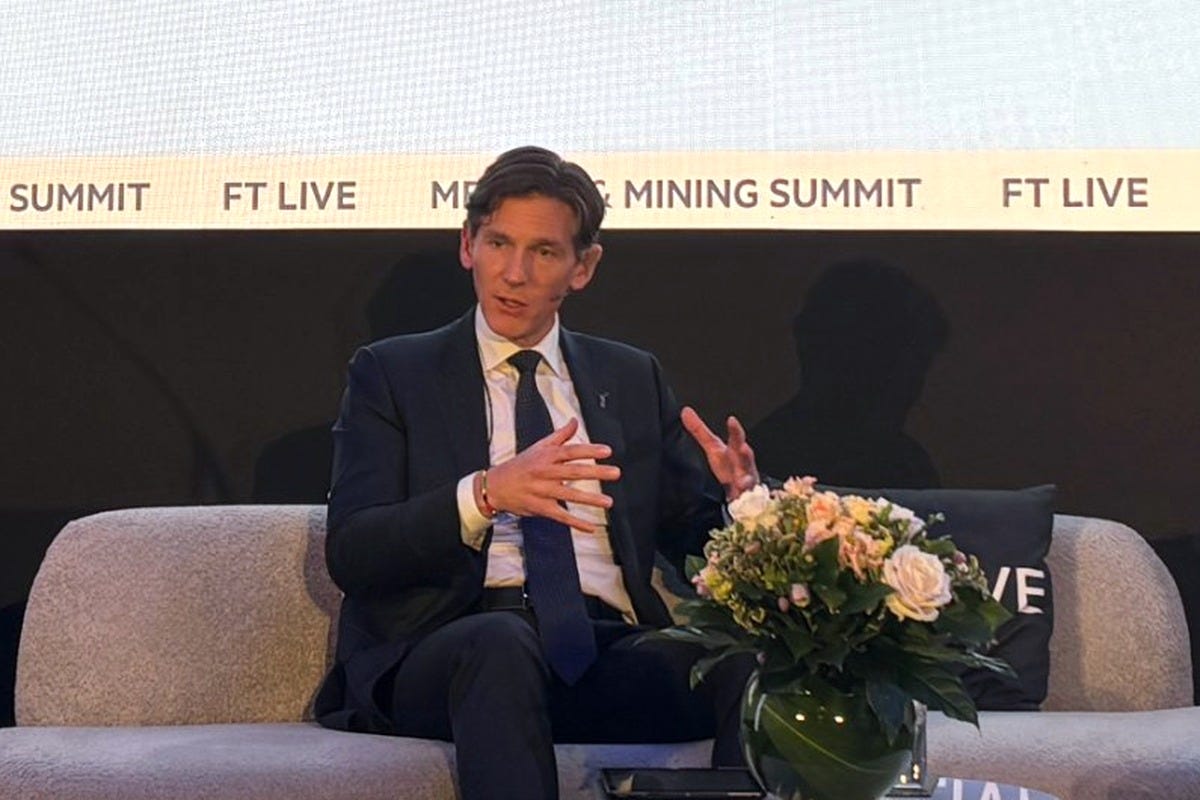
Price spoke at the FT Metals & Mining Summit, organized by the Financial Times in London on October 15. Dan Thomas, the newspaper’s natural resources editor, interviewed him during a keynote session.
Asked whether the cycle could turn, with tariffs, US copper stockpiles and the risk that the AI boom fades, Price said Teck remains positive about copper’s long-term fundamentals. He said electrification, and now AI data centers and the power they need, will keep demand rising while supply struggles to keep up.
“We see a doubling of demand by 2035, and we see supply shortages of around 30% in 2035. That’s huge,” he said.
Filling that gap could take around 30 tier-one mines. Building them is becoming more expensive and technically more challenging.
“We see a tripling of data center requirements out to 2035, and it can take six months to build a data center,” he said. “It can take 15 years to discover, permit and build a new mine.”
Exploration has been underfunded for more than a decade, so few projects are shovel-ready. Governments are working to speed up permitting, but bringing a new mine into production still takes a very long time, creating what Price called a significant time-based disconnect between supply and demand.
That demand, however, has yet to translate into value for miners. Mining companies were once the biggest companies around, a position now held by trillion-dollar tech firms.
“When you look at the value attributed downstream of what we do, to the hyperscalers and everything that sits in between, we’re not yet seeing that value move upstream to the mining industry in the way that it should,” Price said. “We should see more balance there.”
Investor interest in Teck now centers more on electrification, data centers and AI than on copper alone, he said.
“What we’re not seeing yet is that rebalancing of valuations, and perhaps that comes over time,” he said. “Perhaps that comes with more consolidation or scale at the upstream end of the market.”
He cited the argument that greater scale would draw more passive and active funds into larger, more resilient miners.
Canada’s critical minerals champion
Canada approved the merger quickly under the Investment Canada Act. Price said Teck is the country’s de facto critical minerals national champion, and Anglo Teck would be far bigger.
The company has committed to spend at least C$4.5 billion in Canada over five years, covering:
The Highland Valley Copper mine-life extension, already underway
An expansion of the Trail smelting and refining facilities
The Galore Creek and Schaft Creek copper projects in northwest Canada
“For Canada, at a time like this in particular, having a critical minerals champion of world-class scale and diversification across geographies is something that the government is very interested in,” he said.
Anglo Teck’s global headquarters will be in Vancouver. Price said a headquarters attracts talent, technical consultants and financing arrangements, creating a multiplier effect for the Canadian economy beyond the minerals it produces and the mines it opens, with strong support in British Columbia.
China is the last major regulator still to approve the merger of Anglo American and Teck Resources. He expects approval by March 2027, after constructive talks.
The merger targets $800 million of annual synergies, with copper making up more than 70% of the combined portfolio. Sending higher-grade, softer ore from neighboring Collahuasi through the QB plant could add about 175,000 tons of copper a year.
“We think it’s demonstrably true that the combination of QB and Collahuasi is the lowest risk, the highest return, the lowest capital intensity and the fastest route to more copper volume than either operation could achieve on its own,” Price said.
Partners on both sides of the combination still need to agree on commercial terms.
Meanwhile, Teck is carrying out studies, environmental baseline work and permitting preparations, and has begun engaging communities and governments. Price said the work will better inform the complex commercial negotiation still ahead, where he sees significant value for all parties.
He said scale matters in mining because world-class projects need large, resilient balance sheets and teams that can deliver on time and on budget, which has been a challenge for the industry.
“Growth is very much in favor at the moment because of the opportunities that exist in the market here,” he said. “Others like us can see this structural gap emerging, and they can see an opportunity here to create value through investment in growth.”
A base dividend or other returns of capital show investors that growth will not come at all costs. Anglo Teck could grow organically or through acquisitions, though he said it is too early to be definitive.
Price is set to become Anglo Teck’s deputy chief executive and chief strategy officer once the merger closes. The combined group will keep Anglo’s iron ore and Teck’s zinc businesses, but with data center requirements set to triple by 2035, he said its growth will center on investment in new copper supply.