


Taiwan is deploying surveillance systems that can track swarms of military drones and relay high-volume data to satellites via laser. The technology has been tested and deployed with the island’s Air Force and Navy.
As tensions with China mount, a new generation of space startups is converting the island’s precision electronics heritage into dual-use hardware. Free-space optical (FSO) communication, which transmits data via laser beams rather than fiber cables, is a prime example, finding applications in both civil satellite services and military data links.
Henry Chen, senior manager at Base Technology, said his system can track airplanes, drones and other objects at distances of more than 15 kilometers, using artificial intelligence (AI) to scan the skies automatically, 24 hours a day.
“We have already deployed our systems with the Taiwan Space Agency and even the military. We have completed projects with the Air Force and the Navy in Taiwan. We hope to find partners in Europe,” Chen said.
He said many companies in Taiwan develop radio frequency systems, but very few work on FSO. BaseTech handles every component in-house.
The company’s HawkView Monitoring System can track more than 300 Chinese sparrows in real time at Kenting, on Taiwan’s southern tip. The same precision is turned toward monitoring ship movements and identifying warships in coastal waters.
BaseTech, founded in 2021, has received government funding and is now seeking customers in Europe.
The dual-use nature of space technology prompted a direct question from a journalist in the audience. Lloyd Lopez, co-founder and chief executive of HEX20, an Indian-Australian small satellite maker, offered a broader answer.
“Space was invented for defense. Anything you do in space can be used for defense. GPS was invented for defense, and now we are using it in Google Maps to find someone’s home,” Lopez said.
Jessi Fu, head of global partnership at the Industrial Technology Research Institute (ITRI), said BaseTech’s system has also been used to monitor vessel movements in Taiwan’s coastal waters, detecting unusual ship behavior and alerting the government.
From chips to space
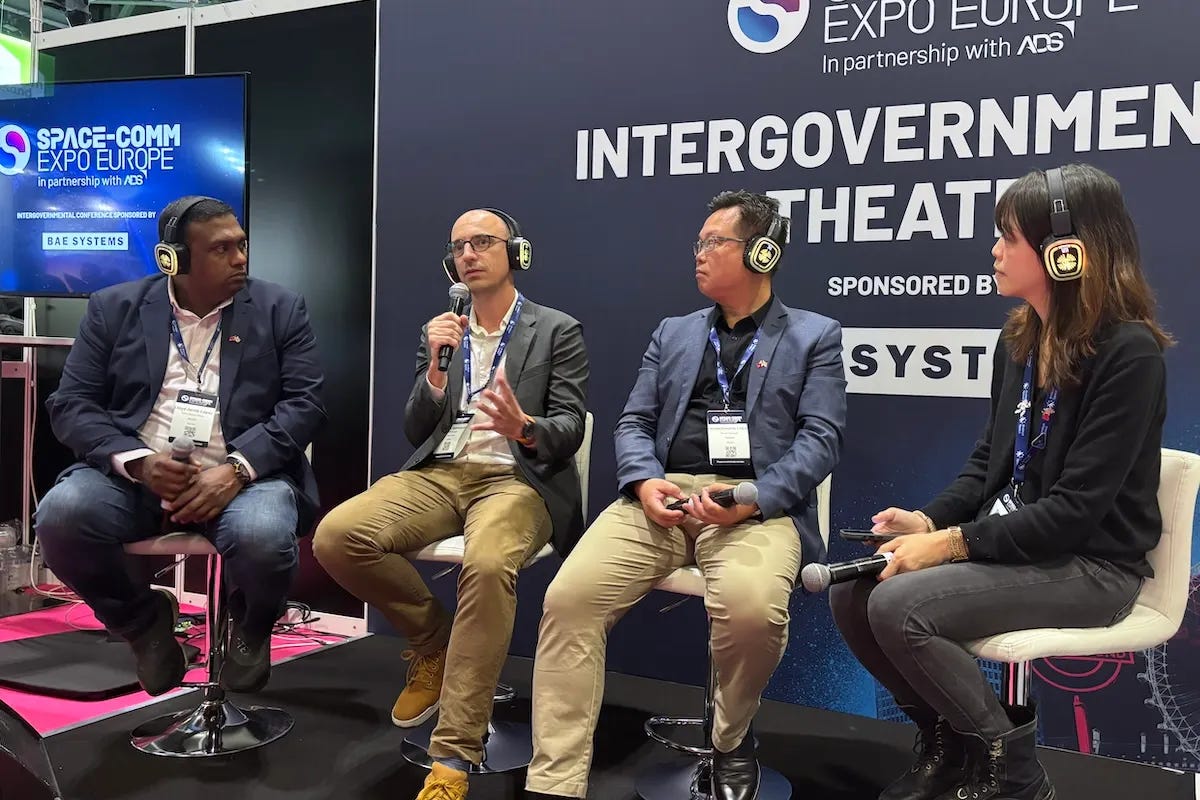
At the 2026 Space-Comm Expo Europe, Fu moderated a panel on Taiwan’s role in the global space industry. The event was organized by Space-Comm Limited in partnership with ADS Group, the UK trade body for aerospace, defense, security and space.
Julien Hennequin, head of sales at Tensor Tech, brought 15 years of global space industry experience to the Taipei-based attitude determination and control system (ADCS) startup.
“We definitely have an edge compared to other countries when it comes to fast prototyping and how quickly we can innovate with our supply chain, which is sometimes just five minutes across the street. The supply chain is very dense in Taiwan, with plenty of suppliers to choose from across Taipei and the island,” Hennequin said.
Taiwan was once widely seen as a country that copied existing designs from the US or Europe. He said this perception is now changing.
“In Taiwan, there is a huge wave of innovation being led by local companies in many areas, and space is slowly following. It’s not just redoing what exists elsewhere but really leading the innovation. That’s a very nice place to be at the moment,” he said.
Lopez said India’s more than 60 years of experience in space technology can fill a gap that Taiwan’s ecosystem still needs to close.
“Taiwan is well known for high-end electronics and precision manufacturing. But all these electronics cannot just fly to space. They need to go through a different process first,” he said.
Fu said the Taiwan Accelerator Plus (TAcc+) program was designed to help international companies enter this ecosystem. Supported by Taiwan’s Ministry of Economic Affairs and managed by ITRI, it has backed 42 international startups since launching in 2023.
“We have invited 42 companies to come to Taiwan for a one-month program. During that time, we provide more than 100 business-to-business meetings and help them find the partners they need, whether that’s a component supplier or a communication service provider,” she said.
Five UK startups joined last year, signing memoranda of understanding (MoUs) with Taiwanese firms and securing new orders.
HEX20 and Slingshot Aerospace, a US-based provider of AI-powered satellite tracking solutions, subsequently established Taiwan-based subsidiaries.
“If you are a startup or a corporate looking for partnerships, we have the full ecosystem list and can make the introductions,” Fu said, adding that working with any one Taiwanese partner typically draws in the surrounding ecosystem as additional support.
Proving it works
“Winning overseas contracts has required Taiwan's space firms to clear a hurdle that no factory can solve."
“The most frequent question from customers, especially from Europe or the US, is about flight heritage. Is it working? What’s your experience? It’s a very legitimate concern,” Hennequin said.
Tensor Tech was founded by university students with no prior industry experience. Hennequin said the Taiwanese government’s decision to act as an anchor customer for local space companies fundamentally changed the dynamics.
“Having the Taiwan Space Agency as an anchor customer has really helped the local industry get hardware into space, into orbit, with in-orbit demonstrations. That has been the game changer in how we could reach out to customers and address a very legitimate concern: does it actually work?” he said.
Lopez said HEX20 faces the same scrutiny.
“Heritage is the main question we also get, because space is very difficult. Once you launch your satellite, there is no way to catch and fix it. It must work the very first time. Luckily, we now have multiple projects we can showcase, working with different companies,” he said.
He said mutual partnerships serve as a form of heritage validation. When a potential customer asks about HEX20, they can verify directly with Tensor Tech, and vice versa.
HEX20 is currently managing seven to eight missions across the globe and building two satellites for Taiwan, which are due for launch this year. Its platforms follow CubeSat standards, where each U represents a standardized cube roughly 10 centimeters across.
“We build small satellite platforms from 3U to 7U and from 50 kilograms to 250 kilograms. We can go to low Earth orbit, medium Earth orbit, geostationary orbit, around the moon and even to deep space missions. That’s how we differentiate ourselves,” Lopez said.
An introduction through National Central University during the TAcc+ program connected HEX20 with ispace, a Japanese lunar exploration company. The two firms are now partners on a lunar satellite mission. HEX20 is also delivering an asteroid lander for the UAE Space Agency, due for completion this year.
Funding for Taiwan’s space startups remains primarily domestic, drawn largely from the island’s own technology conglomerates.
Hennequin said large groups such as Acer and Asus are making small bets on space startups while watching for larger opportunities. He said cross-border investment between Taiwan and international partners remains rare.
Lopez said the priority for any startup seeking investment is first to demonstrate capability through real missions and credible partnerships. As Taiwan’s space firms accumulate in-orbit credentials, both he and Hennequin said the next phase would bring more international investors and cross-border deals.