


Fusion developers are pressing governments to move faster, warning that 10-year roadmaps no longer match the technology’s pace.
The argument centers on public-private partnership as the structure best suited to absorbing fusion’s enormous cost and technical risk, with backers pointing to past state-industry collaborations that delivered breakthrough technologies once dismissed as decades away.
“We look at public-private partnership as being the path,” said Jonathan Toretta, chief executive of TAE Global GmbH and chief revenue officer of TAE Technologies Inc. “Fusion is extremely hard, and this is an endeavor not for the modest.”
“Roadmaps out 10 years on paper make me nervous, because the urgency around what we’re trying to deliver is greater than a 10-year timeline,” Toretta said.
He said fusion is capable of reshaping economics, the defense sector and global geopolitics, while also serving as a way to lower energy costs and shorten supply chains worldwide.
Building that sense of urgency, he said, was the second half of what he wants from the public sector.
He compared the dynamic to the US space race, calling public-private collaboration one of the few examples of the two sectors working materially together at this scale, adding that TAE’s own five-generation machine program reflects that model in practice.
He described the goal simply as putting a pin into decision-making that too often treats fusion as a distant bet.
He said the fusion industry is still forming its own market structure, spanning a supply chain, consumers, producers and ancillary businesses that will take time to coalesce, and that TAE deliberately treats other fusion developers as allies rather than rivals because the sector cannot afford internal competition given how difficult the underlying science remains.
He said the biggest mistake in the industry is when one company criticizes another, given how seriously difficult the underlying science remains.
“Nobody in the fusion industry is here by mistake,” he said.
“I do expect consolidation, radical success and radical failures,” he said. “Some of the presumed winners will be losers, and some of the presumed losers will be winners.”
TAE Technologies, founded in 1998 as Tri Alpha Energy and based in Foothill Ranch, California, is one of the longest-running private fusion developers, pursuing an approach that aims to burn hydrogen-boron fuel without the radioactive byproducts associated with conventional reactors.
The company has raised more than $1.2 billion in private funding since its founding, according to public records.
Betting on Culham
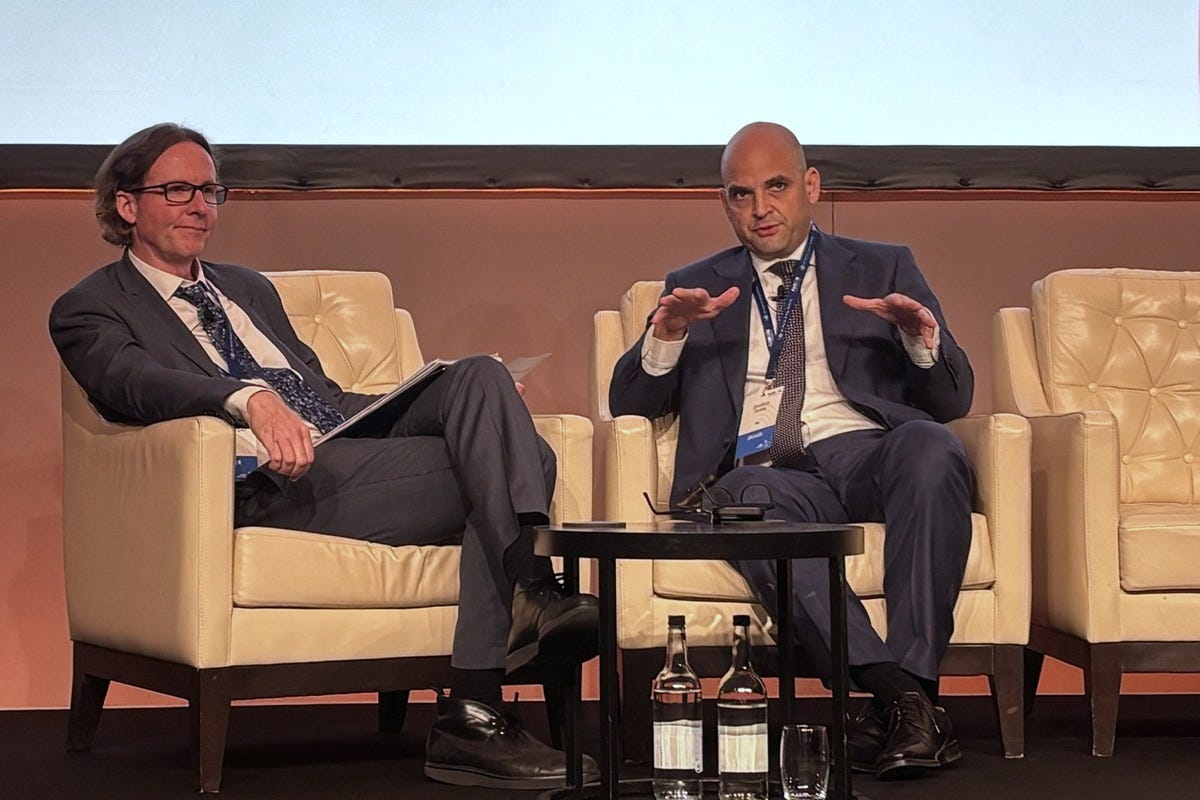
The exchange took place at the UK Fusion Forum, held in London on September 15, 2026 and organized by the Fusion Industry Association (FIA). The session, moderated by David Capper of the UK Department for Energy Security and Net Zero, examined how public-private partnerships are shaping the UK’s fusion sector.
TAE’s UK presence dates to an acquisition years ago in the West Midlands, its beam technology base, later paired with a move onto the Culham campus in Oxfordshire, home to the UK Atomic Energy Authority.
“We already had 100 people in the West Midlands,” Toretta said. “Right place, right people, right technologies, and we expect to build out that supply chain and add labor to the workforce there.”
“We have brought together 40 years of experience at the Culham campus with 25 years of beam technology expertise in the US that we felt practically belonged here,” he said.
The Culham move became TAE Beam UK, a joint venture with the UK Atomic Energy Authority announced in December 2025, under which the authority is investing £5.6 million to develop the technology for fusion, cancer treatment and other applications.
Toretta said Southern California’s venture-heavy culture, where TAE has been based since 1998, is not suited to the company’s next, fully commercialized phase, and that a site needs PhD-level researchers, hundreds of megawatts of power and heavy water infrastructure concentrated in one location, something he called difficult to replicate anywhere in the world.
“The labor pool that we are accessing on that campus is highly unique, and we find it very difficult to replicate anywhere else,” he said. “A nod to the UK, you see that happening here. The UK may be in front.”
Toretta said fusion remains TAE’s ultimate goal, but the company has also built two revenue-generating businesses alongside it: EmFi Technologies, a UK-based life sciences unit with operations across Europe, the US and Asia, and a power management business he described as having large addressable markets.
“TAE has a north star in delivering fusion, no doubt,” he said. “But the company has also built technologies that are intrinsic to its growth.”
“We’ve built TAE Life Sciences, a company with operations in Europe, the United States and Asia that is revenue generative, and also a revenue generative power management business that has large addressable markets and notable revenue,” he said.
He said the life sciences business shares a production facility in part with an Italian partner also attending the forum.
Toretta said most of TAE’s workforce is now international, split between the US, Europe and Asia and built around recruiting specialists wherever they are strongest, pointing to smaller specialist offices in Italy, the Czech Republic and Slovenia alongside its larger UK operations.
“More than 50% of our employees are not Americans,” he said. “We will recruit people from anywhere in the world who are the right people to help us de-risk fusion technology and the derivative technologies we build.”
He declined to disclose specific revenue figures for either business but said they represent a meaningful differentiator for TAE with investors and government backers.
Splitting fission from fusion
Toretta said he wants a clear regulatory separation between fission and fusion, arguing the physics carries different risks.
“I would really like to see a true separation of fission and fusion,” he said. “You can site a TAE reactor in a city or next to a population, and that should not be viewed the same way as a radioactive neutronic fusion system.”
“Continental Europe should really catch up in this regard,” he said.
Toretta said interest in the sector has grown sharply since he attended his first fusion industry gathering in 2018 or 2019, when he recognized nearly everyone in the room within minutes.
He said the rise in attendance and public coverage since then reflects the field’s shift toward a mainstream investment case.
TAE’s technical case rests on five generations of machines built since 1998, using a field-reversed configuration (FRC) design that lets the company switch fuels rather than being locked into one. Toretta noted that Helion, another fusion developer that spoke earlier the same day, has described building seven generations of machines in 12 years.
The latest machines operate in temperature regimes up to 70 million degrees Celsius, Toretta said.
“We’ve been around since 1998,” he said. “I think we’re the longest-standing fusion company, certainly at the commercial level, but maybe in the world.”
“These are FRC-focused machines that are fuel agnostic,” he said. “We can burn DT [deuterium-tritium], deuterium-helium-3 and hydrogen-boron, the three fuels targeted by the industry.”
Toretta said he expects fusion’s timeline to keep beating expectations, pointing to how quickly net energy gain has moved from a distant prospect to an active discussion.
“My sister is an MIT nuclear engineer,” he said. “She said one of the most arresting things in her own life is that fusion was studied as a 2050 or 2060 event in the early 2000s, and she’s shocked there’s now discussion of net energy gain in the 2030s.”
“We hope that we deliver net positive energy by the early 2030s,” he said.
Toretta, whose career in the oil and gas sector dates to 2007, before he joined TAE, said he sees the same pattern of underestimated progress playing out across other fields, pointing to supercomputing, drone technology and AI as areas that advanced faster than expected.
“We’re going to be equally surprised at what we see in nuclear, in both fission and fusion gains,” he said.
TAE is targeting net positive energy in the early 2030s while continuing to expand its life sciences and power management businesses alongside its core fusion program.