


Artificial intelligence (AI) models and digital twins let companies rehearse supply chain shocks and switch shipping routes and production sites much faster than before.
Scenario modeling that once took weeks is now far quicker and cheaper. Acting on the results remains the hard part.
“That modeling used to take weeks and weeks. Now you can do it for 100,000 tokens, and that’s a dramatically different game,” said Suketu Gandhi, global co-lead and chair of strategic operations at consulting firm Kearney.
“AI can tell you a lot of choices, but you physically have to do stuff,” he said.
Gandhi said 42% of chief operating officers (COOs) have told Kearney that resilience has shifted from keeping the company running to a competitive advantage. He cited a consumer products company that spent $2 billion building resilience and saw it pay off within one quarter.
He said consumers ultimately pay for resilience, but efficiency gains at large manufacturers and logistics firms have kept that bill far lower than it would otherwise be.
Companies have slashed product variants as modeling exposes where limited inputs cannot meet every need, helping lift margins.
Vicky Cuthbert, chief product supply chain officer for Unilever Personal Care, said her unit delivers 14 billion units a year in nearly 200 countries, using systems built in a hurry during the Covid-19 pandemic and later scaled up with AI.
“We are building models using AI where we’re directly able to connect with our retailers to get a much better read of consumer signals and trends,” she said. “We have a number of very advanced models that we’re using to model all of our material flows around the world, constantly scanning for disruptions and future weather patterns.”
“It’s now very clear that this uncertainty and volatility is only going to continue and only going to escalate, and that this is something that we need to lean into and turn into a competitive advantage,” she said.
Mark Patterson, chief customer officer for DHL Supply Chain in the UK and Ireland, said the logistics firm runs “digital twins” alongside its customers’ real supply chains. These map factories and final destinations, then test what-if scenarios such as port closures, shipping-lane shutdowns, weather and political shocks.
“We can then say: well, maybe having a factory in this location is not the best thing,” he said.
His example was a large European fruit-and-vegetable supplier whose twin is linked directly to weather forecasts. It shows how the weather would hit crops and which production sites should open in response.
He said supply chains now reach global boards in ways they didn't a decade ago, after the chip shortage and geopolitical shocks forced companies to seek alternative sourcing. Twins let decisions be made at different levels almost in real time.
From data to action
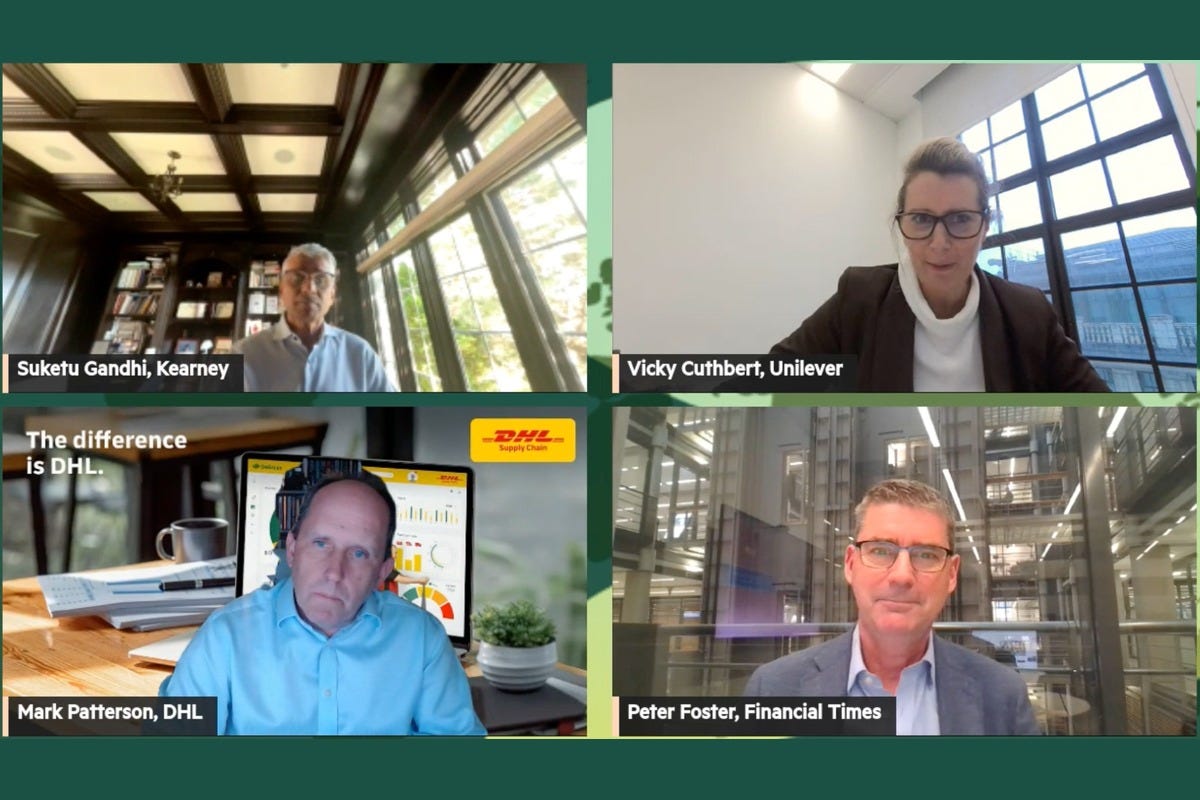
The panelists were speaking at an online webinar titled “Building resilient supply chains in an era of geopolitical uncertainty” on October 7. Organized by FT Live to launch its FT Supply Chain Forum and sponsored by DHL and Kearney, it was moderated by Peter Foster, world trade editor of the Financial Times.
Patterson said the change is about speed, not data. Political risk feeds, port closures and strikes now flow into the twin, so pre-mapped switches from air to sea or sea to rail can be triggered within minutes.
“What we now have is the ability to run these models very quickly and make informed decisions almost in real time,” he said. “Those are not decisions where you can sit down around a board table and say, let’s look at that in the next six to nine months.”
But he said companies too often crunch the data and then do nothing until it is too late.
During the recent disruption in the United Arab Emirates (UAE), DHL first secured its staff, then prioritized life sciences and medical products with the agreement of other customers. It soon began flying goods in through Saudi Arabia.
Gandhi said AI lets planners move beyond routine questions on stock levels and delivery rates to hunting for risks they have never considered. He described a formula, set out in an upcoming book, that multiplies a company’s ability to sense what is happening across the whole chain by its ability to decide and to act.
“If one of them is zero, the whole value is zero,” he said.
Kearney has found that board members who once avoided supply chain questions as too complex now see supply chains as the heart of the business. When boards take an interest, action follows from the chief executive down.
Cuthbert said every Unilever site worldwide is a potential entry point for hackers. The company now treats cybersecurity as seriously as staff safety and product quality, and is educating staff across the organization because anyone can create an AI agent these days.
“This is probably one of the biggest unknowns that gets bigger every minute and every hour,” she said.
Patterson said an attack on DHL or a customer can spread both ways, as their warehouse management systems are directly linked. He noted attacks on Marks & Spencer (M&S), Jaguar Land Rover, the Co-op and US medical device maker Stryker.
“Our businesses and our supply chains today rely on digital data, and with that comes the challenge that when you’re attacked, you’re going back to zero,” he said. “M&S’s warehouse management system is proprietary. It’s across the whole of M&S, so there was no alternative.”
He said companies must disconnect quickly while keeping some service running. DHL and its large customers now rehearse mock attacks from the board down, and customers are writing cyber protections into contracts.
Twenty on the line
Gandhi said the weakest links are often tier-three suppliers that find a way into a company’s systems, and employees who click on urgent-looking emails. He said AI is making companies more robust against such threats if they understand it well, and that cyber and resilience should be treated as one problem.
“You walked into a factory that produces hundreds of millions of products and had maybe 20 people working on the lines and 250 people working on cyber, AI and digital, so that’s where we are going,” he said, describing a recent visit to one of Vietnam’s most advanced factories.
Cuthbert said Unilever measures resilience mainly through service levels and on-shelf availability, tracing availability losses back to resilience gaps. It also sets sub-metrics for critical areas, such as having two suppliers for key materials and qualified backups for vital systems, and tests its backups regularly through a business continuity program.
Patterson said a warehouse’s business continuity plan once stayed unchanged for years but now changes almost every six months to cover cyber, terrorism and other threats. He hopes more will go digital rather than stay as paper files on a shelf.
Gandhi said Kearney’s latest research shows nearshoring and friendshoring have delivered less than the political talk suggests.
“An average factory you cannot move in less than three years,” he said. “What the best companies do is they lift, redesign for new manufacturing and then shift. Otherwise, you are paying a significant financial penalty.”
He said friends become enemies in 30 seconds, so firms must stay close to critical inputs such as copper.
Cuthbert said certain major materials became very hard to obtain this year, forcing Unilever to quickly reformulate large parts of its portfolio. It segments its range by value density, localizing cheap, water-heavy products while keeping high-investment formats on regional or global supply.
“What makes the economics not work is if you’re producing the product in a factory and you’re bringing in a lot of materials from far away,” she said.
She said Unilever keeps backup product versions ready and stress-tests each investment against tariff swings and allies turning hostile.
Patterson said sustainability may have slipped down board agendas amid other crises, but the UK push to electrify freight creates a new resilience risk.
“People talk about, let’s electrify from a freight perspective, from a transport perspective. There is no way we can do that. There isn’t the infrastructure that would allow us to do it,” he said. “If that were to fail, then suddenly you’ve got a network of electric trucks that are now not very resilient.”
Gandhi said COOs surveyed by Kearney believe they are only about 10% of the way through the journey, leaving 90% of the work on faster, cheaper and more competitive supply chains still ahead.