


The quantum computing industry is racing to build specialized chip factories, without agreeing on what one should even be.
Different qubit technologies, from superconducting circuits to photonic and ion-based systems, draw on overlapping tools for sensing and quantum communications. Much of what lies beneath them turns out to be existing photonics and semiconductor hardware, and quantum startups are already funneling large shares of their funding into foundry costs.
“We haven’t even defined what a quantum foundry is in this conversation yet,” said Joe Spencer, UK director of Global Quantum Intelligence (currently director of IoniQ Consulting). “There needs to be some conversation of what that actually looks like at a global scale.”
He said most of the shared technology beneath different compute modalities is largely existing photonics and semiconductor hardware.
“We haven’t got a modality that wins out yet, so I think we should be agnostic to all of them for a foundry model,” he said.
Spencer’s firm has assessed about $5 billion in quantum investment. His focus is resilient supply chains for defense and security.
He said even within one modality such as superconducting qubits, a shift to new materials such as sapphire to extend coherence lifetimes could force a rebuild of the entire materials-processing pipeline. He said materials, components and people remain key supply chain parts, and a shared foundry model could support talent, job creation and specialized processing.
“The best tech is not necessarily the best investment,” said Manjari Chandran-Ramesh, partner at Amadeus Capital Partners. “Execution and agility matter just as much as having the best technology.”
Her firm, Amadeus Capital Partners, has invested in 200 companies and exited 100 over three decades.
“A number of our companies are spending a humongous amount of what they raise on foundries,” she said. “That is a big chunk, comparable to several full-time employees in the quantum business.”
Her portfolio includes the quantum firms Photonic, New Quantum and the error-correction specialist Rebellion.
“It’s great that there is GlobalFoundries, there is CEA-Leti and so many other foundries, but for whatever reason they get a very big chunk of money from the company,” Chandran-Ramesh said.
Betting on one technology
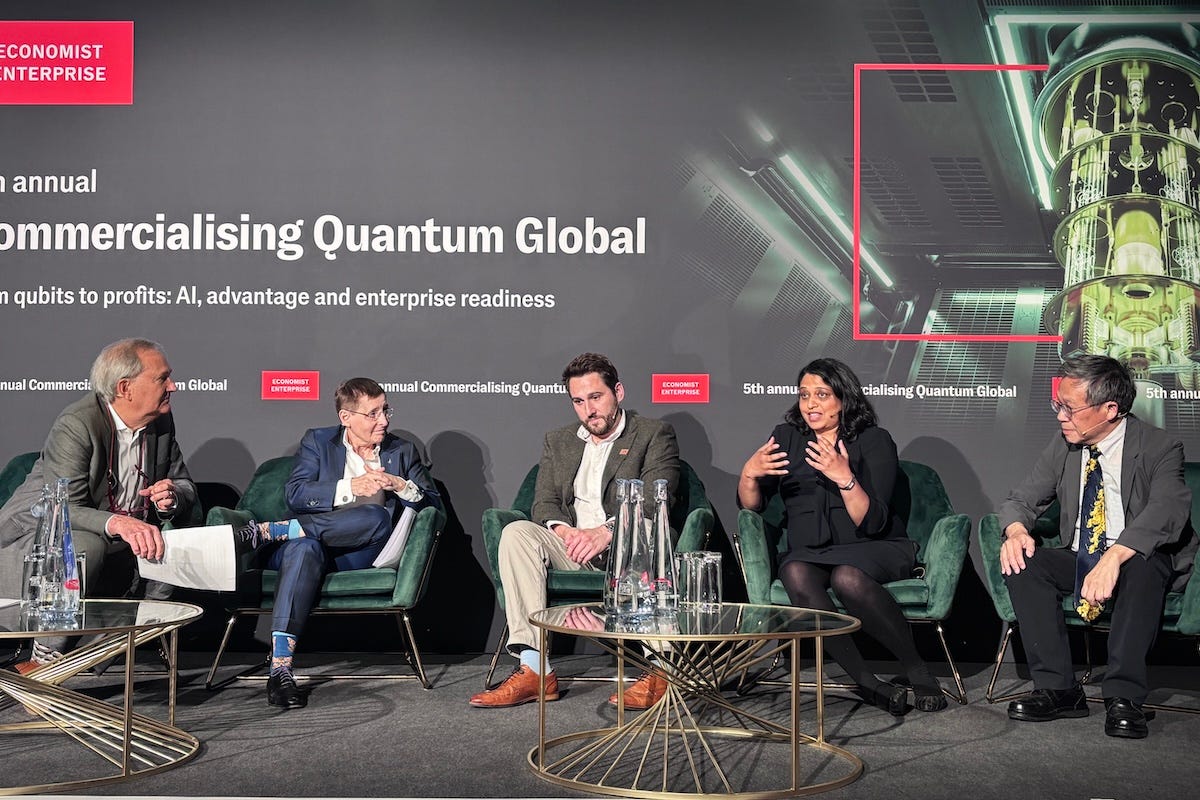
The panel was part of Commercialising Quantum Global 2026, an event organized by Economist Enterprise in London. Christopher Bishop, chief reinvention officer of Improvising Careers, moderated the discussion on who will own the infrastructure behind the next generation of quantum computing.
He opened by asking how a new foundry model might reshape the wider quantum economy.
Ann Dunkin, a distinguished professor of the practice at Georgia Institute of Technology, is a former chief information officer at the US Department of Energy.
She told the panel that Washington’s approach to funding one specific quantum foundry breaks with historical precedent.
“All of them involve the US government taking an equity position in those companies, and that is historically not something the US government does when it invests,” Dunkin said. “We invest to move the US economy forward. We do not invest to make money.”
Dunkin said there were nine such investments in total, and only one was a foundry.
The rest are companies developing quantum computers or related technology. The Commerce Department’s letters of intent, signed in May, are worth a combined $2 billion, according to public records.
Anderon itself is an IBM spinoff backed by $1 billion in CHIPS Act incentives, matched by IBM.
“Anderon is supposed to be superconducting first, and then other things. That is what they have promised,” Dunkin said. “Will it actually be more things, or have we in fact put our thumb on the scale for superconducting?”
“The typical government behavior is to make bets on multiple technologies, so it is unusual to see a billion dollars for one particular technology,” she said. “I find the scale of that one investment a bit concerning without others being made.”
Dunkin said the Department of Energy runs a separate effort focused on artificial intelligence (AI), called the Genesis Mission.
“Genesis sees quantum as an accelerator for AI, and I think that’s the right answer,” she said. “Quantum high-performance computing and AI will be a set of tools we use together to accelerate a lot of important research.”
The scramble for talent
Dunkin said it is entirely possible the quantum industry ends up concentrated in a handful of foundries worldwide.
“The United States is very good at innovation. We are not very good at scaling things, and we need to get in early to scale,” she said.
She said China is far better at scaling, and the West risks repeating losses already suffered elsewhere.
“We should be stapling a green card to the diploma for every single person we graduate from university who is not a US citizen,” she said.
Spencer offered a UK view.
“Imagine being in the UK, where we’re good at innovation but not so good at commercialization or scaling,” he said. “We have the roadmaps and the plans to execute on this, and we are doing it.”
Chandran-Ramesh said Europe has an opening created by the US-China rivalry, pointing to an existing foundry ecosystem built around Imec in Belgium, CEA-Leti in France and VTT in Finland, all backed by decades of public and private investment in advanced manufacturing.
“Europe can come out as one of the key players here,” she said.
“Export controls are part of life. There is a law of unintended consequences. If you put restrictions on something, other nations will develop their own capability,” Spencer said. “Dual use is not binary; it is a spectrum, and we should monitor how it evolves.”
Ching-Ray Chang, a board director at Foxconn, also directs the Quantum Information Center at Chung Yuan Christian University in Taiwan. He said the island’s own semiconductor history carries a warning for the quantum race.
“In 1988, I saw a lot of female workers come by bus every day. I asked them who they were and where they were going. They said TSMC. I had never heard of that,” Chang said. “Nobody expected that after 40 years TSMC would become so successful and become the backbone of the electronics industry.”
“Kodak was doing very well in the film business and had even invented the digital camera, but it never pushed that lab research into industrial application,” he said. “After 40 years Kodak disappeared, but TSMC did not.”
“Taiwan is slow in quantum technology because most of our talent and money is invested in semiconductors,” he said. “We don’t have enough talent for quantum technology.”
Chang said Taiwan is racing to catch up.
Heavier classification of quantum research now makes international collaboration harder than it was in the early days of semiconductors, he said. The coming year, from Anderon’s build-out to Europe’s push for a bigger share of the supply chain, should show whether the industry can scale as fast as it innovates.