


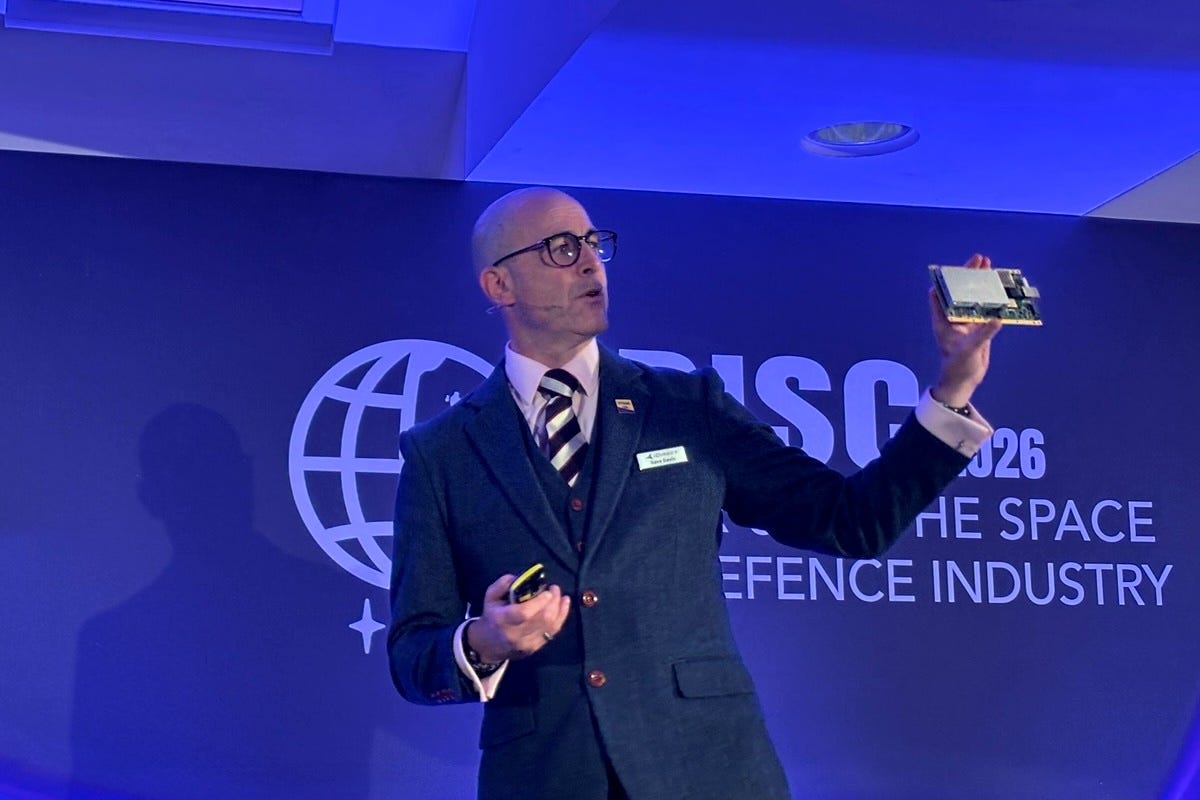
Military satellite communications suppliers are finding memory chips and circuit-board materials scarcer as artificial intelligence (AI) data centers absorb supply and war disrupts production.
In April, Iranian missile strikes on Saudi Arabia’s Jubail petrochemical complex halted about 70% of global supply of high-purity polyphenylene ether (PPE) resin. The material goes into the laminates of high-frequency, high-reliability circuit boards, including those used in radio-frequency designs. Circuit-board prices rose by as much as 40% in a single month after the strikes.
“We lost 70% of the world’s PPE resin production, which is critical for high-end circuit boards. It will hit over the period of the next few months,” said Dave Davis, senior technical director at ST Engineering iDirect.
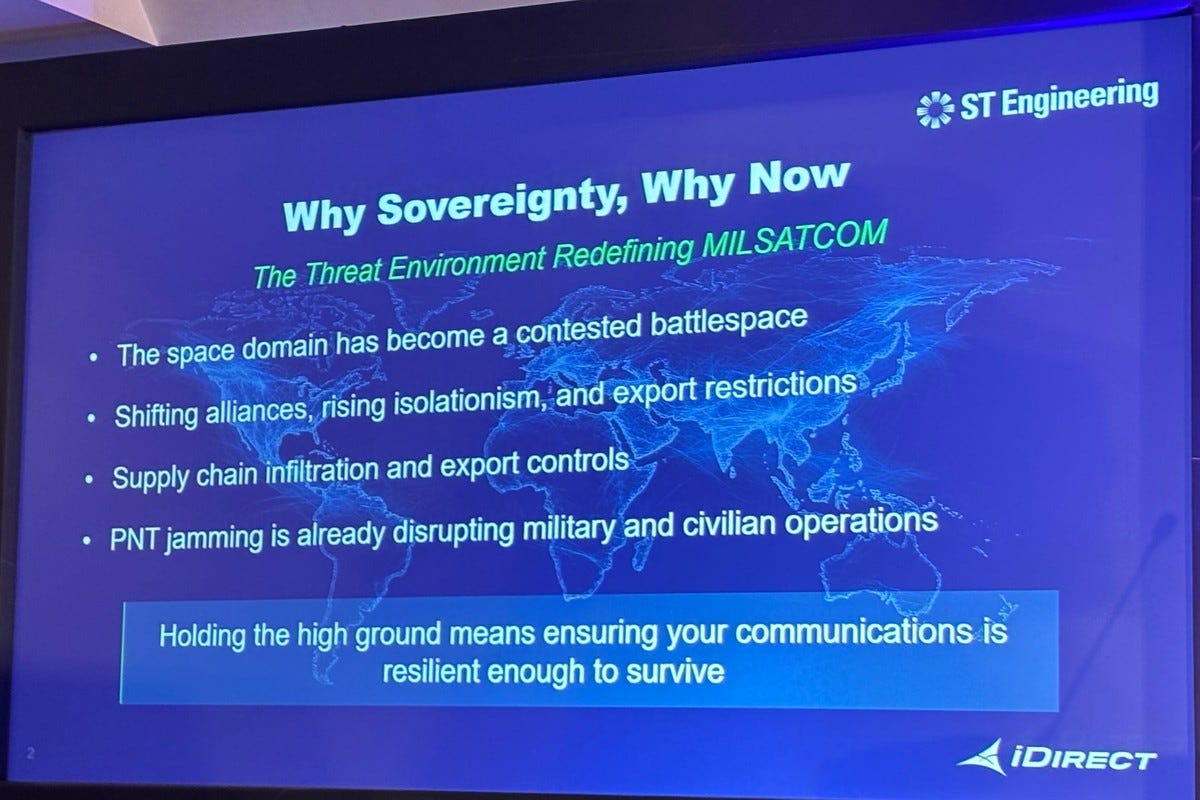
“We’ve seen memory and other component capabilities particularly are becoming very much more difficult to procure. It’s getting much more difficult, particularly the memory, because of the abundance of AI farms. Having a supply chain that you can control, having a supply chain that’s predictable, is getting increasingly difficult,” he said.
He said manufacturers told him lead times had grown from weeks to months, and potentially years.
He added that export controls and restrictions are becoming harder to navigate, particularly for a company like his with products covered by the US International Traffic in Arms Regulations (ITAR).
Supply chain infiltration, which has already affected many capabilities, is another threat.
Position, navigation and timing (PNT) has moved from the edge of the defense debate to its center, as jamming disrupts military and civilian operations. Forces are relying more on smaller, more reliable inertial navigation systems that check satellite PNT only occasionally, so they can work in denied environments.
“We know we’re going to get hit. We know we’re going to get taken out. We just need to bounce back as quickly as possible,” Davis said.
He said the space domain has become a contested battlespace, and forces should expect their networks to be attacked. What matters is how quickly they recover, which is why resilience, sovereignty and assurance have become recurring themes in defense space discussions.
ST Engineering iDirect is the satellite communications arm of Singapore’s ST Engineering, making hubs, modems and network management systems.
Davis is a chartered engineer and a non-executive director of the Institute of Telecommunications Professionals (ITP). He also chairs the Satellite Technical Network of the Institution of Engineering and Technology (IET).
Sovereign but not alone
Davis delivered the keynote “Owning the High Ground: Building a Sovereign, Software-Defined MILSATCOM System” on October 27 at the Defence in Space Conference (DiSC) 2026 in London. The two-day conference, now in its fourth edition, is organized by and for the space and defense industry.
“Sovereignty is not isolationism. Having sovereign capability doesn’t mean going it alone. You need to have the sovereign capability, and you need the interoperability in there as well,” he said.
He said shifting alliances are one driver. Allies that countries assumed would always be there may not be, or may grant access to only some capabilities, so forces must be able to operate independently. Europe and Canada are now moving away from capabilities they long relied on.
“A single solution isn’t replaced by a single sovereign solution. Effectively, it’s replaced by a multitude of different systems that operate all together to give that end user that one single network,” Davis said.
He said the goal is control without isolation, through a hybrid architecture that combines interoperability with sovereign control. That gives forces freedom of access and freedom of action while letting them operate effectively among their allies, with open standards holding it all together.
Where sensitive data is stored and how it travels have become key tests of sovereignty.
“That whole thing about cloud computing is someone else’s computer. Having a cloud capability doesn’t necessarily mean it’s not sovereign. It just has to have that tight control on it,” Davis said.
He said the industry is shifting away from buying equipment and then building a capability around it, toward software-defined capability. Instead of selling hubs and boxes, ST Engineering iDirect now aims to run its technology on virtualized platforms kept inside a customer’s own controlled environment.
The modem board he showed on stage hosts seven waveforms, including Viasat’s and sovereign ones.
“Even having one capability, that is still a single point of failure. So you need multiple modems, multiple waveforms, to be able to keep that assurance that you’re going to get guaranteed throughput,” he said.
He said vendors should also be willing to host each other’s waveforms, subject to controls and intellectual property rights (IPR).
Open standards will be essential to that collaboration. He singled out the Digital Intermediate Frequency Interoperability (DIFI) standard as crucial for distributed radio-frequency systems. DIFI sets a common packet format, so compliant modems and digitizers from different vendors can work together.
Antennas as decoys
Davis expects future forces to keep people away from anything that transmits.
“As soon as you start transmitting, you’re going to attract the attention of adversaries. If you attract attention of adversaries, you very quickly become unpopular because it means there’s probably a missile on its way to find you,” he said.
He said that at a forward operating base, troops would deploy antennas on the ground around them and link to them through optical connections using DIFI. That way, incoming missiles are drawn to the antennas rather than to the people operating them.
The same approach can work with uncrewed land and sea vehicles.
He said resilient networks will also mix commercial and defense capacity, several orbits and links between terrestrial and non-terrestrial systems such as 5G and 6G, plus tropospheric scatter, high-frequency (HF) and very high-frequency (VHF) radio, all run by a “manager of managers.”
Commanders have long planned communications around PACE, for primary, alternate, contingency and emergency links. He said the goal now is automated PACE that switches before users realize they need to, with AI helping to predict when a link should change.
“The systems are being constantly monitored, and then switching at the right time to provide the right capability without the user having any input. If you can reduce the cognitive load as much as possible, so it’s automated, then it makes life much easier for that individual on the ground,” Davis said.
He said low Earth orbit (LEO) is the missing piece in multi-orbit switching, though partnerships there are growing.
A cohort that the ITP took through its program, recruited from the hospitality and retail industries, was about 50% women. Davis called it one of several promising initiatives to bring new people into the sector.
“You can take those people and you can teach them technical skills. It’s much harder to take engineers and teach them people skills. It’s not just the technology; it’s the people, and it takes much longer to get those people up to speed than it does to develop that technology,” he said.
Defense procurement is getting faster, with NATO now open to capability demonstrations and information sharing, though it is still not fast enough, he said.
He said capabilities would speed up if conflict hit Western Europe or North America, as in Eastern Europe.
For Davis, taking the high ground is a journey that needs competitors to collaborate as well as compete, giving troops several independent systems that together deliver resilience, sovereignty and assurance.