Modern military communications doctrine is being recalibrated as proliferated satellite constellations, once hailed for resilience and redundancy, increasingly raise questions about battlefield detectability. As operations become more distributed and contested, the ability to communicate without revealing location is emerging as a strategic requirement rather than a technical preference.
Traditional assumptions that more satellites automatically equate to greater survivability are being challenged by operational realities. Platforms operating across proliferated low Earth orbit networks must constantly track and hand off between satellites, a process that can unintentionally broadcast their position. The resulting exposure is prompting militaries to reconsider how space-based communications are architected and integrated with ground and airborne assets.
“In proliferated networks, one of the things that a platform using them has to do is keep track of where all the satellites are,” said Todd McDonell, President, International Government at Viasat. “What you’re seeing here is basically how a platform gives its position away by having to keep track of the satellites it’s talking to.”
“There was a famous NATO report that pointed out that when you use certain low Earth orbit networks, you give your position away every 15 minutes,” he said. “As someone who has been in uniform, I’d be quite concerned about my platform declaring where it was every 15 minutes.”
Rather than abandoning satellite communications altogether, McDonell said the challenge is to rethink how connectivity is delivered across contested environments. One alternative approach is to invert the tracking relationship between the user and the spacecraft, reducing the signaling burden on the platform itself.
“We think there’s another way to solve that problem,” he said. “Don’t make the platform track the spacecraft. Make the spacecraft track the platform.”
Such architectures rely on steerable beams operating in protected military spectrum, delivering effects similar to a dedicated sovereign satellite while retaining commercial flexibility. By allowing the beam to follow the asset rather than having the asset signal for service, the approach aims to reduce exposure while maintaining high-capacity connectivity.
Blended networks
The comments were made at the Defence in Space Conference 2025, a two-day conference in London, where McDonell spoke during a panel discussion titled “Alternative Comms Scenarios in the 21st Century.” The session focused on how governments and industry are adapting communications strategies for increasingly contested environments.
McDonell said no single network or transport layer can meet all operational needs. Instead, modern forces must contend with a patchwork of platforms, missions, and form factors, each imposing different constraints on size, power, and signature.
“When you want to connect lots of things, they all have very different form factors and use cases, and so one size does not fit all,” he said.
He suggested the answer lies in blended networks supported by tactical gateways that allow disparate links to interoperate without modifying legacy platforms. These gateways act as translation layers, enabling assets using different waveforms and transport technologies to share data through a common information flow.
“You need a way to make different types of connectivity decisions, but you also need a way to make sure they can all talk together,” he said.
According to McDonell, such gateways are increasingly being miniaturized to match the realities of forward deployment. Early versions were vehicle-mounted or shelter-based, but newer designs are approaching man-pack scale, reflecting the shift toward fewer personnel managing a larger number of autonomous or semi-autonomous assets.
“These are devices that allow you to do this mixed mode of operation, so you can pick up the different components of your deployed assets and users and combine what they’re using into one piece of connectivity and information flow,” he said.
The emphasis on interoperability without modification also reflects fiscal and operational constraints. Militaries are under pressure to extract more value from existing platforms rather than undertake lengthy and costly upgrade programs.
“Increasingly, what you see is the need to take your assets and get better use out of them, not modify them,” McDonell said.
Industry pace
Beyond network architecture, McDonell pointed to a broader shift in how military capability is generated. Rapid iteration by industry, often driven by commercial demand, is compressing development cycles and challenging traditional procurement timelines.
“If you always use the same solution to solve every problem, you probably won’t solve them,” he said.
He cited recent conflicts as evidence that commercial innovation, rather than bespoke defense programs, is increasingly setting the pace. Short development loops, modular designs, and lower-cost systems are allowing new capabilities to be fielded in months rather than years.
“What we’re seeing is industrial capacity and industry capability driving this, not so much a defense agenda,” he said.
This dynamic is also shaping how governments think about sovereignty in space. Rather than pursuing fully national systems in isolation, some programs are blending sovereign capacity with commercial infrastructure to accelerate deployment and reduce cost.
“There are examples right now of how to deliver more capability for governments in a much cheaper way and a much quicker way, versus going through a long, drawn-out process,” he added.
One such model combines dedicated sovereign capacity with commercial services to support both defense and civilian users, including shipping and aviation, particularly in remote or strategically sensitive regions. The approach reflects a growing recognition that resilience can come from architectural diversity rather than ownership alone.
Managing signatures
At the same time, McDonell warned that connectivity is only as effective as its security.
“RF (radio frequency) always makes you findable,” he said. “There’s always something giving you a signature.”
He said emerging operational concepts are forcing militaries to think beyond bandwidth alone and focus more explicitly on how communications links shape tactical behavior.
In highly contested environments, every transmission carries a trade-off between information advantage and exposure, making signature management a central design consideration rather than an afterthought.
The proliferation of sensors and autonomous systems is generating vast volumes of data, placing new demands on encryption and data movement between platforms, data centers, and users at the edge.
“The two biggest areas you need to think about are how to move the petabytes of data that are generated by all the sensors, and how to deliver some of that to the platform or person on the pointy end who needs to use it,” McDonell said.
He said the challenge is not only moving petabytes securely, but also delivering relevant information to individuals and platforms operating under tight size, weight, and power constraints. As warfare becomes increasingly asset-heavy and personnel-light, the security of each node becomes critical.
This shift has renewed interest in alternative transport mechanisms that can complement satellite links, particularly for short- to medium-range connectivity.
“We could generate high-bandwidth connectivity without having to generate an RF signature,” he said.
Optical and non-RF solutions are being explored as ways to move large volumes of data while limiting the electromagnetic footprint of deployed units, allowing commanders to separate where data is generated from where it is transmitted.
Tactical edge
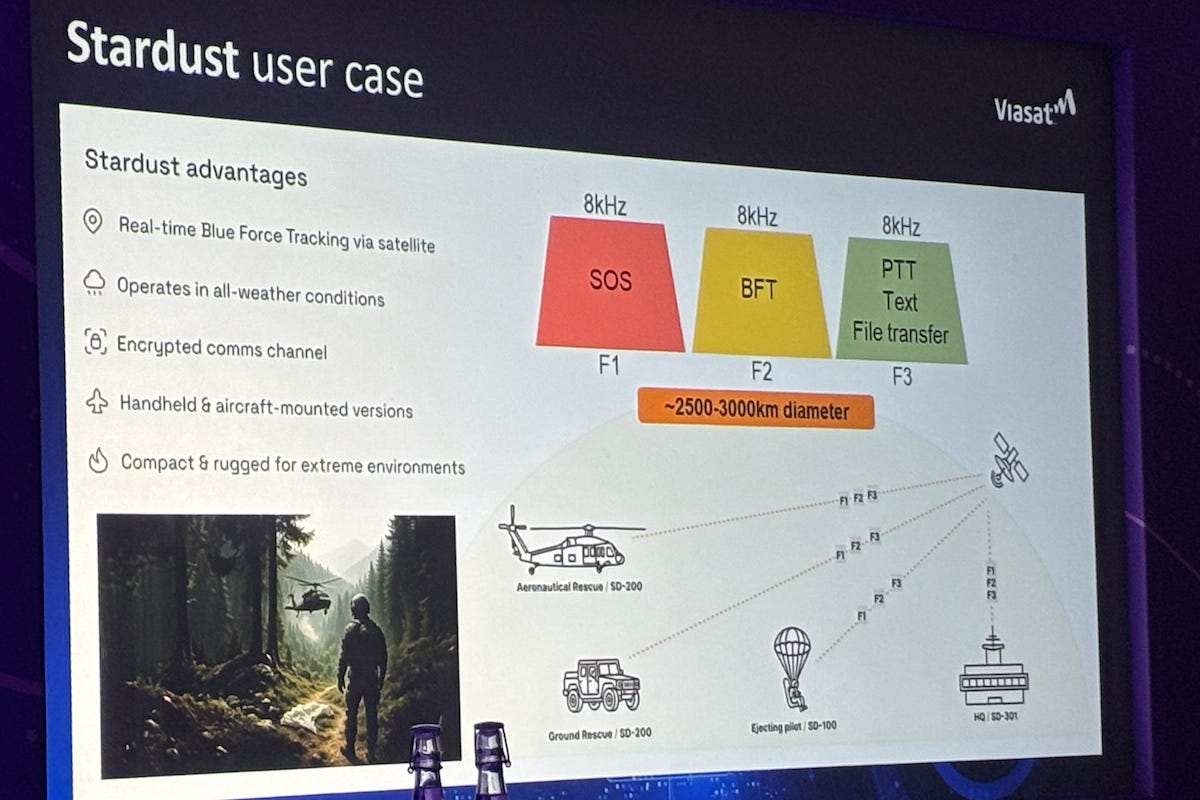
McDonell also pointed to extreme miniaturization as another way to preserve connectivity while reducing risk at the tactical edge. He highlighted a device known as Stardust, which he said represents the smallest class of satellite communications terminals now being fielded.
He said the device is designed for scenarios such as downed pilots or forward-deployed operators, providing basic messaging and voice connectivity while keeping weight, power consumption, and electronic signature to a minimum. Rather than prioritizing broadband performance, McDonell said the emphasis is on narrowband resilience, giving users a last-resort communications path when survivability and discretion matter more than throughput.
Looking ahead, McDonell said militaries will need to balance bandwidth, signature management, and interoperability when designing future communications architectures in contested domains.
He said future communications architectures will be judged less by raw connectivity and more by how flexibly they can be adapted under pressure.
No single satellite model is expected to dominate future architectures. Instead, layered approaches combining steerable beams, blended gateways, and alternative transport mechanisms are emerging to preserve connectivity while managing exposure.
The central lesson, he suggested, is that adaptability, rather than allegiance to any single network model, will define success in the next phase of military communications.