Satellites that can be reconfigured from the ground while in orbit, and ground systems that make autonomous routing decisions by fusing military and commercial feeds are no longer the stuff of roadmaps. Airbus Defence & Space is building and delivering them now.
The shift is architectural. Where previous generations of military satellites were fixed in capability at the point of launch, the new generation can have their beam position, beam shape and core software updated mid-mission. On the ground, a new autonomous platform fuses inputs from multiple satellite types and makes real-time decisions without human intervention.
“The way that we have changed our satellites over the last few years is really moving from software-defined in space and on the ground,” said Martin Rowse, Campaign Director of Airbus Defence & Space. “OneSat is our first fully software-defined satellite. You can now change your beam position and shape, and upgrade it while it’s in space.”
“We’ve got a software-defined defence baseband which is now a fully autonomous decision-making platform using multiple different inputs from multiple different satellite types,” he said. “That means you could have a military satellite and a commercial satellite all feeding in, and it is making autonomous decisions.”
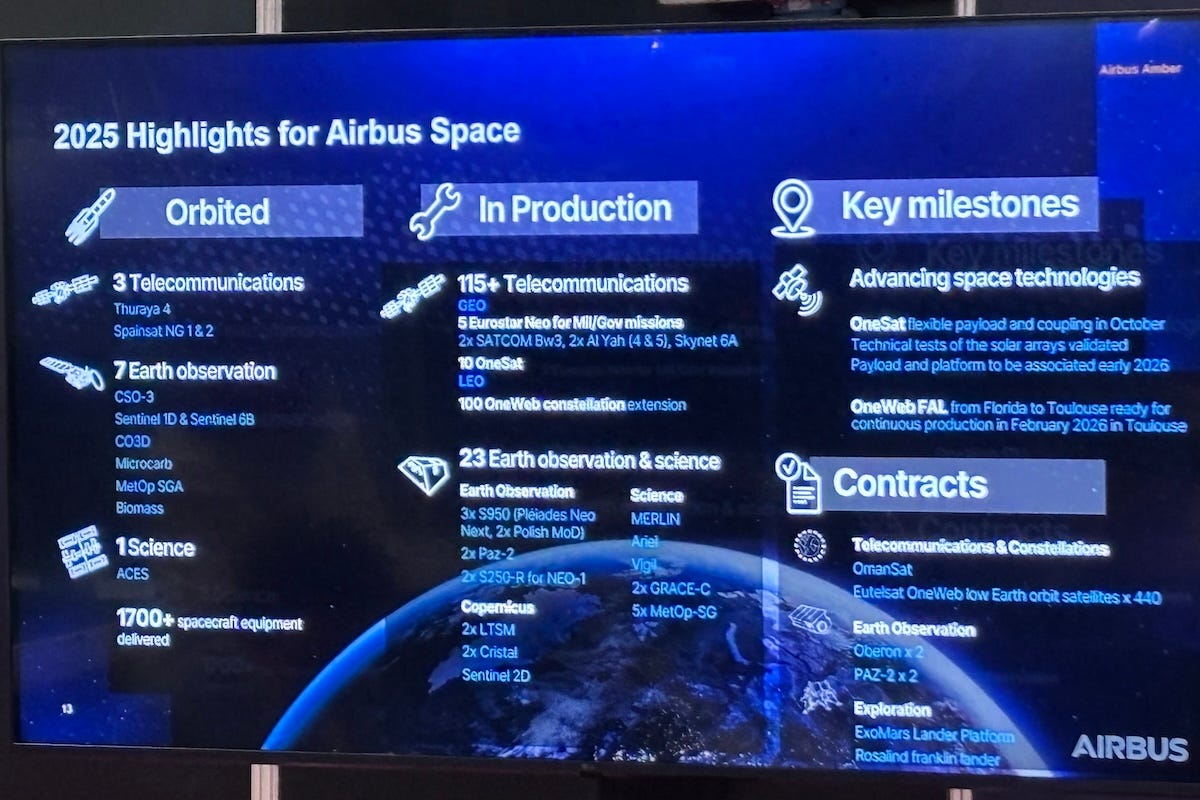
The case for software-defined architecture rests on a simple observation: no operator today can reliably predict what they will need from a satellite 15 years from now. Airbus’s answer is to make the capability itself adaptable. The standardized design of OneSat has enabled the company to run a production line of 10 satellites simultaneously, each differing only marginally in software configuration.
Airbus developed the autonomous routing capability in partnership with an AI company. The STDB (software-defined defense baseband) platform is both a product and a methodology, one that the company is beginning to extend across its broader portfolio. The system also incorporates transparent end-to-end encryption, with an AI-enabled base map running beneath the communications layer.
Europe’s open market
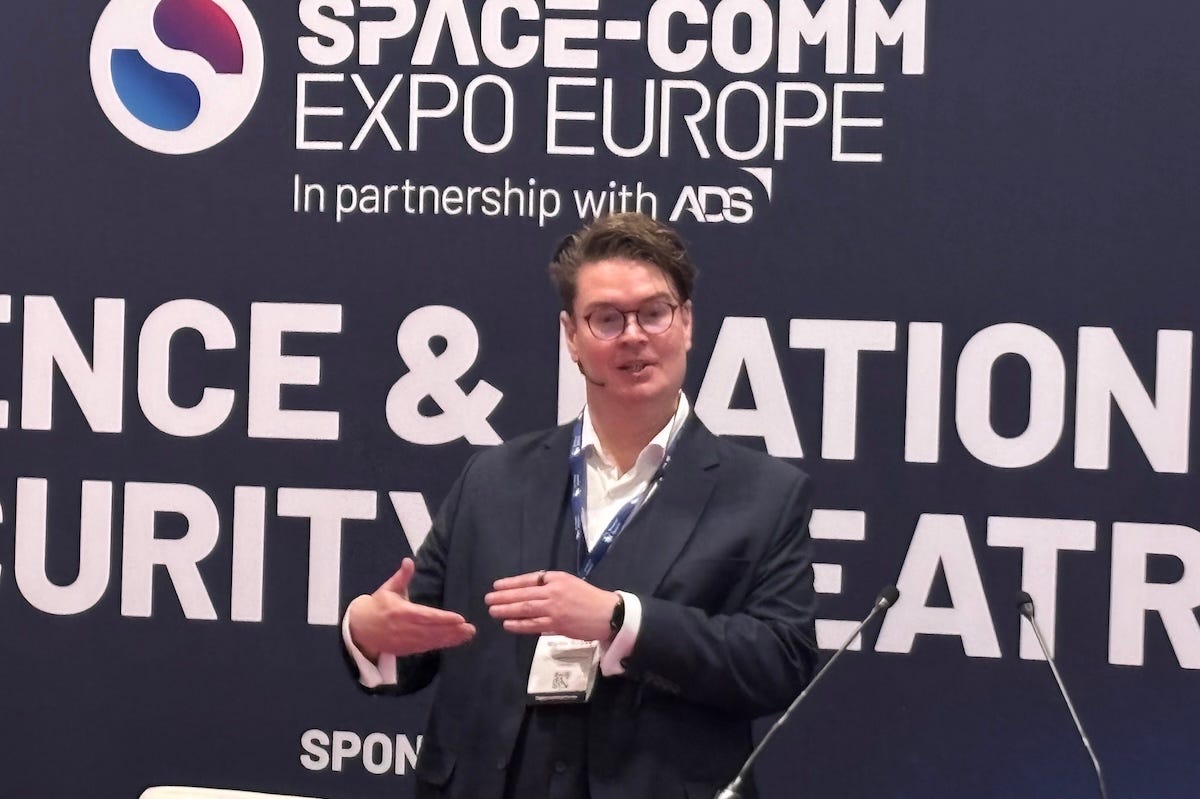
Rowse was speaking at the 2026 Space-Comm Expo Europe in London, organized by Space-Comm Limited in official partnership with ADS Group, the UK trade body for the aerospace, defense, security and space sectors. The session, titled “A Vision for Space,” was open to audience questions.
He used the occasion to make a direct pitch to European hardware companies, uncertain whether to grow domestically or pursue the US market.
“The benefit of Europe is that it is an open market,” he said. “We have a number of companies, Thales and Leonardo, but we’ve now got MDA from Canada and OHB from Germany. We’ve got a wide range of companies, which allows a much more open market.”
The contrast with the US is structural, not merely cultural. Airbus operates a US business that is legally ring-fenced from its European operations, making cross-business collaboration extremely difficult. Rowse said those restrictions make it very hard for the two arms to share technology or personnel.
“In the US, what we’re finding is that the companies are building for the US,” he said. “They’ve got a defined market, very low export capability, and a market which is difficult to break into.”
Brexit has introduced some friction for UK companies operating within the European ecosystem. He said Airbus has found workable solutions. European primes actively seek partnerships with smaller specialist companies across multiple nations, an openness he said is structurally absent in the US market.
Europe’s ability to compete in space faces a vulnerability that Rowse did not attempt to minimize. An audience member noted that the continent lacks a sovereign launch capability that can match SpaceX's and that the anticipated arrival of Starship threatens to widen that gap further.
“You’re right that a lot of the time we are still relying on American launch capability,” Rowse said. “We use essentially whatever the customer requires or wants. But with Russia’s attack on Ukraine, we could no longer use Russian capability.”
ArianeGroup, a European aerospace company jointly owned by Airbus and Safran, is catching up but remains behind the curve. Airbus is pushing for Ariane to develop reusable launch capability, and Rowse said he expects it to close the gap within a couple of years.
The UK Space Agency’s focus on sovereign launch from British soil addresses only the small-payload segment, and he described the broader ambition as a 10-year journey from nothing to meaningful capability.
Skynet and beyond
Space is increasingly a warfighting domain, not merely an enabler of operations on land, sea and air.
When Skynet launched its first satellites 54 years ago, the system existed to carry voice communications. Today, it must handle machines talking to machines, transferring data at volumes that analog-era infrastructure was never designed to support.
Underpinning Airbus’s ambitions is a MilSatCom (military satellite communications) heritage that stretches back decades. The company claims up to £10 billion in export potential from its UK-based MilSatCom portfolio. At the center of that portfolio is Skynet, the UK’s MilSatCom backbone, providing critical communications infrastructure to the US and 17 other NATO allies.
Skynet 6A, built in Portsmouth and completing final tests, is booked to launch on a SpaceX Falcon 9 rocket in 2027 and will operate into the 2040s.
Rowse said the program is a significant wealth generator: Skynet 5 evolves into Skynet 6A, which in turn feeds into the Wideband Satellite System (WSS) satellites. The WSS contract is the UK government’s single largest space procurement, valued at over £1.5 billion.
He closed with a direct appeal to the UK supply chain, saying that none of what Airbus is building would be achievable without the specialist companies that feed into its programs.