


Data center operators are rethinking where their power comes from, and the answer increasingly points away from the public grid.
Rather than drawing more electricity from cities already under strain, some developers are exploring dedicated nuclear generation and modular designs that keep new computing capacity entirely off residential networks.
“The way to get people more excited about data centers is to choose a location that’s appropriate and take them off our grid infrastructure,” said Amy Daniell, senior vice president of strategy and development at STACK Infrastructure, a data center developer. “To do that, you need an adoption of small modular reactors [SMRs] to go down the nuclear route, where you’re providing power infrastructure that is solely for the data center.”
“You’ve got waste heat that can be used to heat houses or leisure centers,” she said.
Daniell’s vision is a “hub and spoke” campus built around a single small modular reactor. The reactor would supply not just the data center but also a nearby medical research facility and a university, all drawing from one dedicated source rather than the public network.
Arash Ghazanfari, CxO advisor for the UK and Europe at Dell Technologies, the US computer and enterprise technology company, agreed that sprawling campuses are not the only answer.
“Artificial intelligence [AI] adoption doesn’t necessarily need to be powered by these mega data centers,” Ghazanfari said. “At Dell, we have a concept to bring AI to your data rather than take data to AI, meaning wherever it makes the most sense to store data, that’s where AI should be applied.”
He said modular data centers are emerging as a less intrusive alternative, adding value at the edge, closer to where the work gets done.
Concentrating computing power in a single city carries its own risk, he added.
“Does it make sense to centralize your compute in London, or does it make sense to look at other locations?” he said. “Data centers are increasingly becoming critical national infrastructure, so we need to think about where we are building them and whether we have sovereignty and control over those assets.”
Maria Jose Rivas-Duarte, sustainability director at Pure Data Centres Group, a UK data center operator, agreed that flexibility, not isolation, will define the next generation of sites.
She said her company’s systems now double as grid assets rather than simple power consumers, supplying reliability back to the network instead of only drawing from it.
“We can be off-grid, but we can also be flexible for the grid,” Rivas-Duarte said. “Our systems have redundancy such as battery energy storage. These are now key assets for the grid.”
Right-sizing AI’s appetite
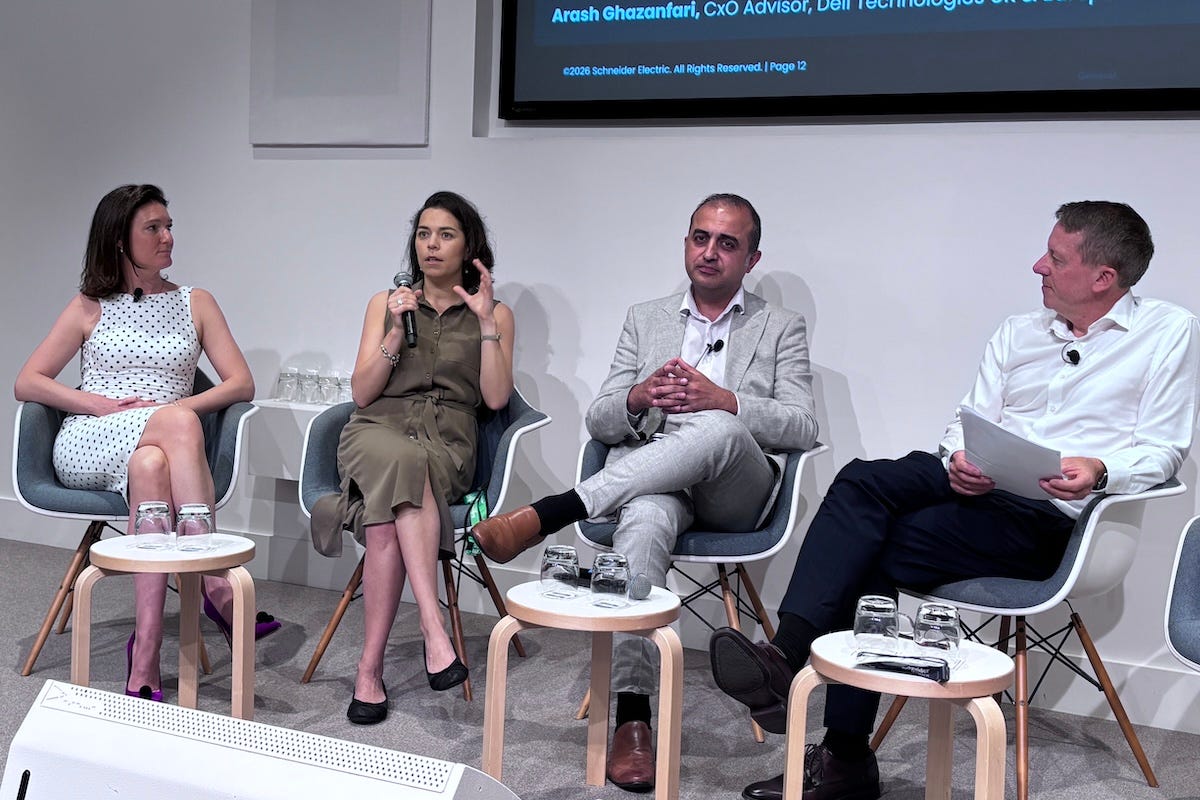
The panel took place at London Climate Action Week (LCAW) on June 25, 2025. It was moderated by Matthew Baynes, vice president of secure power and data centers for the UK and Ireland at Schneider Electric, the French energy management and automation company. The LCAW was organized by E3G, a climate change think tank (Third Generation Environmentalism), in partnership with the mayor of London.
The session brought together data center operators, sustainability leaders and technology vendors to debate whether AI’s growing infrastructure footprint helps or hurts the climate.
AI is not automatically a force for good, Ghazanfari said.
“AI by default is not going to be a net positive contributor,” he said. “Certain conditions need to be met for it to be a positive force for the progression of humanity and the advancement of climate initiatives.”
He said Dell encourages experimentation but treats innovation without governance as a liability.
He said the company operates on a margin of just over 7.5%, leaving little room for error when scaling AI initiatives across the business.
“My concern with governance is that the opportunity we have right now is to catch up with the US in AI deployment,” Daniell said. “Putting more governance into that process will only slow things down, and building a data center is already an incredibly slow process.”
The two positions were not as far apart as they seemed, Ghazanfari said.
“We are talking about right-sizing governance, not governance for the sake of governance,” he said. “It needs to be right-sized to encourage innovation with clarity, consistency and certainty.”
He said the same principle applied to the AI models themselves, comparing them to the human body.
“Large language models (LLMs) consume tokens the way our brains consume glucose or ketones,” he said. “The larger these models get, the more energy they need, and that footprint needs to be controlled. That’s what I mean by right-sizing your AI workloads, using the right model for the right task.”
He added that avoiding unnecessary data duplication mattered just as much, since generative AI can create synthetic data at an unprecedented rate.
“Educating everybody is key,” Rivas-Duarte said. “You don’t use the most powerful model to give you the best recipe for Thai chicken this evening. That element of the right type of AI for the right application is key.”
Coordinating with the grid
Pure Data Centres Group turned to microgrids when regulatory clarity fell short.
“Our example in Dublin was a response to the policy not being clear and us needing to proceed,” she said. “So our company developed a microgrid, which allows us to be not connected to the grid in Ireland, because there was a strain on the young grid there.”
She said the setup allows her company to become an active player in the Irish grid rather than simply a consumer, and that similar approaches are being explored by other firms across Europe.
Daniell cautioned that microgrids still need to be honest about their fuel source.
“People worry that we’re still burning dinosaurs,” she said. “It’s mostly fueled by gas, and we’re not being honest about it. That renewable connection piece is so critical.”
Utility scrutiny is arriving earlier than before.
“We’re at the early stage of driving our substation in Denmark, and the questions we’re getting from the utility provider are so specific, right down to the equipment we’re using inside the racks,” Daniell said. “They want to balance their grid, given how much renewable energy is in the Nordics.”
Shifting AI workloads to match renewable energy supply offers the clearest route to climate benefits, according to Ghazanfari.
“Demand-side flexibility is the clearest pathway for AI to contribute positively to climate initiatives,” he said. “At Dell, we’re working on what we call Concept Astro, using telemetry, digital twin capabilities and agentic AI to orchestrate where the right workload should reside at the right time, depending on energy availability.”
He said he expects the approach to become standard practice, calling any other outcome unacceptable.
Daniell said the industry was already circling the same idea, noting that AI training does not need to run around the clock.
“As an industry, we need to coordinate a lot more on how AI workloads draw energy from the grid,” she said. “When Microsoft’s Office 365 has no users between midnight and 4 am, that’s when AI workloads and learning can be implemented, so you’re not seeing the peak in the grid during the daytime.”
The bigger obstacle, she added, may be the industry’s own habits.
She described a US case from four or five years ago in which 3.6 gigawatts were requested from a single grid operator, with several companies chasing the very same end client, all competing for a contract only one of them could actually win.
“There was only one RFP [request for proposal] that one of them was going to win, but they’d all put in the same request,” she said. “So the grid operator said, ‘How am I going to deal with this?’”
Baynes, who moderated the panel, noted that new UK data center campuses now generate connection requests which, in total, exceed the country’s peak electricity demand, a figure that echoes the kind of duplication in the US example Daniell described, where rival operators filed overlapping requests for power they might never actually use.
Secrecy across the industry has made the problem worse, according to Rivas-Duarte.
“Our industry has worked for a long time without sharing what we’re doing with each other,” she said. “If coordination groups had happened earlier, it probably would have sparked better, forward-looking plans rather than individual ones.”
Panelists agreed that coordination, not speed, will decide the outcome. They said that how much of the coming wave of AI infrastructure the grid can absorb will depend on closer cooperation among operators, grid planners, and renewable developers, rather than a rush to build first and ask questions later.