


Europe’s loss of metal smelting and refining capacity is undermining its ability to produce gallium and germanium, chip materials made as by-products of metal processing.
China produces about 98% of the world’s primary gallium, and both metals have needed Chinese export licenses since August 2023.
“We need the smelters. We need the zinc smelters and the alumina refineries to produce the gallium, germanium and antimony,” said Bernd Schäfer, CEO and managing director of EIT RawMaterials, an EU-backed innovation network. “No midstream, no mine. We have already been losing a lot of midstream.”
He said Europe’s raw materials debate has shifted from supplying the twin digital and green transition to securing materials for defense, and that Europe must first determine what midstream capacity each value chain needs to stay resilient.
Citing Trafigura CEO Richard Holtum, he said Europe’s aluminum smelting capacity fell 30% in a decade and 50% since 2022.
Gallium goes into gallium nitride chips for power supplies in artificial intelligence (AI) data centers, and into chips for radar and 5G networks, while germanium is used in fiber optics and infrared optics. Both are recovered in small quantities during alumina and zinc refining, so supply depends on those plants running.
“This cannot go on, because we are moving in growing markets. So the net loss is much bigger than what has been shown there, and that’s where we are in a make-or-break situation now in Europe,” he said.
James Watson, director general of European Metals, which represents Europe’s non-ferrous metals producers, said a company choosing where to build a smelter today might not pick Europe because electricity is much cheaper elsewhere, even where the carbon footprint is far higher.
He gave Indonesia as an example of where producers could build smelters and then export to the EU.
“We should stay the course on the ETS (Emissions Trading System). We should support those organizations that are decarbonizing Europe by giving them indirect cost compensation until the electricity prices come down,” he said.
The EU’s ETS has long given energy-intensive smelters free allowances and compensation for carbon costs passed through in power prices. He said these are being phased out in favor of the carbon border adjustment mechanism (CBAM), which he called unproven and far from perfect.
He cited the Mosjøen smelter in Norway, which is 91% electrified and receives indirect cost compensation.
America moves first
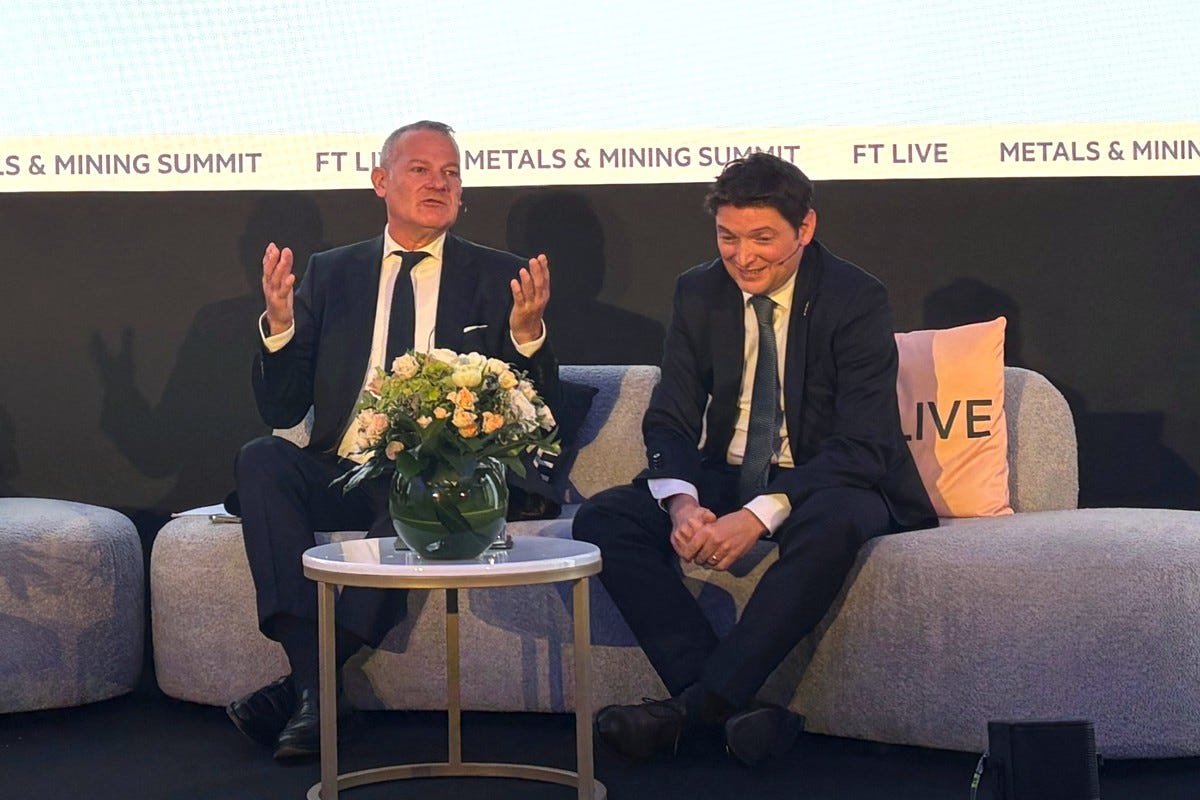
Schäfer and Watson spoke at the FT Metals & Mining Summit, organized by FT Live in London on October 15. Dan Thomas, the Financial Times' natural resources editor, moderated the fireside chat on carbon costs and shifting trade flows.
Europe relies on China for up to 99% of some critical raw materials and over 70% on average, Schäfer said.
“What we’re doing all starts with facts and figures, not with imposed regulations. We want to know what is Europe’s raw materials equation, to give a very clear answer: how much of what, by when and from where,” he said.
He said the analysis should cover all 34 critical and strategic raw materials, plus several defense metals not on the list. It would show:
how much capacity Europe must create at home
how much it must secure through offtakes with reliable partners
how to cut dependence on single sources
The United States has moved faster, investing in Project Vault and guaranteeing offtakes, he said.
“Look what the Americans have been doing. They’ve been building this rare earth permanent magnet value chain, and while we were still talking, they bought a couple of companies from Europe and are strengthening this value chain,” he said. “Everything that we have been saying over the last years, the Americans have taken and implemented.”
Project Vault, launched in February, is a $12 billion stockpile of minerals including rare earths and gallium, backed by a $10 billion loan from the US Export-Import Bank.
Schäfer said EIT RawMaterials proposed an action plan for a European rare-earth magnet value chain in 2020, estimating that about €2 billion in subsidies would be needed to level the playing field with rivals and offset China’s pricing, often based on figures declared by state administrations. It refreshed the plan late last year.
Europe makes far less than 5% of the permanent magnets it uses today, he said.
“We have no proof point in Europe of one functioning value chain where we are very dependent. But if we manage to get this to 20% or 50% self-sufficiency, then definitely this will create credibility and followership,” he said.
Watson said Project Vault and Canada’s critical minerals funding send investors clear signals that Europe has yet to match.
“Strategic autonomy is the pillar of the new competitiveness agenda that we’ve talked about in Europe. But talk is one thing, and delivery is another,” he said.
Money for the midstream
Watson said the planned European Critical Raw Materials (CRM) Center will test whether Europe is serious about securing these materials. On October 20, the European Parliament voted to make the center a standalone EU agency with a €2 billion fund under the bloc’s 2028-2034 budget.
“Will it have money or not? If it doesn’t have money, it’s not credible,” he said.
He said the European Commission’s RESourceEU Action plan, adopted last December, assembled about €3 billion by plucking figures from existing funding pots that companies must still apply to and struggle to access.
The plan lists AI chips and data centers among the industries it aims to protect from supply shocks, alongside cars, industrial motors, consumer electronics, aerospace and defense. He said Brussels still focuses on the ETS, CBAM and permitting, offering little support on competitiveness.
“We never asked for handouts. It’s not just about subsidies. It’s like a kind of addiction: you start, then everyone gets used to it, and no one wants to give it up,” he said.
He said the center must have finance to help build smelter capacity, and called for a critical raw materials bank.
Schäfer said public money for the center could be leveraged eight to 12 times with private capital, turning a fund of billions into a three-digit billion sum.
He said electricity costs about $100 per megawatt hour in Europe, against about $25 in places such as Canada, and a ton of aluminum takes about 14 megawatt hours to make. That leaves European smelters $700 to $1,000 a ton behind, even though they already run on 78% renewable power.
“The origin of the problem that we are having in Europe is not our CO2 efficiency. We are world-class. The real issue is power costs,” he said.
He said imported aluminum carries far higher carbon emissions than metal made in Europe. With half of Europe’s roughly 12 million tons of annual demand imported, that amounts to about 20 million tons of CO2 a year, similar to Croatia’s total emissions.
Both speakers said CBAM, which entered its definitive phase in January, does little to close the power-cost gap. Schäfer noted that aluminum accounts for about 2% of global greenhouse gas emissions, against 8% for steel.
“It’s a bit like a sieve rather than a border. It’s not particularly watertight,” Watson said.
He said loopholes such as a 50-ton threshold and the zero-carbon treatment of post-consumer scrap let suppliers keep resource shuffling. Because CBAM covers only imports, exporters must apply for temporary rebates, which he described as a bureaucratic puzzle that only adds to the complexity.
“CBAM does not create a business. It’s the cart before the horse,” Schäfer said.
He said Europe should first decide how much capacity it needs and discuss CBAM afterward, and that it will have to rethink its entire raw materials strategy if the CRM Center does not happen.