


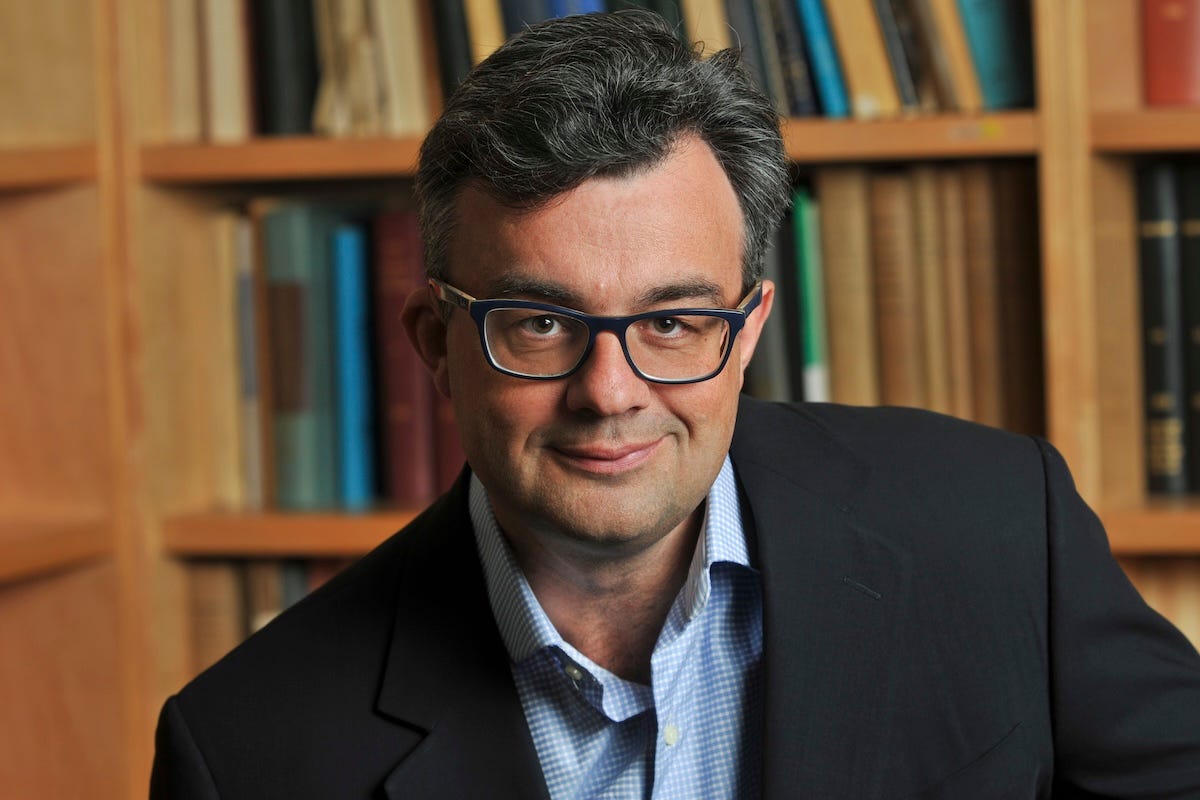
Artificial intelligence (AI) has become good at proving theorems because proofs can be checked, but it cannot yet invent the new theories that drive discovery.
The reason is verification. Proofs can now be formalized in Lean, a programming language that checks their correctness.
“AI is very good at everything that can be verified. A proof can be verified, but new ideas are not,” Emmanuel Candès, the Barnum–Simons Chair in Mathematics and Statistics at Stanford University and one of the two laureates of the 2026 Shaw Prize in Mathematical Sciences, told TechJournal.uk in an interview. “It’s a very good theorem prover. But it doesn’t invent a new theory.”
“It can prove a hard theorem, but it’s very far from telling me that if I were to prove this new result that nobody had thought of, it would have tremendous consequences,” he said. “It’s not good at coming up with interesting problems or interesting questions. It’s very good at connecting the dots.”
An AI system beat world chess champion Garry Kasparov in 1997, when Candès was a graduate student. AI has since mastered Go, coding and now mathematics, all fields where results can be verified.
Candès’s own work is mostly about asking the right questions and building the right framework to connect abstraction with reality. He said AI may get there one day but is far from it now, and whether it will ever invent new theories remains a big open question.
In his view, picking the best paper at an AI conference that receives thousands of submissions is almost impossible for humans and machines alike because a paper’s value cannot be verified at once.
Test-of-time awards, by contrast, honor papers only after they have proved influential for a decade or two.
“AI can stumble upon things, but how does it know that it’s important?” he said. “That’s why I believe we are nowhere near being replaced.”
Asked about warnings that AI combined with robots could one day end the era of human beings, he said he did not know.
“As scientists, we have a responsibility to engage with AI and do what we can so that the bad stuff doesn’t happen,” he said. “You don’t achieve this by sitting on the side and saying AI is bad. You achieve it by engaging.”
Scans in 15 seconds
Candès shares the Shaw Prize in Mathematical Sciences with Camillo De Lellis, IBM von Neumann Professor at the Institute for Advanced Study in Princeton. They received their medals at the prize's award ceremony in Hong Kong on November 10, where Candès described his current efforts to make AI more powerful and safer.
The other five laureates in the prize’s 23rd year were:
Astronomy: Ken’ichi Nomoto of the University of Tokyo and Stanford Woosley of the University of California, Santa Cruz, for studies of stellar explosions and the origin of the elements;
Life Science and Medicine: Anne Dejean of Institut Pasteur, Hugues de Thé of Collège de France and Zhu Chen of Ruijin Hospital at Shanghai Jiao Tong University, for work that turned acute promyelocytic leukemia into one of the most curable cancers.
Each prize carries US$1.2 million, shared equally among its laureates.
Candès and De Lellis were honored for using deep techniques from mathematical analysis. Candès’s share recognizes his work to rigorously understand applied problems in information theory, signal processing and statistics, while De Lellis studied singularities in geometric measure theory and fluid dynamics.
His main contribution was to help discover compressed sensing, a field that reconstructs high-resolution signals from what appear to be incomplete data.
His early work showed that magnetic resonance imaging (MRI) scans could be rebuilt from just a few samples. An MRI scanner takes indirect measurements of soft tissue, and the time each one takes is fixed by physics, so cutting scan time means taking fewer of them.
“When you take too few measurements, you’re missing a lot of data. It’s a bit like trying to reconstruct your bank account number from just a few digits,” Candès said.
His team showed that exploiting an image's structure allows very high-fidelity reconstruction from a limited set of samples.
The most striking use is in children. A two-year-old once had to stay still and stop breathing for about two minutes during a high-resolution scan, but that can now be cut to about 15 seconds.
He then spent about 10 years on the reproducibility crisis in science.
In 2005, his Stanford colleague John Ioannidis published a paper titled “Why Most Published Research Findings Are False.” Biotech firm Amgen later tried to replicate 53 landmark studies from journals such as Nature, Science, the New England Journal of Medicine and the Lancet, but only six held up.
Bayer HealthCare could replicate only about a quarter of the studies it tested.
“Science, by definition, should be replicable,” he said. “Somehow, most of it had vanished into thin air.”
Funding pressure and “team science” played a part, but Candès’s concern was statistical. Before 2000, a lab would hypothesize that a gene had a certain function and then measure carefully to test it. In the late 1990s, a “data tsunami” arrived, as gene microarrays could measure the activity of all genes at once.
“At the turn of the millennium, the scientific method got inverted. We got data first, and then only after looking at the data we ask questions, and we use the same data to answer the questions,” he said. “If I gather a trillion monkeys and put them in front of a typewriter, one of them will start typing Hamlet by chance, but it doesn’t mean that this is Shakespeare.”
He went on to develop many methods so that findings drawn from data used both to form and to test many hypotheses, even with sophisticated machine learning algorithms, are likely to hold up when someone else collects similar data a year later and applies similar techniques.
From search to assistants
Large language models (LLMs) have made spectacular progress, but Candès sees the real transformation in AI agents such as Claude and ChatGPT, which execute tasks on a user’s behalf rather than just hold a conversation.
“The world I knew a year ago is no longer with us,” he said. “Until late last year, LLMs were mostly a substitute for search engines. But in late 2025, everything changed because they became assistants, and the power of these tools as assistants is extraordinary.”
Implementing and testing an idea used to take him a very long time. Coding agents now make it fast, and the pace of his research has accelerated dramatically, which he finds liberating.
“Instead of being constrained in what I could do, because I have only limited time and a lot of responsibilities, I can do much more now. My students can do much more and move faster,” he said. “There is no doubt in my view that these tools will accelerate scientific progress.”
As for the prize money, he plans to keep working with his graduate students on AI-related topics. His research has changed enormously since the work the prize recognized, and his group has focused on the intersection of statistics and AI for three or four years.
“It is very important that we apply mathematicians and statisticians to AI,” he said. “My career is not inward-looking. I’m not waking up in the morning asking myself what lemma or theorem I could prove today. I’m always looking at what’s happening outside the mathematical sciences and how I can contribute.”
With children in high school and students around him every day, Candès is a bit worried by what he hears from mathematicians around the world.
“We might be entering a golden age of mathematics, because we have this powerful assistant that can help us do great things,” he said. “It’s a good time to study mathematics, physics and chemistry.”
He finds it hard to imagine using AI to advance the sciences without understanding mathematics, physics or chemistry, just as no one can be a Chinese poet without understanding Chinese or poetry. He warned that young people must not conclude that the sciences are solved and no longer need studying.
“The worst thing that could happen to humanity is that we drive kids away from the sciences. To imagine a whole generation that becomes scientifically illiterate, numerically illiterate, is a scary proposition,” he said.
He believes schools that discourage AI probably need to change, but what matters most is students who think critically, question assumptions and cannot be deceived by flawed arguments.
“It’s not because we have cars, motorbikes and elevators that we stop walking. The brain is a muscle, just like the rest of our body. You’re going to need to exercise it; otherwise, it’s going to become mush,” he said.
Stanford statisticians ran a randomized experiment on one of their courses.
One group of students could work however they liked, including with AI. The other had to explain their solutions in person to teaching assistants for five to 15 minutes a week, and did much better in final evaluations.
Being able to explain arguments to a real person was strongly correlated with achievement. How to organize such training remains a big debate, and Candès plans to try different approaches in his own teaching.