


Developers of artificial intelligence (AI) data centers must plan for peak electricity demand at specific times and places, not just add more total generation capacity.
Most debate centers on base-load power for sites that run nonstop, while the daily demand curve gets less attention.
“Electricity exists. During the day, you have abundant energy most of the time, but you also need to look at the peak,” said Frédéric Godemel, executive vice president for energy management at Schneider Electric. “The problem can be at the peak, where the supply of energy may not be enough for a given data center.”
“Those are the two sides you have to look at: reinforce the grid, make sure at this point you have enough power and then look at the curve during the day,” he said.
He said developers must first check the energy available at their chosen site and whether the grid can supply it.
Electricity demand from data centers rose 17% in 2025, more than five times the global demand growth rate of 3%, as tech companies spent more than $400 billion on AI infrastructure, the International Energy Agency (IEA) said. It expects data center demand to double by 2030, with AI-specific demand tripling over the same period.
A single 100-megawatt data center can use as much power as 100,000 households, and some now under construction could use as much as 2 million households.
Shortages of gas turbines, transformers and chips, plus grid connection delays, are already slowing projects.
Schneider Electric is a France-based energy management and automation group that supplies power, cooling and software systems for data centers, buildings, homes and utilities. In November 2025, it launched the Energy Technology Coalition with Bloomberg New Economy to promote “smart demand,” which trims and shifts electricity use to ease pressure on grids.
The coalition examines why demand-side tools such as AI-driven grid control and digital twins have not scaled faster. At its launch, Godemel said a resilient and affordable energy future required strong collaboration across the technology and energy sectors.
Shaving the peak
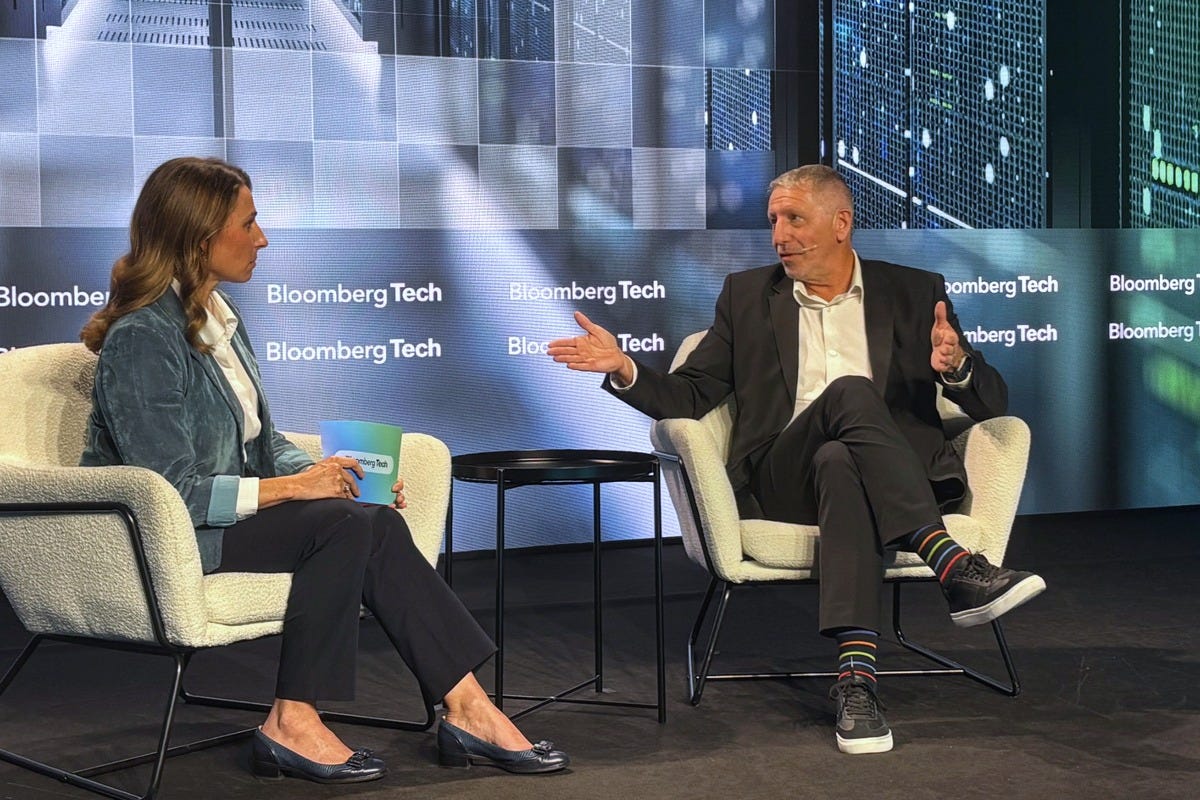
He spoke on November 3 at Bloomberg Tech London, organized by Bloomberg. Dana Perkins, head of market development and partnerships at BloombergNEF, interviewed him on powering growth in the age of AI in a session showcasing the Energy Technology Coalition.
He said there are two ways to lower the peak: efficiency and shifting load to other hours with digital technology.
“The first one, which is the easiest, is energy efficiency. If you’re more efficient, you reduce your peak,” Godemel said. “AI can help you to better manage this energy fluctuation, especially in buildings, where you have natural flexibility with HVAC (heating, ventilation and air conditioning).”
Efficiency gains are already built into forecasts. The IEA projects that the global average power usage effectiveness (PUE) of data centers will improve from 1.41 to 1.29 by 2030, saving around 90 terawatt-hours of electricity.
Some operators are also testing load shifting at scale.
In March 2026, Google said it had reached demand-response agreements with five US utilities to curb electricity use at certain data centers when the grid is under peak stress. It can make up to 1 gigawatt of its data center load available for curtailment, including machine learning workloads that can be paused or rescheduled.
At an Oracle data center in Phoenix, a pilot using startup Emerald AI’s platform cut power use by 25% at peak demand by coordinating clusters of Nvidia graphics processing units (GPUs) in real time.
Google first tested the approach by shifting non-urgent compute tasks, such as processing YouTube videos, during periods of grid strain. It said data center demand flexibility is still in its early stages and will be available only at certain locations.
Speed now matters as much as supply, and data center investors increasingly see efficiency as part of the answer.
“The first thing you need to look at is, of course, the availability of the site you have chosen. And remember, time to power equals time to token,” Godemel said. “The second point is looking integrally at your compute system, your power system and your cooling system.”
He said developers should also simulate a site before operating it, using design tools to optimize it before it is built so rollout is fast, and to model its efficiency once it is running.
In the UK, securing a grid connection for a new 50-megawatt data center now takes an average of seven years, compared with about four years in Northern Virginia and eight in Dublin. Some developers have been offered connection dates in 2037 and beyond.
Energy regulator Ofgem is consulting on removing speculative projects from Great Britain’s queue, which holds about 73 gigawatts of data center demand. It has proposed a commitment fee for data center projects above about 40 megawatts.
Breaking down silos
“Probably one of the big barriers today is people have a tendency to look at things in silos: I look at my power, I look at my cooling, I look at my compute, and everybody is not speaking much to each other,” Godemel said.
Linking those systems gives operators a constant view of how much power, compute and cooling they really need, so they can keep optimizing them with digital tools and AI.
“Data centers are here to support AI, but AI can help data centers to be much more efficient,” he said.
Peak demand drives expensive network upgrades, and those costs filter into electricity bills, even for customers who never use AI tools or services.
The new generation is also slow to arrive. GE Vernova said in July 2026 that its gas turbine backlog had reached 116 gigawatts and that a heavy-duty turbine ordered now would not be delivered until around 2031. Wood Mackenzie puts lead times for large turbines at five years.
In the UK, more than 100 data center projects are weighing on-site gas generation while they wait for grid power.
Godemel said AI investors should look now at how much power is available to them and how flexible they can be, and simulate their installations so they can optimize them over time.
“All that I explained on flexibility is giving available power today. There is energy available in the short term, most of the time during the day,” he said. “At some point in time they may need to support the grid; they need to become an actor of the grid.”
Google has said such flexibility reduces the need for new transmission lines and power plants.
“Of course we need more electricity for the future, because all new sources of technology are using electricity,” Godemel said.
The IEA expects data centers to account for about one-tenth of global electricity demand growth to 2030, less than industrial motors, air conditioning in homes and offices or electric vehicles. Bloomberg New Economy says an electrification supercycle is driving a 75% increase in global electricity demand.