


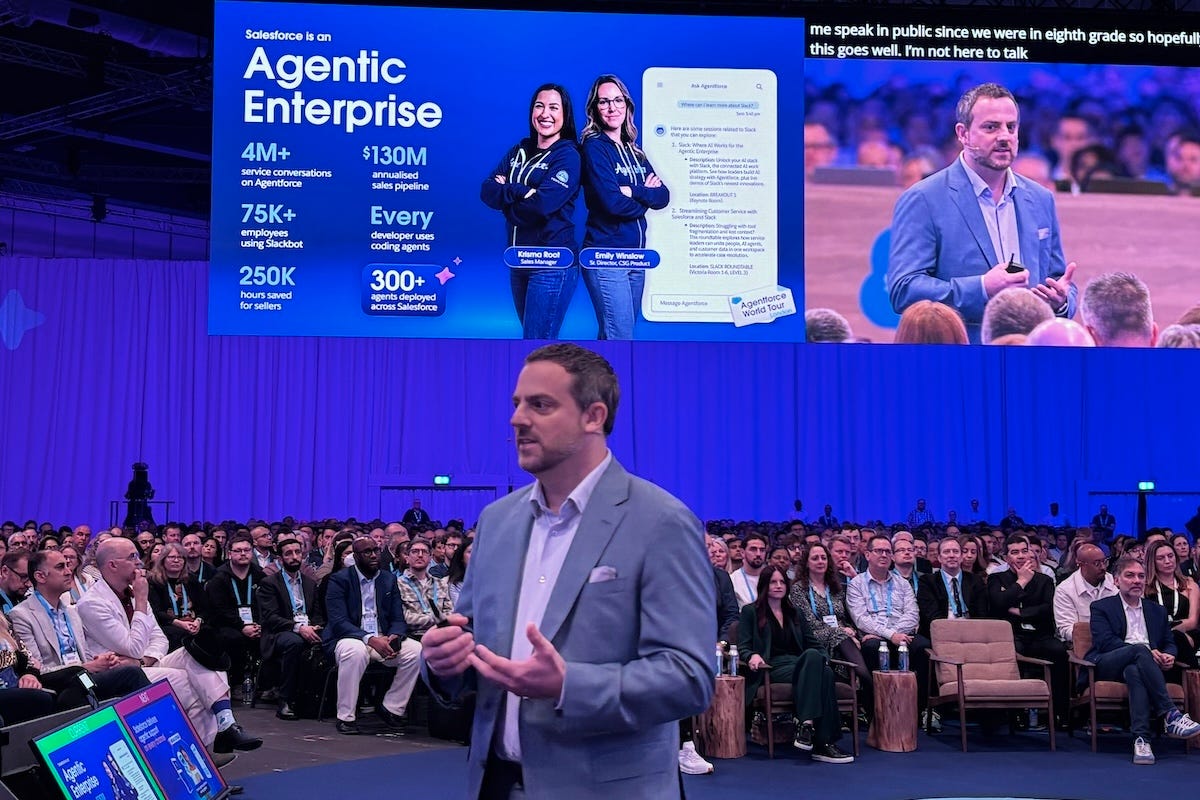
Salesforce has opened its customer relationship management (CRM) platform to any external artificial intelligence (AI) agent or developer tool, allowing products such as Claude and ChatGPT to query, reason over and update live Salesforce data without leaving their own interfaces.
The capability, called Headless 360, represents a significant architectural shift: Salesforce is no longer positioning itself purely as the interface through which enterprise work gets done, but as the data and logic layer beneath any interface.
Launched on April 15, Headless 360 delivers three core innovations: new model context protocol (MCP) tools and coding skills that give any coding agent full access to the Salesforce platform; a new experience layer that renders rich, interactive components natively across Slack, Salesforce’s workplace messaging platform, as well as Claude, ChatGPT and other external tools; and new controls for managing how agents behave in production.
“Salesforce, for 27 years, has built technology and products to uplift humans, to enable humans. Headless 360 is how we actually do the same thing for agents, how we enable agents to work with humans. This changes the game,” said Joe Inzerillo, President of Enterprise and AI Technology at Salesforce.
Headless 360 allows any external tool or developer to connect to and update Salesforce while respecting the same permissions model that has been built over nearly three decades. Inzerillo said that means the sharing rules that prevent an intern from seeing board-level data are automatically enforced within any connected agent, with no need to rebuild the security model.
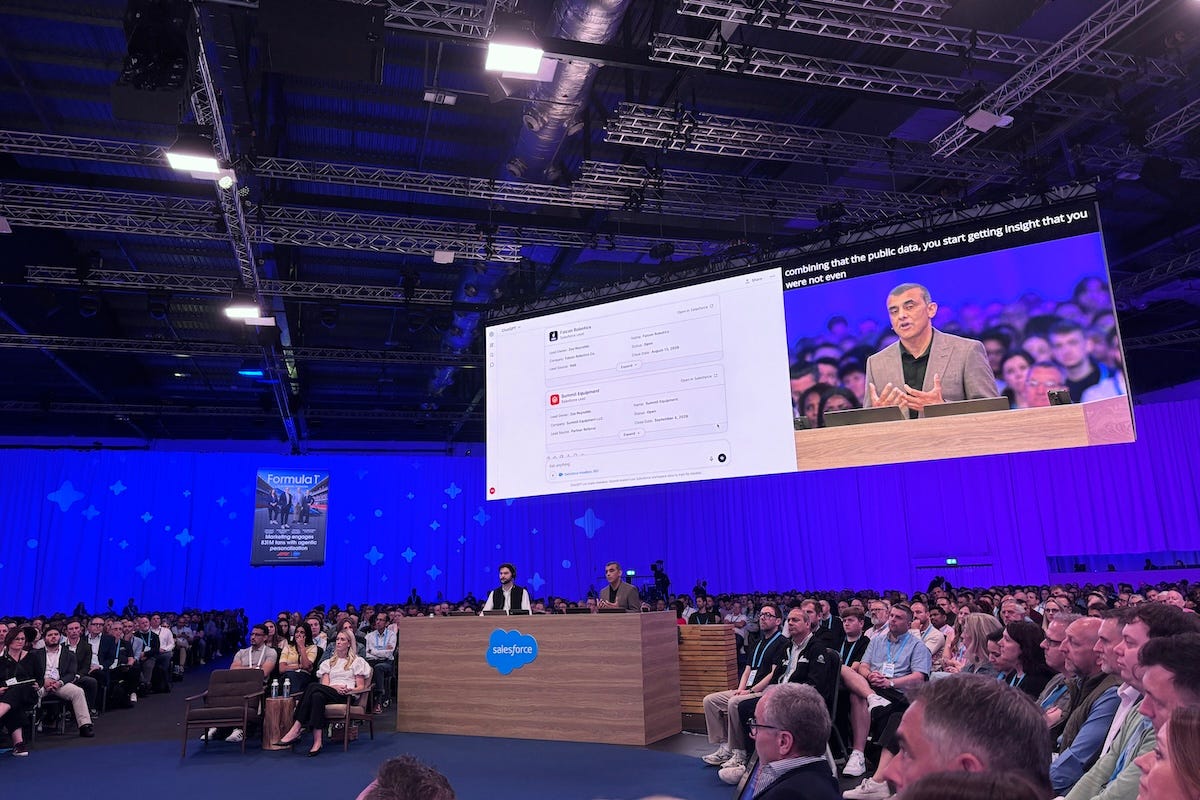
Ansar Ahmed, Vice President of Solution Engineering for UK and Ireland at Salesforce, demonstrated this live on stage at the World Tour London event, connecting Salesforce to both Claude and ChatGPT in minutes, querying a live sales pipeline from within each tool and updating a CRM record directly from within Claude.
“For 25 years, getting value out of Salesforce meant logging in, clicking through screens and navigating a UI. But AI agents do not use browsers. They call APIs, they invoke tools, and they run autonomously,” Ahmed said.
“The AI did not change. The context did. Salesforce has always been the system of record for your people, and now it is also a system of record for your agents,” he said.
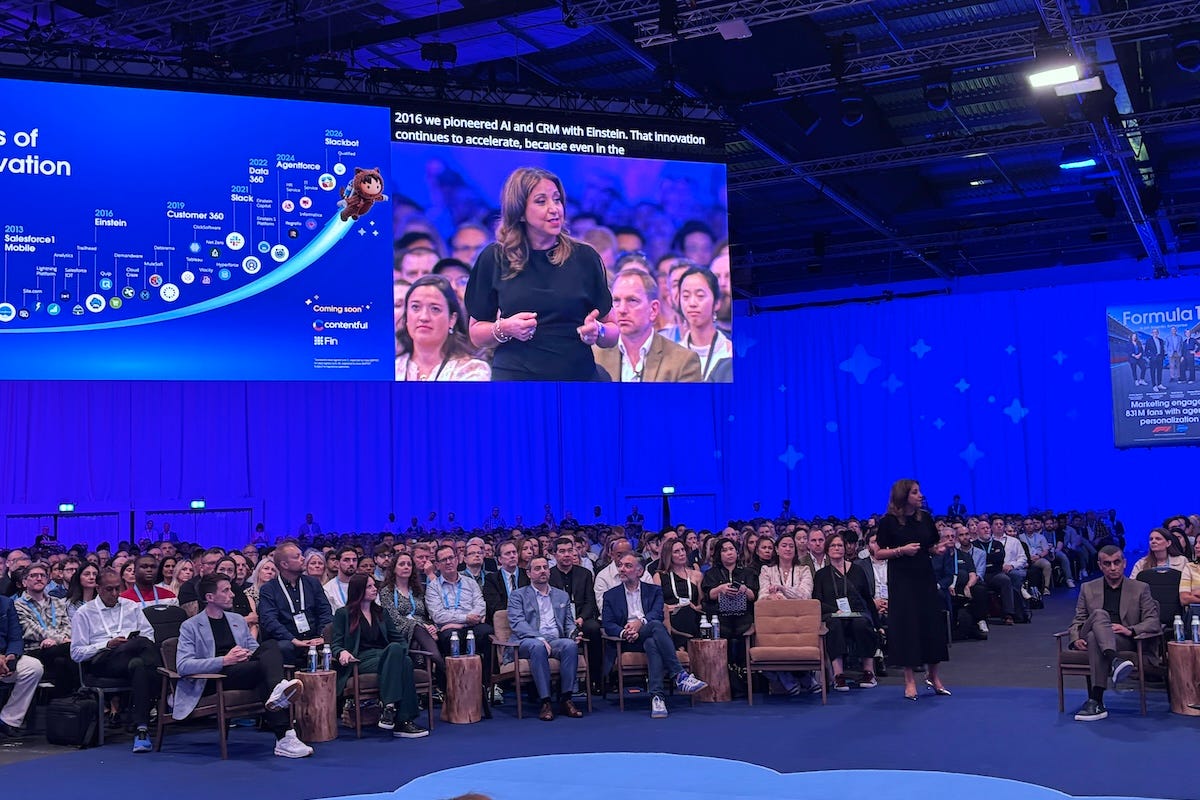
Zahra Bahrololoumi, President, UKI at Salesforce, set the broader context for the day. The company has committed $6 billion to its UK operations through 2030 and recently opened a new AI center forming a connected campus with its Salesforce Tower in London.
“Agentic AI doesn’t just benefit commercial businesses. It can also elevate citizen services, from policing through to transport, health and welfare,” she said.
Salesforce has already applied the approach internally, building a legal request routing system using Headless 360 and Claude Code in five weeks and saving an estimated 12,000 lawyer-hours annually.
Police calls and premium retail
The Agentforce World Tour London event, organized by Salesforce and hosted by Bahrololoumi at a London venue on June 18, brought together enterprise customers, partners and developers. Several customer speakers presented live deployments that moved well beyond the pilot stage, anchored by a finding from Inzerillo.
“94% of people who have gotten on the journey are not seeing the ROI (return on investment) for AI. They have spent the time and money, but they are not seeing the ROI,” he said.
Inzerillo said the most common causes are fragmented data, agents that understand knowledge but cannot take action, failure to escalate to a human when stuck, and security gaps. Salesforce addresses this with five systems: context, work, agency, engagement and insight.
One of the day's most striking customer stories came from UK law enforcement.
Tom Kempster, Director of Digital and Innovation at Thames Valley Police, described a force handling between 1.3 and 1.4 million contacts per year across Thames Valley, Hampshire and the Isle of Wight, with average wait times on its non-emergency 101 line running at 26 minutes.
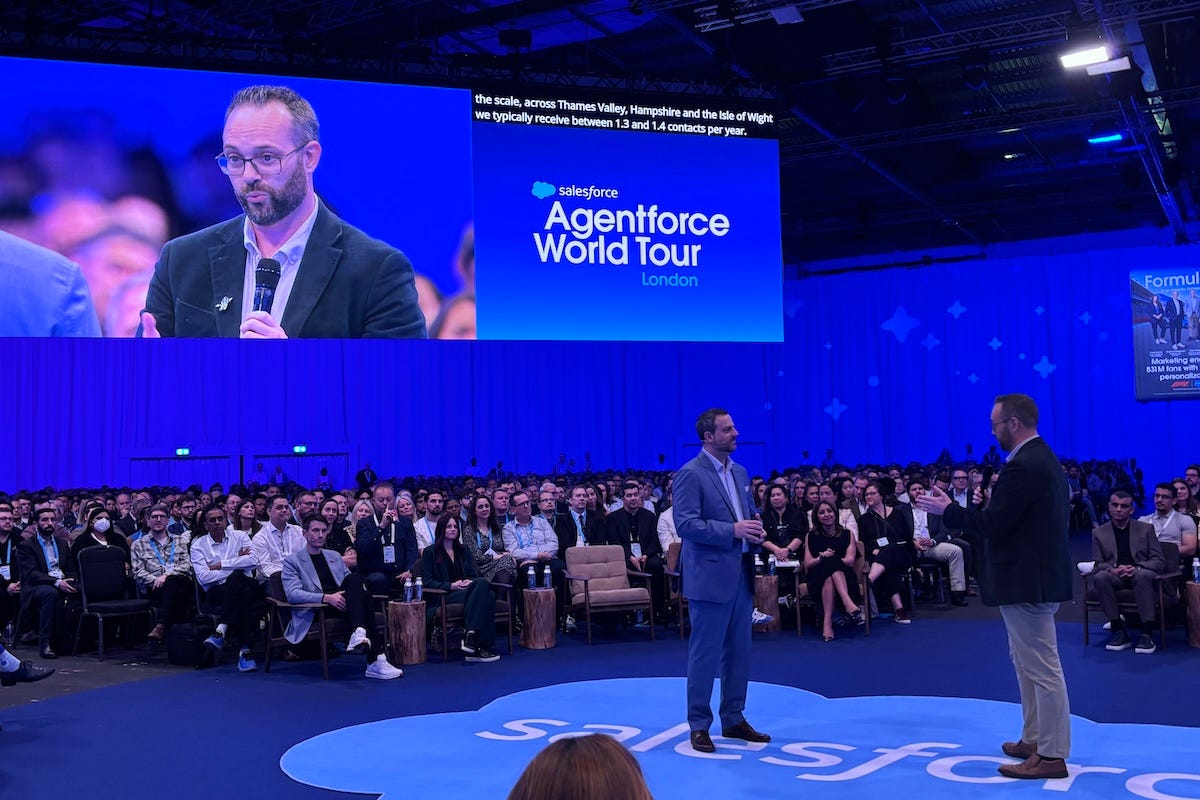
“Our traditional approach of peopling our way out of the situation was not going to work. We were looking at a potential £11 million opex increase to do this without technology,” Kempster said.
The force deployed Bobbi, an agentic AI built on Agentforce, for non-emergency contacts. Bobbi now handles 70 to 75% of those contacts autonomously, totaling approximately 162,000 interactions. Average wait times have fallen from 26 minutes to around 2.5 minutes, and customer satisfaction has risen by 15%.
“Any channel that the police open could potentially be an emergency. We cannot dictate that you can only use it under these circumstances, and we would be failing the public if we gave them a service that said ‘Sorry, I cannot help you with that,’ which is your more traditional chatbot approach,” he said.
He added that what sets Bobbi apart is that the contact center team’s expertise in handling distressed callers, including empathy, victim agency and de-escalation, was translated directly into how the agent communicates. The force has had multiple cases of people reaching out through Bobbi who could not use any other channel, resulting in arrests.
“It is not just about diverting contact. It is about delivering the service that the public expects, and it was a combination of what the agentic AI can do with its language that we have never seen before in technology,” he said.
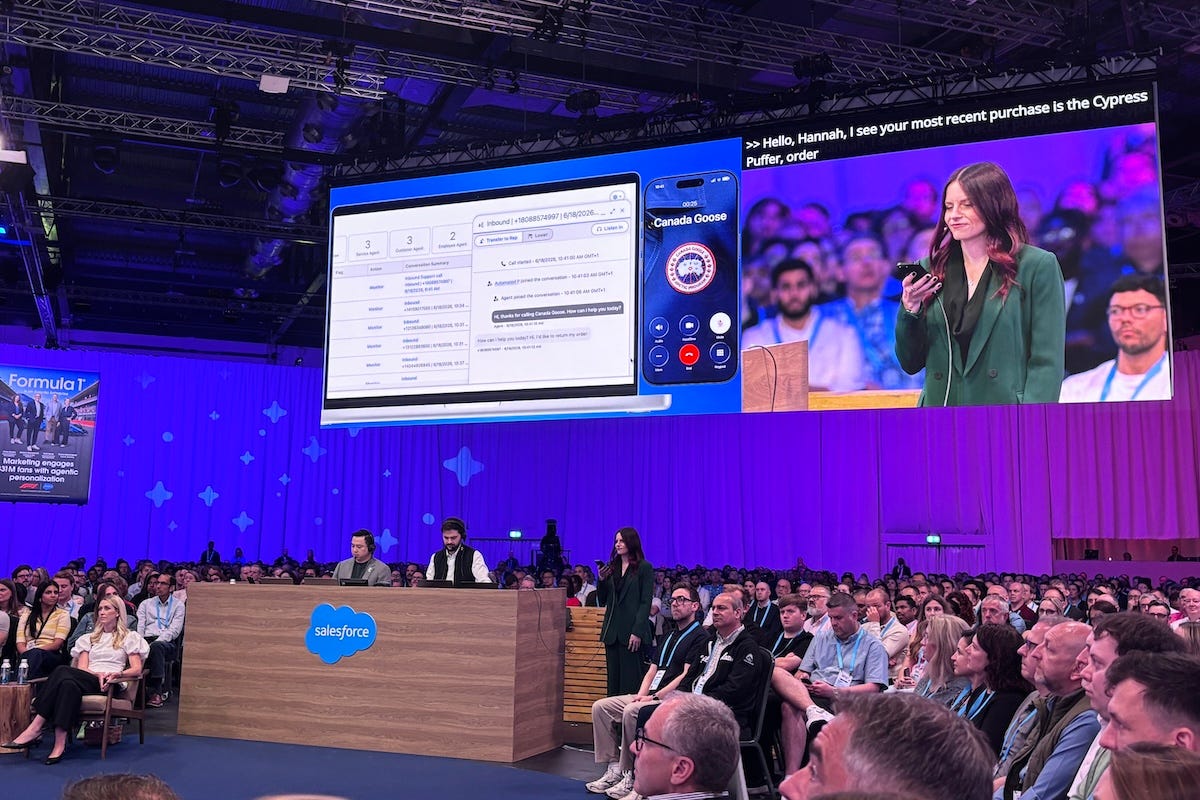
Hannah Rose, Distinguished Solution Engineer at Salesforce, demonstrated how Canada Goose, a global performance luxury brand, has automated over 89% of routine customer service tasks using Agentforce while preserving the premium experience its customers expect.
“Before Agentforce, providing that high-touch service meant teams were jumping from system to system, trying to piece together a customer’s history, all while that customer waited. Every disconnected interaction became a make-or-break moment for customer loyalty,” Rose said.
A live demo showed the Agentforce AI recognizing a caller without requiring identification, confirming the correct order, selecting the customer’s preferred channel to send a return label, and escalating to a human stylist when styling advice was needed, passing the full conversation context and purchase history across seamlessly.
“Most AI systems can answer questions, but very few can carry this level of customer context into every interaction,” Rose said.
She said Agentforce Script allows brands to set hard guardrails in natural language, ensuring the agent behaves consistently each time a defined situation arises, which is critical in regulated industries where the wrong answer carries compliance risk.
Pipeline agents and F1
Katie O’Neil, Director of Product Marketing at Qualified.com, presented Adecco, the world’s largest staffing and recruiting company, which deployed an AI sales development representative, Ecco, on its website using Qualified and Headless 360. Ecco now sources 85% of the company’s inbound pipeline.
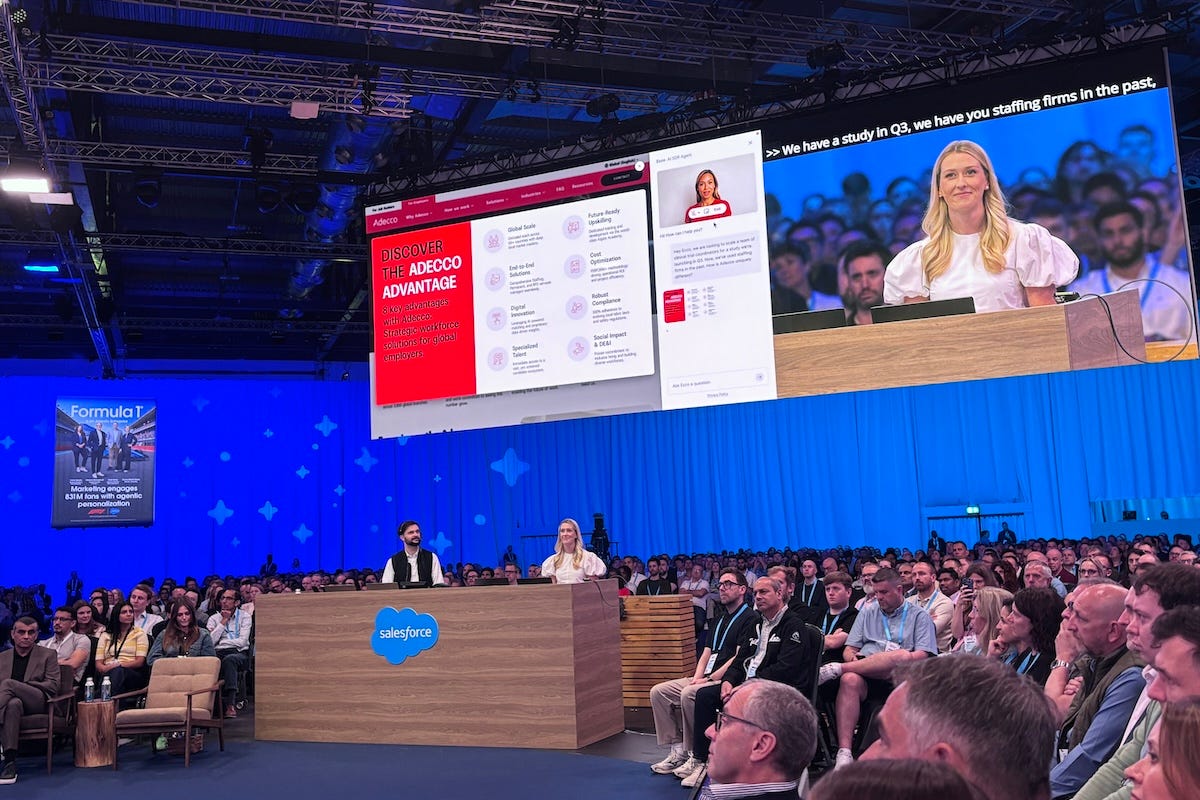
A demo showed Ecco identifying an inbound enterprise buyer, engaging her by voice on the website, switching to French on request, and following up with a bespoke email before booking a meeting with the aligned account executive, all without a human SDR (sales development representative) involved.
Qualified has more than 700 customers, all live in production, with every new customer going live within 45 days. O’Neil said the agent is configured in plain language via Qualified’s Agent Studio, requiring no coding or IT involvement, and can engage buyers across text, voice and video.
The event closed with Formula 1, whose four-year partnership with Salesforce uses Data 360 to serve 831 million fans globally. Tom White, Trackside IT Engineer at Mercedes-AMG PETRONAS Formula One Team, compared the challenge facing F1’s lean marketing teams to a pit stop.
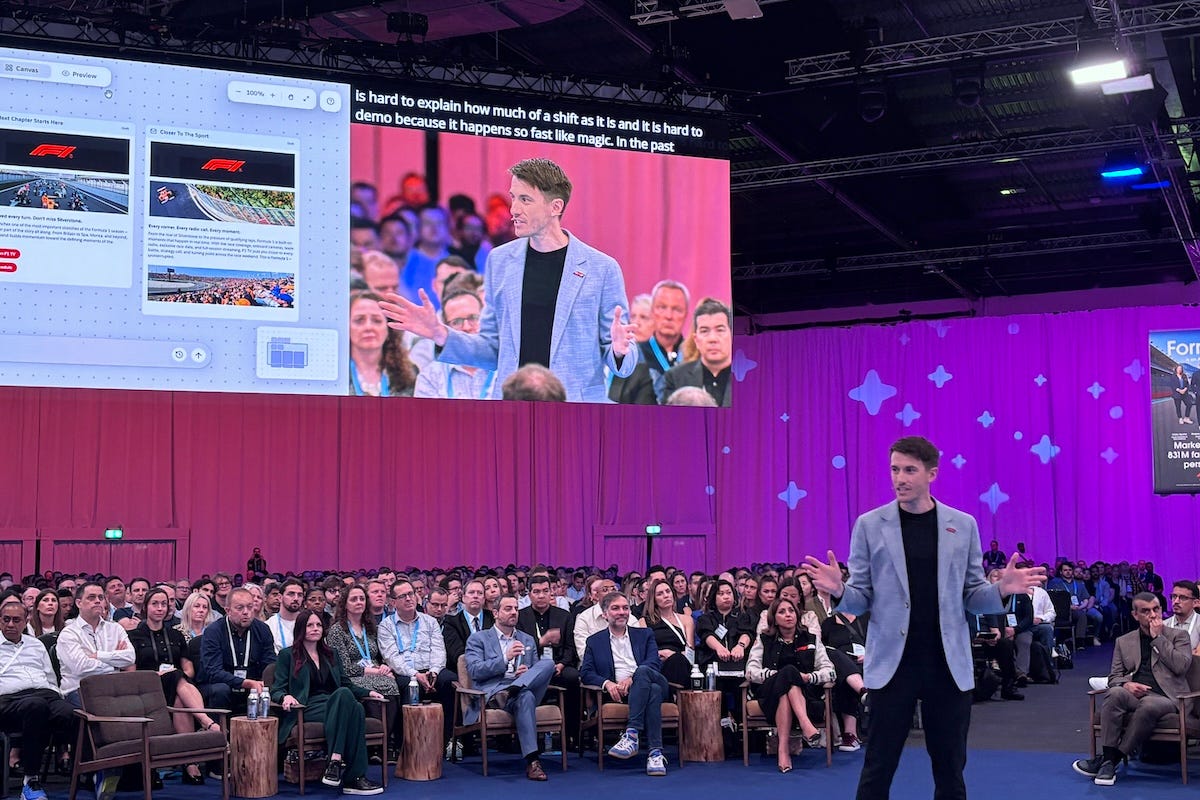
“Imagine you are a Formula 1 driver pulling into the pits, engines roaring, time ticking. You need to get out fast, and you pull into your team’s garage expecting the full pit crew, but there is only one person. Compare that to the reality of F1: 18 specialists, sub three seconds, done. That is the difference between how some marketing teams work today and what we will show you next,” White said.
Agents now handle 70 to 75% of fan queries autonomously during peak race periods, with average handling times down 50%. An F1 marketing demo surfaced from Data 360 that Australia had three times the baseline viewership for last year’s British Grand Prix, prompting an audience expansion the team had not considered.
Stefano Domenicali, President and CEO of the Formula 1 Group, said the sport has grown into an entertainment and sales ecosystem that demands personalization at scale.
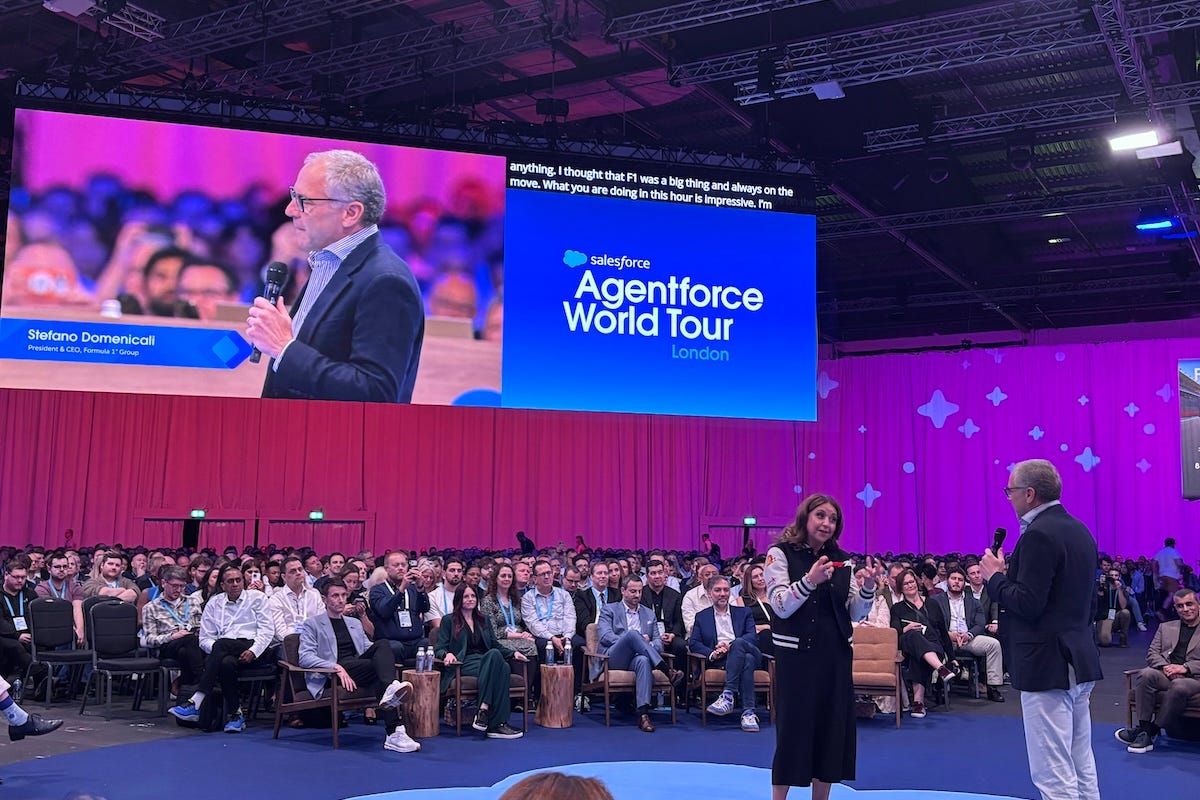
“The way Salesforce represents technology by keeping the human being at the center is really the key to your success,” he said.
For Salesforce, the day’s presentations pointed toward a near-term future in which the boundaries between enterprise software, AI agents and customer experience collapse into a single continuously operating layer. Both Bahrololoumi and Inzerillo said the next phase will focus on deepening agent autonomy, expanding Headless 360 integrations and scaling the London AI center into a hub for skills development and enterprise experimentation.