


Enterprises are starting to test where quantum computing might add value, with experts pointing to network resilience, energy systems, and industrial design as early targets. These use cases remain exploratory rather than deployed, reflecting a field that has yet to reach broad, commercially valuable application.
Companies are therefore narrowing the scope to specific, well-defined problems where early-stage systems or simulations can be assessed alongside classical tools. The objective is not replacement, but to identify incremental gains in areas where complexity limits conventional approaches.
This reframing is shifting the conversation from theoretical milestones to practical fit. The immediate challenge is to align use cases with current hardware constraints and demonstrate measurable outcomes, even at a limited scale.
“How do we start to go about matching the right use case for the right stage of hardware development?” said Simon Fried, vice president of communications at Classiq, a quantum software company focused on algorithm design and orchestration, adding that enterprises are now focused on that challenge.

“We have a network and need to factor in what happens if a particular node goes down. What’s your fallback plan and the best way of rerouting that information?” he said.
He said these issues extend beyond routine service disruptions to national security and to whether an economy can continue to communicate.
Use cases emerge
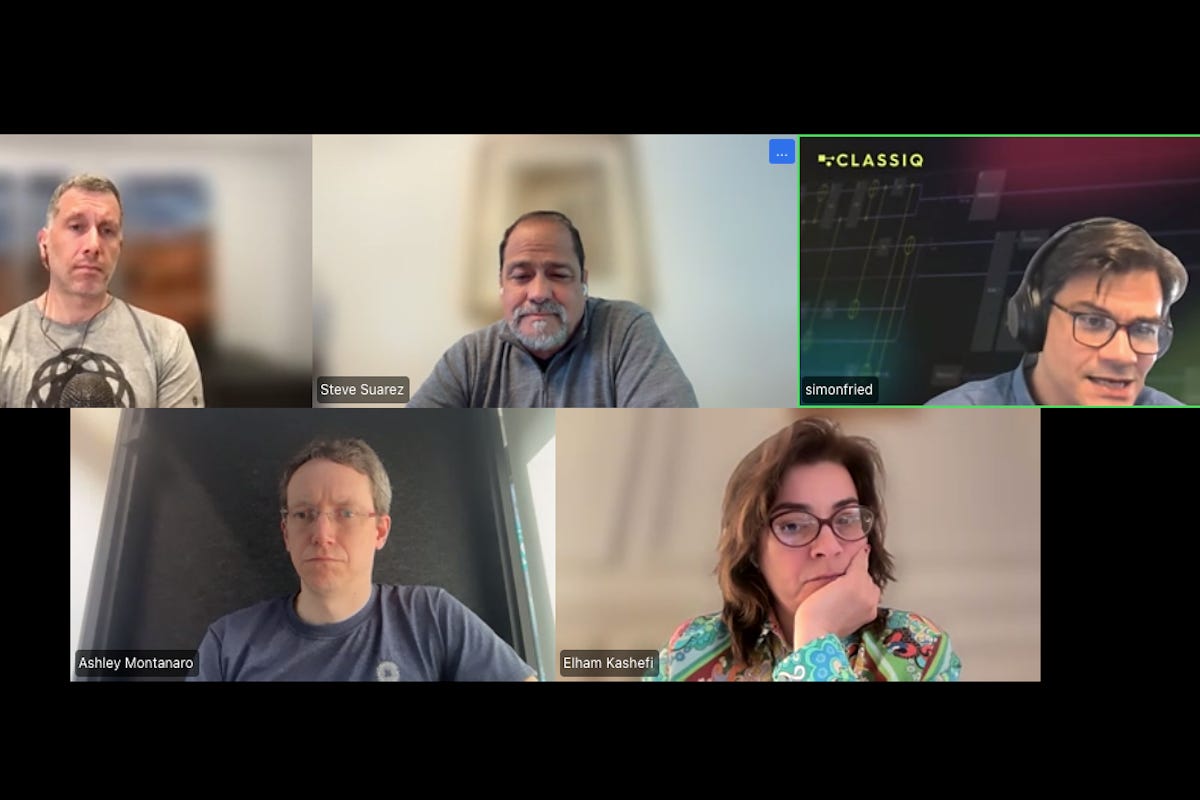
The discussion took place during an online roundtable hosted by Economist Impact on March 31, moderated by Steve Suarez, chief executive of HorizonX Consulting, a technology advisory firm focused on emerging technologies.
The panel explored whether the race to so‑called “quantum utility” — the point at which quantum systems deliver practical value — is already underway.
Speakers said enterprises are increasingly experimenting with optimization problems. Quantum systems can explore complex solution spaces more efficiently than traditional methods. These include telecommunications networks, power grids, and supply chains.
“We’ve been working on network optimization for energy systems, understanding how quantum computing can accelerate classical algorithms and get to a more resilient, higher‑performance configuration,” said Ashley Montanaro, co‑founder of Phasecraft, a quantum algorithms and applications company.

In parallel, companies are exploring design and engineering use cases.
Incremental gains can translate into measurable efficiency improvements. These include optimizing component placement in complex systems, reducing energy consumption, and improving reliability under stress conditions.
Montanaro said these early applications are less about replacing classical computing and more about augmenting it in areas where combinatorial complexity becomes a bottleneck.
Another major area is the simulation of physical systems, including materials and chemistry, where quantum computers can model atomic‑level interactions more naturally than classical machines. This could enable advances in battery design, catalysts, and drug discovery, although current hardware limitations mean these applications remain in early stages.
Utility defined
As use cases emerge, the industry is converging on a more practical definition of progress. Rather than focusing on theoretical milestones such as “quantum supremacy,” participants increasingly describe the current phase as one of “quantum utility.”
“Quantum utility really means it’s competitive. We don’t have definitive evidence that it’s better, but the results are competitive with what comes out of a supercomputer,” said Michael Biercuk, chief executive of Q‑CTRL, a quantum infrastructure software company specializing in control and error reduction.
He contrasted this with “quantum advantage,” which he defined as the point at which users would choose quantum systems based on a clear return on investment (ROI).
“We have pretty clearly reached this utility era where quantum computers are solving really challenging problems that the best classical algorithms struggle to match,” Montanaro said. “We have not got practical utility for commercially valuable problems yet, but we are very close to that point.”

Elham Kashefi, chief scientist at the UK’s National Quantum Computing Centre (NQCC), a government-backed research center focused on advancing quantum computing capabilities, said utility remains context‑dependent and is not yet broadly applicable across industries.
“We are not at the point where utility is fully generalized, but it is becoming visible. These are early task‑specific advantages, which are still very valuable,” she said.
Hybrid workflows
Much of this early progress is being driven by hybrid approaches that combine quantum and classical computing.
“We have seen incredible progress in hybrid workflows where quantum is used as a component inside larger classical, artificial intelligence (AI) and high-performance computing (HPC) pipelines,” Kashefi said.
These workflows allow quantum systems to handle specific sub‑problems while classical systems manage the broader computation. This makes it possible to extract value even from today’s imperfect hardware. In practice, this means enterprises can integrate quantum routines into existing workflows without overhauling their entire technology stack.
“It’s not plug‑and‑play or broad industrial deployment yet, but these integrations are already very meaningful,” she added.

For users, the focus is increasingly on outcomes rather than underlying theory.
“What the end user cares about is whether they can run something on the machine and whether it is better, faster, or delivers some other benefit,” Biercuk said.
While quantum computing continues to mature, other areas of quantum technology are already delivering clearer commercial benefits.
“In a real‑world test on an airplane, the quantum‑enabled navigation system was 100 times better at determining position when GPS was off than the best conventional alternative,” Biercuk said.
“This is well past utility. This is now a definitive advantage. It is better,” he added.
He said applications such as navigation, resource exploration, and medical imaging are seeing strong demand. Customers are already identifying clear use cases. These developments highlight how different branches of quantum technology are progressing at different speeds, with sensing moving ahead of computing in commercial deployment.
“There’s no question about the use cases of navigation. Customers know what they need, and we can deliver that right now,” he said.
As the field advances, benchmarking and verification are becoming critical to assessing performance.
“We want to validate the whole pipeline and compare it to the best classical baseline. That allows us to realistically assess where we stand,” Kashefi said.
She said new frameworks are enabling more rigorous comparisons between quantum and classical systems. They help identify where quantum approaches offer meaningful gains. This is increasingly important as enterprises seek evidence‑based justification for investment decisions.
“We now have serious benchmarking and verification frameworks that let us compare quantum and classical performance properly,” she said.
Software also plays a central role in translating theoretical advances into practical results.
“We provide the infrastructure layer that connects high‑level algorithms and translates them into real machine instructions while reducing errors and improving performance,” Biercuk said.
From theory to ROI
Participants said the industry has undergone a significant shift in recent years. The focus has moved from theoretical discussions to practical considerations such as cost, performance, and usability.
“The end user solving a logistics problem does not care about computational complexity theory. They care about whether it is better or faster,” Biercuk said.
“This is a very different conversation from four years ago. Now we are focused on real outcomes, not abstract theory,” he added.
Montanaro said the current phase represents a transitional period in which quantum systems are becoming genuinely useful, even if full commercial deployment remains ahead.
“It’s a really exciting period where quantum computers are becoming genuinely useful, even if we are not yet at full commercial utility,” he said.
As enterprises continue to experiment with targeted applications and hybrid models, the focus is expected to remain on identifying practical value, building internal capabilities, and scaling successful use cases as hardware improves.