


Long‑term data protection is becoming an urgent operational mandate as quantum threats converge with ageing cryptographic infrastructure. With the rise of post‑quantum cryptography (PQC), companies are under pressure to assess how quickly they can transition away from classical encryption systems before a future “Q‑Day”—the moment when large‑scale quantum computers can routinely break today’s cryptographic standards.
Technology and defence experts emphasised that the threat is not theoretical. Malicious actors are already engaging in “harvest now, decrypt later,” accumulating encrypted data today with the intention of unlocking it once quantum systems mature. When Q‑Day arrives, decades of stolen information—from commercial IP to national‑security files—could be exposed instantly.
Organisations must therefore begin comprehensive inventories of cryptographic assets and quantify the technical debt they face.
“Quantum computers will be able to break almost all modern encryption,” said Matthew Kinsella, chief executive of Infleqtion. “Because of ‘harvest now, decrypt later,’ it will be very disruptive.”
“Companies are going to have a large technical debt here, and they need to start figuring out what that is and how they’re going to resolve it,” said Ann Dunkin, chief executive of Dunkin Global Advisors.
“Quantum is really upon us in a big way,” said former UK Defence Secretary Grant Shapps. “We know hostile states are already collecting data with the intention of analysing it later when they get enough computing power.”
Geopolitical Pressures
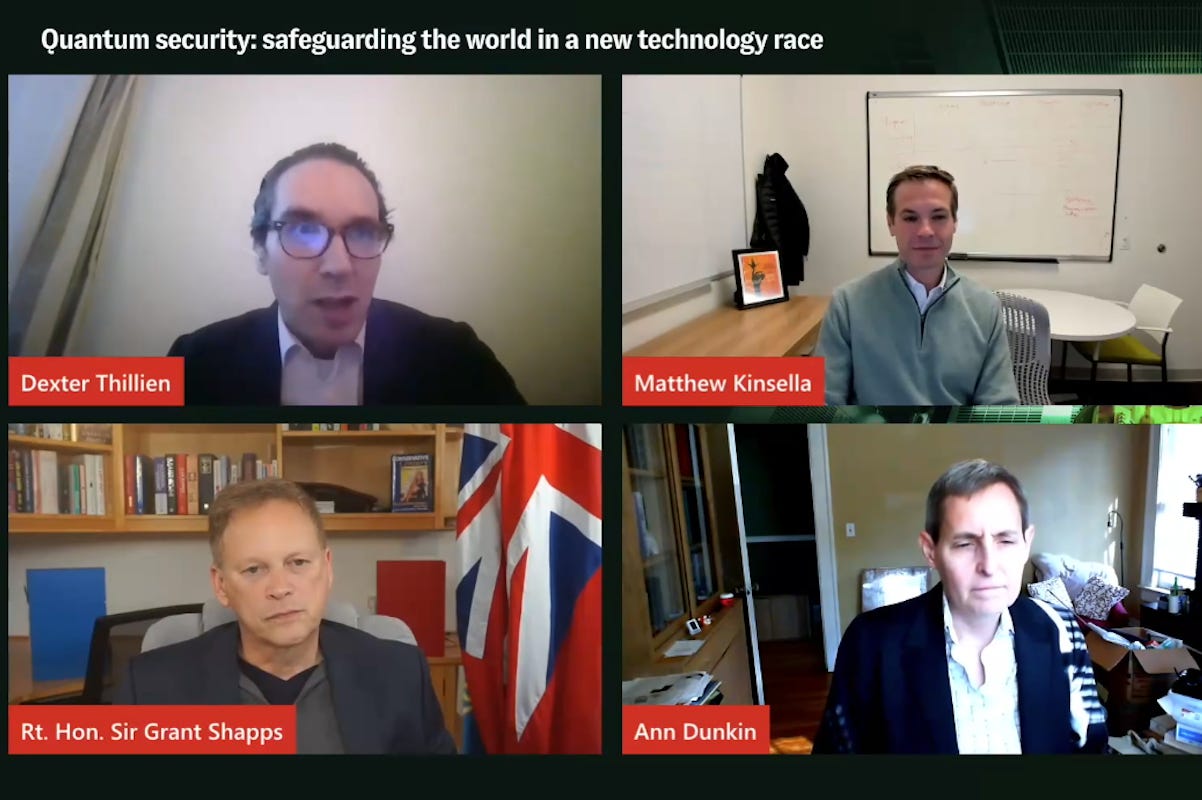
The speakers—joined by moderator Dexter Thillien of The Economist Intelligence Unit—shared their insight during a webinar titled “Quantum security: safeguarding the world in a new technology race,” organised by The Economist on December 2.
To frame the stakes, they stressed that geopolitical competition is unfolding alongside rapid technical advances, making quantum security both a technological and strategic priority.

Shapps said the strategic challenge lies not only in who develops quantum technologies first, but in how governments choose to deploy them.
“The biggest challenges come not from the technology itself, but from the way it’s implemented by rival regimes,” he said, warning that authoritarian states may leverage quantum systems for surveillance or coercive control.
Kinsella noted that quantum progress is inherently nonlinear.
“There may be breakthroughs that take us from 20 to 1,000 logical qubits much faster,” he said. “And at that point, you’ll start to have programs that can actually decrypt all this information.”
Dunkin challenged assumptions about cryptographic longevity.
“It’s incredibly dangerous to assume you have that much time,” she said, arguing that PQC migration must become an operational priority.
The panel agreed that institutional inertia remains the most significant obstacle.
“Complacency is probably our biggest threat,” Shapps said.
Dunkin also highlighted vendor‑related exposure, noting that many organisations rely on suppliers that lack quantum‑ready roadmaps.
“It is all about the vendor,” she said. “It’s incumbent upon the vendor community to pay attention to this and embrace it.”
Workforce capacity is emerging as another constraint. Kinsella warned that demand for cryptographers, quantum‑aware engineers, and advanced security architects will rise sharply. Organisations should begin upskilling programmes now to avoid future shortages.
Kinsella said the question is no longer whether quantum disruption will arrive, but how prepared each organisation will be when it does. He said organisations that act early will strengthen resilience and position themselves to capitalise on quantum‑enhanced technologies.
Infrastructure Threats
Quantum security threats extend far beyond encryption vulnerabilities. Kinsella warned that global navigation satellite systems (GNSS), including GPS, are increasingly spoofed or denied—threatening aviation, financial markets, and energy networks. He referenced an analysis estimating that a major GPS outage could cost the UK economy more than £1 billion per day.
He said quantum clocks offer a path to resilient timing and synchronisation in the absence of satellite signals.
Dunkin said organisations must understand vulnerabilities across their sensing, timing, and communication systems—areas that classical cyber frameworks often overlook. She noted that weaknesses in these layers can cascade through national infrastructure, amplifying operational and economic risk.
Shapps said resilience must be designed into critical systems. He recalled an incident in which his Royal Air Force (RAF) aircraft lost GPS while flying near Belarus.
“Pilots have many different ways to navigate,” he said. “What organisations need to be thinking about is the resilience that means if the system you’re using today goes down, all is not lost.”
As quantum investment accelerates globally, the speakers called for deeper alignment on standards and shared supply chains.
Kinsella said photonics—the lasers and optical components foundational to many quantum devices—remains fragile. He added that standardisation would reduce cost, strengthen supply chains, and accelerate commercial deployment.
Dunkin pointed to collaboration across the US, UK, and Europe, but stressed that harmonisation must continue. National bodies are advancing PQC standards, yet fragmented adoption would leave critical systems exposed. Regulatory timelines, she said, remain too slow for the pace of technological change.
Leadership engagement is essential to overcoming inertia.
“You need to make sure your leadership team understands why this is a risk that’s important to fund,” Dunkin said. She explained that without explicit board‑level sponsorship, security teams struggle to secure budget for cryptographic migration and resilience planning.
Opportunities Ahead
As the conversation progressed toward commercial implications, the speakers emphasised that quantum’s most promising contributions will come from its ability to transform scientific modelling, accelerate complex computations, and strengthen innovation pipelines across multiple sectors.
Kinsella said the most immediate breakthroughs will emerge in simulation‑heavy fields where classical computers already face performance bottlenecks. He explained that materials science, fusion‑energy research, and advanced chemistry stand to benefit from quantum’s ability to represent and analyse systems that are currently impossible to model.
“By 2028, we will have quantum computers with enough logical qubits to do things that classical computers will never be able to do,” he said, positioning the technology as a catalyst for scientific progress.
Dunkin described how quantum will integrate with existing high‑performance computing (HPC) environments, reinforcing—not replacing—the computational workflows that underpin modern research.
“All our science is computational now,” she said. “Adding quantum to that mix is tremendous in terms of its ability to model nuclear reactions, to model new materials for batteries and solar panels.”
She said hybrid workflows, where quantum accelerators support classical systems, will shorten R&D cycles and improve modelling accuracy across clean‑energy technologies, pharmaceuticals, and climate science.
The speakers agreed that early adopters will hold a structural advantage.
Kinsella said sectors such as aerospace, healthcare, and energy are already examining where quantum‑enabled modelling can reduce cost and compress development timelines. He said these early use cases will shape market expectations and widen competitive gaps as hardware and software mature.
Dunkin added that organisational preparedness will determine how quickly companies can leverage quantum capabilities. She said early investment in workforce training—particularly in quantum‑aware engineering and computational science—will be essential to identifying valuable applications and integrating future platforms into enterprise environments.
Shapps urged organisations to frame quantum readiness as both a security obligation and a long‑term economic safeguard. He said sustained investment in resilience, diversified supply chains, and workforce capability would determine which countries and companies thrive in the quantum era.