


Quantum transformation is forcing organizations to confront how unprepared their structures and talent models are for a technology that could scale faster than expected. Executives increasingly recognize that readiness must begin well before quantum systems demonstrate a clear commercial advantage.
The deeper challenge is cultural. Organizations must balance short‑term operational pressures with long‑term strategic bets, cultivating leaders who can champion disruptive innovation without destabilizing core performance.
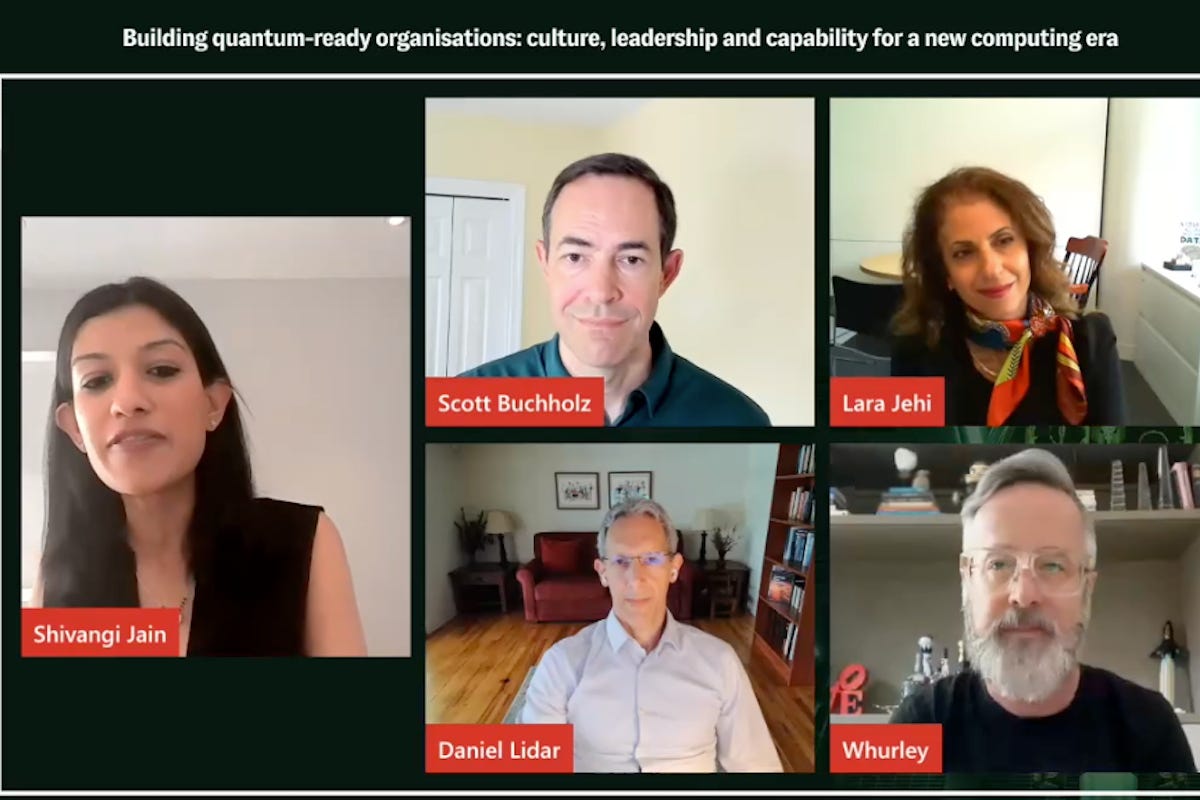
“Quantum computing is the first real step away from the way we’ve done computing since the invention of computing,” said William Hurley, founder and chief executive of Strangeworks, who is widely known as “Whurley”.
“If your organization hasn’t already been looking at this when a breakthrough arrives, you will face real barriers to adopting it and taking advantage of it.”
He outlined the five elements he believes define quantum readiness: awareness, talent, partnerships, use‑case exploration, and infrastructure integration.
“Quantum needs to be part of the long‑term innovation strategy,” he said. “This could happen in a seemingly overnight change, and organizations that have not prepared will be left behind.”
Scott Buchholz, global lead for quantum computing and chief technology officer for government and public services at Deloitte Consulting, said early movers will have a decisive advantage as talent constraints intensify.
“It does take a year or two to move somebody from being a developer to being a proficient quantum developer,” he said. “The organizations that take action now will be the ones who can attract that talent in the future.”
Leadership demands are especially evident in mission-critical sectors such as healthcare.
Lara Jehi, chief research information officer at Cleveland Clinic, said organizations with long planning horizons cannot afford to wait for fully mature systems.
“If all I’m doing is maintaining my day-to-day operation, I will be obsolete very soon,” she said. “You have to invest now in technologies of the future, and that ability to see long-term will differentiate the organizations that survive.”
Strategic leadership shifts
At a webinar hosted by The Economist, speakers emphasized that leadership teams increasingly frame quantum strategy as an organizational transformation rather than a standalone technology program. Shivangi Jain, head of economic modelling and EMEA team lead at Economist Impact, moderated the webinar.
Speakers stressed that organizations must anticipate a moment when quantum capability accelerates suddenly, driven by improvements in device scale, coherence, and algorithmic efficiency.
Buchholz said executives continue to underestimate the pace of exponential change.
“The capacity of devices does continue to double every 18 to 24 months across vendors. Years from now, things that are 32 times bigger will start solving meaningful problems,” he said. “Because of exponential growth, that timeline may happen sooner than people think.”
He added that boards should review quantum assumptions annually to ensure the strategy keeps pace with technical progress.
Daniel Lidar, Viterbi professor of engineering at the University of Southern California, said universities remain essential to mapping where quantum machines will outperform classical systems.
“Quantum simulation remains the most promising application,” he said. “If you can simulate quantum mechanics, you can discover new materials and potentially new pharmaceuticals.”
He noted that this foundational research is shaping how industries—from energy to biotech—are beginning to model long-term capability shifts.
Racing past technical barriers
Speakers said the physics challenges remain significant. Today’s machines are constrained by decoherence, which collapses quantum states into noise and prevents long, accurate computations. Overcoming this barrier is central to unlocking meaningful value.
Lidar said quantum error correction is the field’s primary frontier.
“As we develop more powerful and capable error-correction strategies, there will come a day when quantum computers can carry out long calculations,” he said. “That will be the moment when application-level quantum advantage becomes attainable.”
He added that crossing this threshold will likely recalibrate industry expectations almost overnight. He also pointed to recent experimental progress.
“We were able to demonstrate, for the first time, an exponential quantum advantage on hardware using Simon’s algorithm,” he said.
Simon’s algorithm is a quantum procedure that solves a specific pattern‑finding problem with an exponential speedup over the best classical algorithms, making it one of the earliest demonstrations that quantum computers can outperform traditional machines.
Lidar said this experiment offered a rigorous separation between what classical and quantum machines can achieve, strengthening confidence that commercial-grade quantum performance is feasible.
The speakers agreed that organizations should track improvements in qubit stability, chip architecture, and algorithmic efficiency as leading indicators. They said these metrics will help determine when enterprise-scale use cases—such as molecular simulation or complex portfolio optimization—will transition from research to production.
Talent for a quantum era
The workforce challenge is becoming one of the most significant barriers to organizational transformation. Buchholz said enterprises consistently underestimate the difficulty of translating classical development experience into quantum capability.
“People were accustomed to walking up to something, picking up the tool, and everything worked,” he said. “This is not that journey.”
He said organizations need both intensely trained specialists and domain experts capable of framing business problems in ways that quantum systems can address. He said this dual capability requires structured training programs, long-term hiring plans, and partnerships with universities.
Jehi said physical proximity and interdisciplinary collaboration can accelerate internal capability. Cleveland Clinic installed a quantum system inside its biomedical research facility to ensure daily engagement between scientists and quantum engineers.
“What we saw over a year and a half was a shift in who was using the machine,” she said. “At the beginning, it was mostly engineers, but now it is mostly our biomedical researchers.”
She said this model fosters curiosity, practical experimentation, and faster iteration on problem statements—traits that organizations across industries must cultivate to derive meaningful value from quantum systems.
Preparing for acceleration
Although commercial breakthroughs remain ahead, enterprises are beginning to treat quantum exploration as a strategic necessity. Whurley said more than 100 Fortune 500 companies now experiment with quantum workloads, especially in optimization, logistics, and machine‑learning‑inspired methods.
“Businesses have woken up,” he said. “Budgets were zero three years ago. Now almost everyone has some budget, even if it’s small.”
He said benchmarking classical and quantum approaches side by side helps organizations understand readiness.
“We can show them what works and what does not, and where quantum fits into their architecture,” he said.
He also noted that public markets are speeding up adoption. “The fact that there are publicly traded quantum companies, and that Wall Street is taking interest, is permeating across the Global 2000.”
As organizations look to 2025, the speakers said quantum readiness should be measured through leadership clarity, workforce capability, and structured experimentation.
Buchholz said companies must establish a plan that defines “who, what, when, where, why, and how,” enabling them to accelerate when the technology matures.
Lidar said universities will continue to prepare the talent pipeline.
“Internships and collaborations with quantum hardware and software companies are giving students hands-on experience,” he said. “It provides a new paradigm for how training can take place beyond the classroom.”
Jehi said organizations can track progress by assessing whether they have built environments that connect education, industry partnerships, and internal innovation.
“When those elements come together, you create the foundation for sustained engagement and meaningful problem formulation,” she said.
Together, the speakers said these efforts mark the difference between organizations that will simply witness the quantum era and those prepared to lead it.