


Large quantum computers could crack public key encryption in five hours, a job one estimate says needs artificial intelligence (AI) data centers covering Earth’s land surface twice.
That moment is known as “Q-Day,” and a yearly survey of quantum experts has long put it around 2033.
“What we see sometimes in quantum is technology jumps that we can’t expect. So it might jump sooner, and there’s hardware, software and algorithm progress that sometimes takes us forward quickly,” said Carmen Palacios-Berraquero, founder and chief executive of Nu Quantum.
She said her data center comparison, still being calculated more formally, should be taken with a pinch of salt for now. It assumes a quantum computer of the kind expected around 2033 to 2035.
In March, Google moved its own Q-Day estimate forward to as early as 2029.
Its researchers showed last year that a 2,048-bit RSA key could be broken in under a week with 1 million noisy qubits, down from 20 million in a 2019 estimate.
“The main point here is that the underlying encryption method has to be changed. Independent of the dates that we talk about, the urgency comes more from the need to change our current encryption schemes,” said Jan Goetz, co-founder and chief executive of IQM Quantum Computers.
He said messaging apps that promise end-to-end encryption often rely on the RSA standard, which has to be switched to something quantum-safe.
Bitcoin is vulnerable to quantum computers to a certain extent, though some cryptocurrencies are already quantum safe, he said.
“Companies are doing it. If you want to get big government contracts with the US government, also in Europe, you have to have a quantum strategy to change by 2030,” Goetz said. “So there is a push.”
AI across the stack
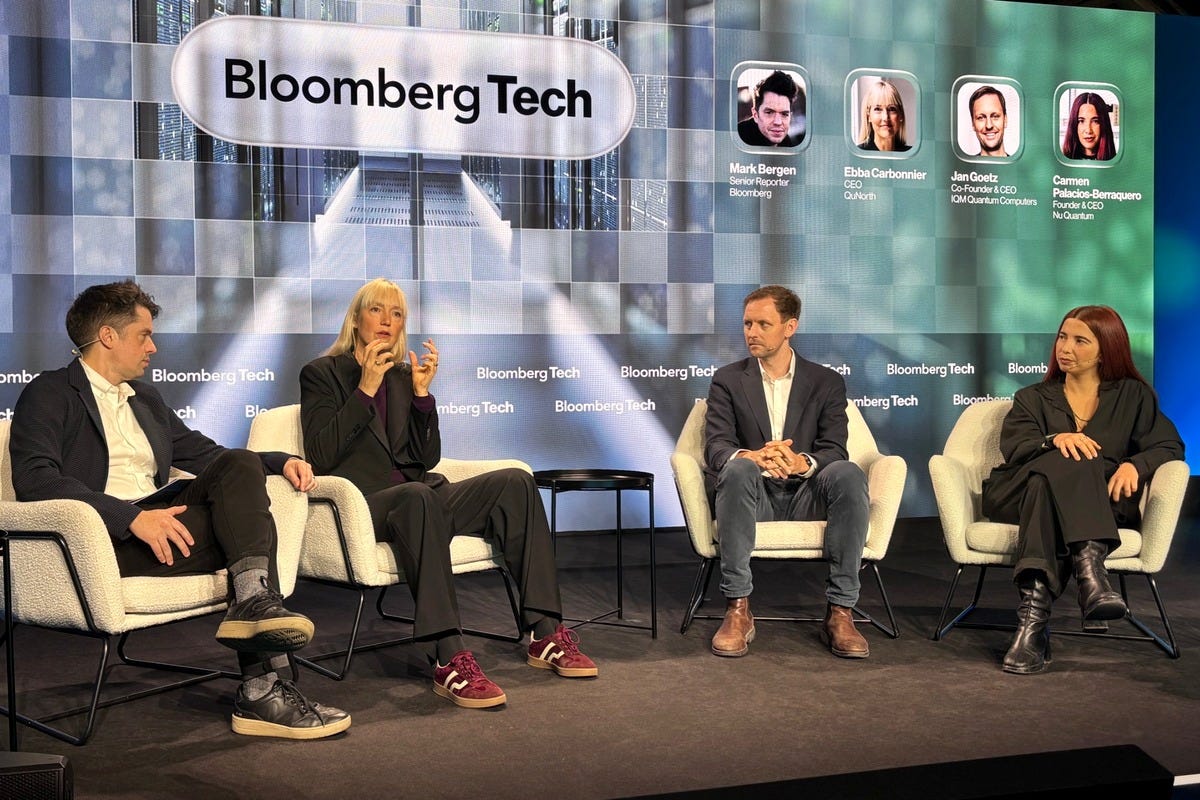
The panel took place at Bloomberg Tech London, organized by Bloomberg in London on November 3. Mark Bergen, a senior reporter at Bloomberg, moderated the discussion on quantum computing’s commercial turning point.
“On the hardware side, the roadmaps are what they are, and that’s very much engineering-driven. But on the algorithmic side, we have seen some of these jumps. What’s interesting now to come is also the impact that AI has on algorithm development,” Goetz said.
He expects AI to bring more such jumps, allowing algorithms to run on much smaller hardware.
In October, Anthropic said its Claude model, working with researchers from Harvard University and QuEra Computing, had designed quantum circuits that beat the best published designs in seven of eight tasks.
“I hope AI labs do, because it means we can run these algorithms earlier on the machines that we build. Whatever they come up with to make the algorithms more efficient is very good news for the whole community,” Goetz said.
“It’s a tool to design, to optimize and design better algorithms and circuits. But it doesn’t mean that they can run those algorithms or circuits,” Palacios-Berraquero said.
Qubits are fragile and must be tightly controlled, a job usually handled by dedicated calibration hardware.
“We’re also seeing how AI is starting to be used at the quantum hardware level for things like calibration. We’ll see that across the stack, and it will be a good thing,” she said.
Ebba Carbonnier, chief executive of QuNorth, said quantum developers now use AI much as classical software developers do.
Quantum development kits hold libraries of the most relevant quantum algorithms. Users describe a task such as a molecular simulation in plain language, and the AI tool picks the matching one, she said.
Goetz said quantum computers will not completely replace supercomputers but will work alongside them in a hybrid approach, with each machine handling part of the problem. IQM places its quantum computers next to server racks full of graphics processing units (GPUs) and central processing units (CPUs), and connects them.
“It’s happening today. We ship quantum computers into big data centers and computing centers, and then we integrate them,” he said.
IQM ran a train-scheduling case study with Germany’s rail operator, which must re-plan whenever a fallen tree blocks the tracks.
“There are not so many high-speed trains and not so many stations. You can count them, but still the number of combinations and the complexity is so high that current supercomputers cannot do it,” Goetz said.
He said IQM works with Nvidia, which develops the GPU side, on agentic calibration and error correction.
“The quantum space, similar to semiconductors and computing, will have different players, and probably we will see quantum foundries and quantum design houses. It’s probably hard to say from today’s perspective who will take exactly what role, because the whole stack is still very fluid,” he said.
In October, Intel agreed to buy Israeli quantum software firm Classiq in a deal reported at $2.3 billion.
Utility by 2033
Palacios-Berraquero said the industry aims to reach early quantum advantage, solving a useful problem a classical computer cannot, within the next year or two. The US and UK governments have mostly set the pace through large procurement programs.
She said commercial utility, bringing industry a traceable economic advantage, is expected around 2033.
“Coming to 50, 60 logical qubits, then we can start doing some interesting experiments. We’re reaching for level three, the fault-tolerant era,” Carbonnier said.
The levels come from a framework Microsoft proposed in 2023:
Level one, foundational: machines running on noisy physical qubits, the stage where the industry started
Level two, resilient: machines running on reliable logical qubits, each built from many error-corrected physical qubits
Level three, scale: fault-tolerant quantum supercomputers that can solve problems the most powerful classical supercomputers cannot
QuNorth, a Copenhagen-based venture backed by the Novo Nordisk Foundation and Denmark’s Export and Investment Fund, will have a level two quantum computer with 50 logical qubits next year. Called Magne, it combines Atom Computing’s neutral atom hardware with Microsoft’s software.
Quantum hardware comes in several types, including superconducting, spin, photonic and neutral-atom systems. Carbonnier said the hardware still needs error correction, so developing compilers, algorithms and software jointly with it is very beneficial.
There is no timeline yet for a drug discovered with quantum computing, she said.
QuNorth’s target areas include drug discovery and photodynamic therapy for cancer, which is underdeveloped but promising because simulating its molecules and electrons is intractable for classical computers. Fuel-cell efficiency for cars and catalysis are others.
National Grid Partners invested in Nu Quantum because it believes quantum computers at scale could solve grid simulation, which is already a problem today, Palacios-Berraquero said.
“Imagine in five or 10 years, when the grid is moving from one-to-all to something that looks more like the internet, with millions of sources: solar panels, wind farms, storage batteries and users,” she said.
Goetz said Europe has to build a completely new industry, including its full supply chain, and create demand.
“The more we have from Europe, the more independent we are. But I’m not saying everything has to come from Europe,” he said.
Europe has more quantum computers installed in supercomputing centers than the US, because the European Commission bought machines early through the EuroHPC program, he said. They are small, but the purchases helped European firms earn revenue, build products and attract private capital.
He said IQM works well with partners across the Atlantic and has sold machines to US computing centers. He hopes transatlantic collaboration stays active.
Carbonnier said she does not fear the US hoarding a quantum breakthrough.
“Within the quantum community, we’ve been so integrated for many years with research and development and collaboration, and even the commercialization part. We have much more interesting things to work on,” she said.
China is progressing very quickly in quantum computing after focusing on quantum communication a few years ago, she said.
Goetz said Europe’s longer-term Grand Challenge program, similar to UK procurement and the US Defense Advanced Research Projects Agency program, now aims for machines around 2030.