


Quantum computing’s central fight is not over restriction, but over who qualifies as a trusted partner.
Governments broadly agree that some of the technology must stay guarded, but there is far less consensus on how to categorize the allies, partners and potential rivals who should decide who gets access to what, and on what terms of trust.
“I see us as an accelerator, not the end point or the primary end user for this,” said Chester Butterworth, head of strategy, disruptive capabilities and technologies at the Royal Navy of the United Kingdom.
He said defense can act as an early risk taker, working with small businesses, academics and laboratories long before industry is ready to scale a technology, contrasting the handful of systems a warship might need against the thousands required for 6G infrastructure.
“If we select some half of the world and give access to that, that is a real, serious break to global stability,” said Jorgen Ellegaard Andersen, professor at the University of Southern Denmark and chief executive of Qpurpose.
“In terms of assured capability, who are our allies and partners? How do we work with NATO to create a stronger alliance, where we are able to interoperate, interchange our technology and take the best of what is available at large?” Butterworth said.
He said this collaborative approach, rather than isolation, reflects what he called a renewed momentum for quantum in Britain.
“As much as we want to aspire to open ecosystems, we’re sadly not in an open ecosystem world right now,” said Romi Sumaria, chief commercial officer of QAI Ventures.
Oscar Diez, head of quantum computing at the European Commission, said cooperation must rest on reciprocity, not open-ended access.
Money follows the moment
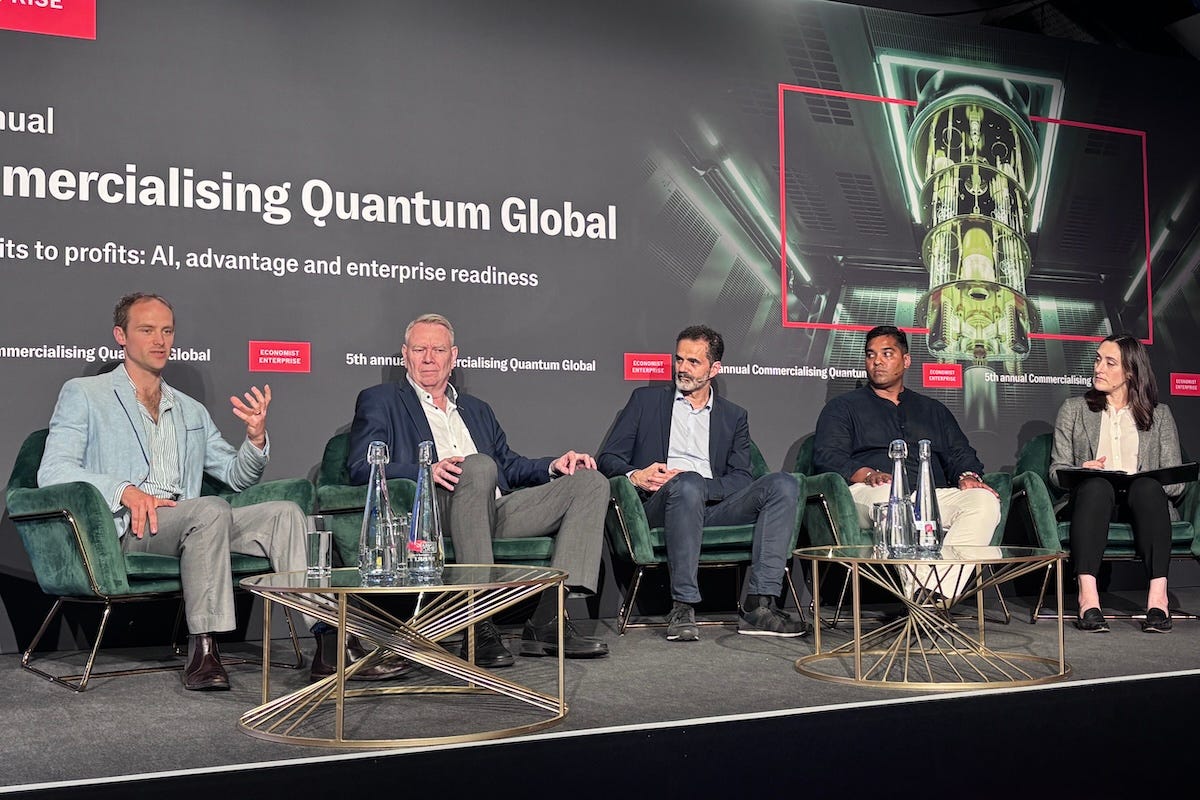
The debate took place at the Commercialising Quantum Global 2026, organized by Economist Enterprise, in London. Cailin Birch, principal global economist at Economist Intelligence, moderated the panel on whether quantum computing will fragment into competing blocs or grow into an open ecosystem.
The panel brought together defense, academic, government and venture capital perspectives on an industry moving toward commercial deployment.
“Let’s just look at quantum hardware. How many IPOs [initial public offerings] of the hardware are happening outside the US? That is the problem we have at hand,” Sumaria said.
Andersen said pension funds favor safe bonds over risky, early-stage technology, warning that Europe cannot afford to repeat past mistakes.
“We have basically lost on chip production. Personal computers and AI, you name it. If we lose it on quantum too, we are not doing really well, so we have to be there,” he said.
Diez pointed to Pasqal and IQM, two European-founded quantum computing firms that have listed, or are preparing to list, on the New York Stock Exchange instead of a European one, calling it part of a wider European problem in scaling technology companies to late-stage growth.
“When you go into the final rounds, it is very difficult to find funding here in Europe,” he said.
“America is driving capital flows into the hardware and infrastructure segment. Europe is driving innovation and fostering collaboration, but we have nowhere near the scale of capital needed,” Sumaria said.
Britain, though, is trying to change that calculus.
Butterworth pointed to what he called Britain’s “quantum moment,” a £2 billion government quantum package unveiled in March 2026, made up of £1 billion to procure large-scale quantum computers and a further £1 billion over four years to help the industry scale.
He said the funding follows new competitions to build quantum supply chains, with money set aside for that purpose.
“What I see internally from government is a significant increase in collaboration, not just between defense and security, but how defense talks to the Department for Transport, the Department for Business and the Office for Investment,” he said.
He said even the best quantum sensors are of little use without a supply chain capable of producing them at the scale an industry like aviation would need; the government recognizes the gap and is working to close it.
He added that the Royal Navy applies government-funded exchange programs to test technology at sea.
Software still lags hardware
The panel’s sharpest disagreement was not about money, but about what to build first.
Andersen cited a recent talk from Rolls-Royce, where it took five years to get a finished quantum algorithm into operational production. He said the industry is already behind on software as a result.
“A good example is GPUs. In high-performance computing (HPC) systems, there was a dead period for a long time. The number of GPUs was growing but they were not being used. Eventually people started to learn to use them, and now there is a big hype about that, which is AI,” he said.
“It is going to be the other industries, not the quantum industry, that pull this in the long run. Industry has to pull, and it pulls when it sees useful use cases,” he said.
He said that alone will not close the gap.
“We are having this European initiative where we benchmark all existing software and make it totally open source, so everybody can see what the good and bad ones are,” Andersen said.
One such initiative is Open QBench, an open-source EuroHPC JU benchmarking framework developed by EuroQCS-Poland.
Diez said the picture is more complicated than a simple hardware and software split. The European Commission has set up six pilot production lines and a software center of excellence, and has connected quantum computers to HPC centers for four years, expanding from six machines to eight, with two more planned.
“We have a similar number of companies at European level in quantum, very similar to the number in the US. I think it’s relatively healthy,” he said.
The gap has consequences for talent as much as technology.
“The defense budget is catastrophically higher in the US than anywhere else, and that is the first industry to adopt these technologies. Historically, defense innovates and then industries adopt from there,” Sumaria said.
Singapore is trying something similar through Enterprise Singapore, encouraging researchers to build local ventures.
“It gives an unfair advantage on talent acquisition. If you are a scientist and we give you an amazing test bed with all the best facilities, it is like a Disneyland for scientists,” he said.
He said the clock is already running.
Sumaria said Europe needs to double down on the technology now, warning that Asia is catching up fast in areas where Europe has previously led.
His biggest frustration, though, was with the frame of the conversation itself.
“We focus mainly on Europe, the US and the UK. What about China? What about Singapore? What about the Middle East? China is spending billions every year, and we do not really have a view of what is being built there,” he said.
“Look at India. It is the same concept. They are investing heavily in quantum, but they have shifted their policy from a software era, where they exported talent, to building infrastructure in-house,” he said.
Sumaria said his own firm’s strategy reflects that same shift toward specific sectors, including life sciences beyond drug discovery into diagnostic medicine, financial services built around quantum cryptography and industrial applications where deep subject matter expertise meets a well-defined problem, the kind of pairing he said drives early adoption.
“Especially at the intersection of quantum photonics, we have a fantastic photonics industry in Europe,” he said.
Butterworth said the UK now has a genuine opening to convert its funding into lasting advantage. Whether Europe can close the software gap, and whether talent stays instead of chasing larger American budgets, will likely determine which vision of the industry prevails.